Saturday Oct 03, 2026
Saturday Oct 03, 2026
Thursday, 29 January 2026 03:19 - - {{hitsCtrl.values.hits}}
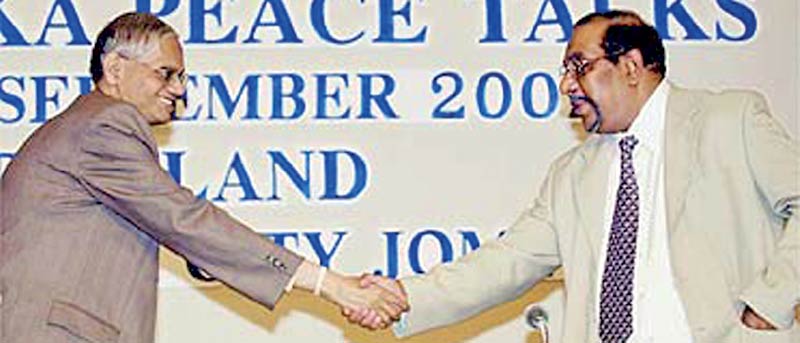
Prof. G.L. Peiris (left) and Anton Balasingham
 Though the culmination of the peace process in all-out war was almost certainly unavoidable, the lopsided character of that peace process which fatally delegitimised and diminished the UNP and SLFP was avoidable, as was the scale of that war due to the neglect of the armed forces and the unilateral gains permitted the Tigers
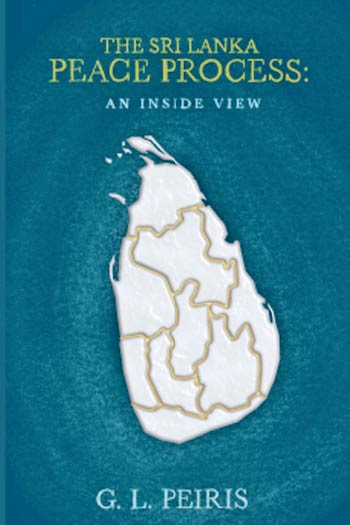
 Prof. G.L. Peiris’ memoir ‘The Sri Lanka Peace Process: An Inside View’ is invaluable, indispensable reading. It should be on the bookshelf of every student of contemporary history of Sri Lanka. It should also be on the bookshelf of every student of ‘peace and conflict studies’ worldwide, as an example of what should and should not be done in striving for a negotiated peace.
The book must be taken for what its ‘strap’ says—an inside view. It is a narrative of an experience interwoven with a view, that is to say a perspective of a key player during a certain stage of the peace process. It is not an overview; a complete or comprehensive analysis of the process as a whole, or even of that particular stage of the process. It is by no means a holistic view; a perspective that strives to grasp the complex totality.
Prof. Peiris presents an authentic account as the chief negotiator from the Sri Lankan side during a decade of the peace process. For this, we must thank him because so few Sri Lankan actors during the thirty-year conflict have shared their testimonies with the public. As a scholar, Prof. Peiris narrates in a style that is lucid and readable, while organised and presented in a manner that makes it assimilable as academic material. I would urge that Chapter 1: The Historical Context, 21 pages in all, be serialised in newspapers, because there is no better background to the discussion on the Nationalities Question in Ceylon/Sri Lanka.
 Tragic tale
Prof. Peiris’ memoir is the unintended account of a tragedy. This isn’t solely due to the zero-sum endgame of intense warfare—obvious testimony to the failure of the peace process. It is a tragic tale also because the peace process caused or resulted in:
1. The structural debility of the moderate centre in Lankan politics.
2. The rise of a Sinhala New Right.
3. A bloodier war than might otherwise have been.
4. A decade of diversion on a succession of ephemeral federalist/federalising constitutional constructs (1995, 1997, 2000, ISGA, P-TOMS).
President Chandrika Bandaranaike’s excesses during the peace process, concluding with the P-TOMS (profiled in the book), generated blowback which reversed the ideological moderation she introduced into the SLFP. Ranil Wickremesinghe’s policies of appeasement discredited the UNP so badly that it is a mere shard.
Prof. Peiris is wrong when he writes that Ranil would have won the Presidential election in 2005 had Prabhakaran not called for a boycott. Prabhakaran couldn’t implement a boycott in most of the island. Ranil lost because he was imprudent enough to adopt an electoral strategy which was dependent on the Tamil vote under Prabhakaran’s control and therefore vulnerable to Prabhakaran’s boycott. Mahinda won because his electoral strategy was far sounder. A much better politician than Ranil, he based himself on winning a majority of the majority.
Though the culmination of the peace process in all-out war was almost certainly unavoidable, the lopsided character of that peace process which fatally delegitimised and diminished the UNP and SLFP was avoidable, as was the scale of that war due to the neglect of the armed forces and the unilateral gains permitted the Tigers.
The peace process was fundamentally flawed, even foredoomed, due to weak conceptualisation, ‘thin’ thinking: it made no inquiry into and had no idea of the nature of the Tigers and Prabhakaran, which rendered them quite specific.
To name it ‘The Peace Process’ as Prof. Peiris does, is misplaced. The book does not bear any dating, any qualifying delimitation, in its title. It seems to regard the peace process of the CBK-Ranil-GL-Norway period as the Sri Lankan peace process. However, what the book deals with is the third stage or phase of the peace process that began post-July 1983 between the Government of India, the Government of Sri Lanka and the LTTE in the 1980s. The first phase was studded with the Indo-Sri Lanka Accord, the LTTE-IPKF war, and the LTTE’s assassination of Rajiv Gandhi. The second stage comprised the LTTE-Premadasa talks, the resumption of the war, and the assassination of Premadasa.
It isn’t that Prof. Peiris’ book should have dealt in any detail with the two earlier historical phases. My point is that from his account it is clear the Sri Lankan side (Chandrika, Ranil, GL, Milinda Moragoda) and the Norwegians in the decade 1995-2005 had neither diligently studied the history of the conflict and negotiations in the 1980s and 1990s nor debriefed the Indian personalities who were engaged with the process during that period. They hadn’t examined the evidence. This a-historicism led to incomprehension of the adversary the LTTE and ensured it retained the initiative.
Had the Sri Lankan or Norwegian side analysed the two previous stages of the conflict and attempts at negotiation, they would have been struck by several questions:
I.How many armed movements, when offered the overwhelming majority share and the chairpersonship of an interim administration in the area they lay claim to, as the Tigers were offered by J.R. Jayewardene under pressure from India’s High Commissioner J.N. Dixit in September 1987, would have spurned the offer as Prabhakaran did?
II. In the history of irregular warfare, how many armed movements have gone to war against a peacekeeping force from a country which secured a substantive reform for it and contained large numbers of cross-border ethnic kin of the armed movement?
III.How many armed movements assassinated political leaders who opened negotiations with them as the Tigers did Rajiv Gandhi and President Premadasa?
IV. How many armed movements executed their own negotiators as the LTTE did Mahattaya?
V. What did the assassination by the Tigers of a former PM of India and the grandson of the iconic Jawaharlal Nehru on Indian soil, reveal about the LTTE’s readiness to come into the global political mainstream and play by the rules at any time, except as leaders of their own sovereign, independent state?
When CBK-Ranil-GL opened discussions facilitated by Norway with the LTTE, it had already murdered a key architect of the 1995 constitutional reform proposal which went beyond federalism (as Prof. Peiris clarifies in this book), namely Dr. Neelan Tiruchelvam. After this act (1999), why did the Sri Lankan negotiators assume Anton Balasingham actually believed Prabhakaran would settle for federalism, also when it was Balasingham who opened the door to Norway’s distinguished diplomat Wegger Christian Strommen who flew to London to demand answers about Neelan, and declared “yes, we killed him; now are you going to just stand there or come in and have tea?”
I’m not arguing that there should not have been a fresh attempt at negotiation with the LTTE. My contention both then and now, was twofold:
A. Norway was the wrong intermediary because of the large Tamil diaspora there and the unavoidable bias/vulnerability that would and did result. Japan (Akashi) would have been much better.
B. A far more hard-headed Realist model of negotiation should have been adopted, given the transparently specific character of the LTTE and its leader.
The ‘Peace Process’ in Prof. GL Peiris’ book was marked by the absence of strategic lucidity and conceptual clarity. While all the complex chatter chronicled by him was being conducted in various capitals, Velupillai Prabhakaran was indicating his intentions in his Mahaveera Day speeches each November
The absence of John Hume
Prof. Peiris’ book shows little awareness of India’s actual apprehensions. When Ranil Wickremesinghe took over the peace process, India immediately replaced its High Commissioner in Colombo, Gopalkrishna Gandhi, a pronounced ‘dove’, with its Ambassador to Norway, the brilliant diplomat Nirupam Sen who had been JN Dixit’s Deputy High Commissioner in Colombo in the late 1980s and went onto be a scintillating success as PRUN New York, taking India into the Security Council, beating Japan in the UNGA vote.
Sen worked closely with Chandrika’s Foreign Minister and advisor on international affairs Lakshman Kadirgamar (LK), with whom he had the closest congruence of views. Kadirgamar made a parliamentary speech containing a detailed critique of Ranil Wickremesinghe’s Ceasefire Agreement (CFA), highlighting the divisive ‘Line-of-Control’ character of the Muhamalai checkpoint, and secured its publication as a full-page piece in the Sunday Times.
CBK and Kadirgamar visited Delhi and briefed Prime Minister Manmohan Singh on the danger posed to both Sri Lanka and India by LTTE inroads under cover of Ranil’s CFA. They used the US PACOM report on the vulnerability of Trincomalee harbour which had been ringed by LTTE heavy artillery.
Kadirgamar kept Nirupam Sen very much in the loop during CBK’s successful move to pull the rug from under Ranil.
The complete absence of John Hume from Prof. Peiris’ book was surprising. Northern Ireland social democrat Hume, awarded the Nobel Peace Prize for his role in the Good Friday Agreement, visited Sri Lanka, was hosted by Kumar Rupesinghe and Tyrol Ferdinands, scrutinised the Sri Lankan peace process, and concluded that its design and dynamics were so badly flawed, “it won’t work; it may as well be shut down”. Delivered publicly at a media conference, this verdict proved prophetic.
Prof. Peiris is doubtless correct when he writes about US Deputy Secretary of State Richard Armitage’s suppleness on talks with the Tigers, but Washington’s flexibility had parameters which were ignored or flouted by Colombo’s peace process. I was at dinner at US Ambassador Jeff Lunstead’s when US Asst. Secretary of State Christina Rocca (with whom I later served as a colleague while a fellow ambassador to the Conference on Disarmament in Geneva) coolly informed CBK’s Peace Secretariat chief Jayantha Dhanapala, that the US would be unable to support the P-TOMS (of which Dhanapala had been chief negotiator and advocate) because US legislation foreclosed funding to any structure effectively controlled by a terrorist organisation.
The strategic architecture of the Colombo’s peace process hadn’t included consulting or adequately informing the US or Indian governments on major moves with the LTTE.
The peace process was fundamentally flawed, even foredoomed, due to weak conceptualisation, ‘thin’ thinking: it made no inquiry into and had no idea of the nature of the Tigers and Prabhakaran, which rendered them quite specific
Getting the UNHRC wrong
Writing in Chapter 11 about ‘Internationalisation’, the UN Human Rights Council and his efforts to defend the country in the international arena, Prof. Peiris notes the resolutions against Sri Lanka which were passed in 2012, 2013, 2014 on his watch as Minister of Foreign Affairs. He attributes these to the composition of the UN Human Rights Council “which was heavily weighted in favour of the Western powers” (pp. 283-292).
This is the exact opposite of the truth. The founding resolution of the UNHRC (A/RES/60/251, dated April 2006) prevented any such bias by ensuring “equitable geographical distribution” of the composition of the 47 members of the Council, with the majority comprising of Asian, African and Latin American states:
“…Group of African States, thirteen; Group of Asian States, thirteen; Group of Eastern European States, six; Group of Latin American and Caribbean States, eight; and Group of Western European and other States, seven…” (Paragraph 7)
Sri Lanka’s solitary victory at the UNHRC in May 2009 leveraged this structural composition of the membership. In a 2016 omnibus, Singapore’s Ambassador/PR in 2009 to the UN Geneva, reflected retrospectively:
“…In the end, Sri Lanka won the understanding of a majority of member states in both the HRC and the wider UN membership….”
(Tan York Chor, ‘50 YEARS OF SINGAPORE AND THE UNITED NATIONS’ eds Tommy Koh et al; World Scientific Publishing Co., Hackensack, NJ, 2016 pp. 74-75).
In 2012, 2013, 2014 on Prof. Peiris’ watch, and 2022 post-GLP, Colombo lost twice over:
(i) In a UNHRC with a permanent inbuilt majority for the Global South.
(ii) The majority vote it had obtained in 2009 from the Global South.
Although 2009 doesn’t rate a mention in Chapter 11 of Prof Peiris’ memoir, the international scholarly literature on that singular win by Sri Lanka easily fills a bookshelf.
The complete absence of John Hume from Prof. Peiris’ book was surprising. Northern Ireland social democrat Hume, awarded the Nobel Peace Prize for his role in the Good Friday Agreement, visited Sri Lanka, was hosted by Kumar Rupesinghe and Tyrol Ferdinands, scrutinised the Sri Lankan peace process, and concluded that its design and dynamics were so badly flawed, “it won’t work; it may as well be shut down”. Delivered publicly at a media conference, this verdict proved prophetic
Absence of analysis
All leading State actors before and barring Mahinda Rajapaksa, who was a quick study, failed to grasp the nature of Prabhakaran and the LTTE. Mahinda uniquely possessed the courage, self-confidence, political will and determination to defeat Prabhakaran and win the war.
The Indian state was caught up in the contradiction of fighting the LTTE with one hand tied behind its back, i.e., the Tamil Nadu factor and its electoral salience. The Tigers waged a total war; India, a limited war.
President Premadasa was hamstrung by his own empathetic delusion that the LTTE was motivated just as the JVP was, by the struggle against social, i.e., class-caste discrimination. He confused the LTTE’s war against the IPKF for a version of Sri Lankan patriotism rather than what it was, hard-core Tamil separatism; Tamil Eelamism. It is true though that Prabhakaran’s valiant deputy, Gopalaswamy Mahendrarajah alias Mahattaya corresponded more to Premadasa’s understanding of the LTTE and was a potential peace partner, but this was intuited by Prabhakaran who executed him.
The ‘Peace Process’ in Prof GL Peiris’ book was marked by the absence of strategic lucidity and conceptual clarity. While all the complex chatter chronicled by him was being conducted in various capitals, Velupillai Prabhakaran was indicating his intentions in his Mahaveera Day speeches each November. He signalled the coming final offensive in his 2004 speech but couldn’t activate it due to the tsunami. He reiterated it in November 2006. Human Rights Watch titled its 2006 Report ‘Funding the Final War’, proving that the LTTE was planning its final offensive and fundraising globally for that explicit purpose throughout the ‘peace process’ narrated by and featuring Prof Peiris.
Negotiations aimed at ending wars operate on one of two paradigms.
(a) Strategy aimed at generating a gravitational pull which undermines and tamps down the armed struggle.
(b) Strategy aimed at buttressing the moderates while isolating and defeating the maximalists.
Which of these two should be deployed depends on the character of the main armed adversary, i.e., maximalist/fanatical or rational, as identified through a behavioural typology.
It was clear in April 1995 when the LTTE returned unilaterally to war against the reformist Chandrika administration, and in 1999 when it tried to assassinate President CBK, that it was a maximalist/political fundamentalist actor. GoSL strategy should have shifted to (b), buttressing Douglas Devananda and D. Siddharthan through an interim administration permitted by the 13th Amendment. But it didn’t, and stayed stuck for years with the Norwegians in (a).
Devoid of analysis, of the epistemology of ‘thinking through’, Sri Lanka’s Peace Process was doomed.
The disappearance without a trace of all the ventures in the Peace Process chronicled by Prof. Peiris, and the contrasting retention in the 1978 Constitution of the 13th Amendment and the system of Provincial Councils, is evidence of the superiority of the Sri Lankan and Indian teams involved in the first decade of the peace process, and the relative inferiority of the supportive academics and think-tanks, Sri Lankan and Norwegian, involved in the second decade.
The exception was Lakshman Kadirgamar. Critical of the CFA, sceptically unsupportive of the P-TOMS, suspicious of (Norbert Ropers’) Berghof Foundation, he paid for his lucidity with his life.
The Indo-Lankan negotiators of the first decade of the post-July ’83 peace process were statist-Realists. Their Lankan-Norwegian successors of the next decade, were (mainly) civil society constitutionalists and NGO-neoliberals. CBK’s statist successor, Mahinda Rajapaksa, a conviction politician, crushed Prabhakaran and his Tigers.
The sole cornerstone to build the post-war peace remains the 13th Amendment and semi-autonomous Provincial Councils—the legacy of the Indo-Lankan statist Realists of the 1980s.
(The author can be contacted at https://dayanjayatilleka.webflow.io/)



