Friday Oct 02, 2026
Friday Oct 02, 2026
Saturday, 1 August 2026 03:19 - - {{hitsCtrl.values.hits}}
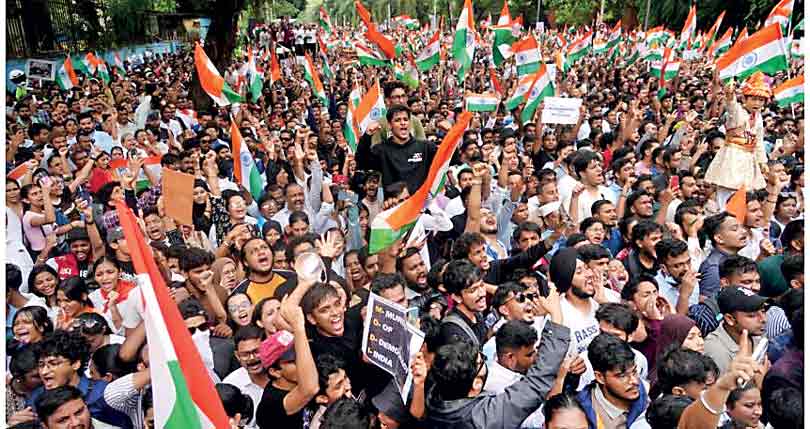
Protesters celebrating after Education Minister Dharmendra Pradhan’s resignation
An unusual name, a serious message
 Few political movements have attracted as much curiosity through their name as India’s Cockroach Movement. At first hearing, it sounds more like internet satire than a serious political campaign. Yet behind its unusual title lies one of the most significant youth-led movements in contemporary India, raising important questions about governance, accountability and the relationship between governments and an increasingly assertive generation of young citizens.
What began as public anger over alleged irregularities and leaks in India’s National Eligibility cum Entrance Test (NEET), the highly competitive examination for admission to medical colleges, rapidly evolved into a nationwide campaign demanding transparency, accountability and institutional reform. Thousands of students protested in New Delhi and other cities, while millions followed the movement online. The Government subsequently announced reforms aimed at restoring confidence in the integrity of the examination system.
For neighbouring countries, however, the movement’s significance extends well beyond India’s domestic politics. It offers valuable lessons about youth expectations, digital mobilisation and the evolving relationship between governments and citizens across South Asia.
When merit comes under question
Competitive examinations occupy a unique place in Indian society. For millions of families, they represent the principal pathway to higher education, professional advancement and social mobility. More than two million students sit the NEET examination each year, investing years of preparation, considerable financial resources and immense personal sacrifice in pursuit of a place in medical school.
When allegations of examination paper leaks emerged, public concern quickly spread beyond the immediate controversy. Many students believed that the principle of merit itself had been compromised. What began as a dispute over an examination became a broader debate about fairness, transparency and equal opportunity.
 For Sri Lanka, the principal lesson from India’s experience is not about replicating another country’s response but recognising a common regional reality. Like India, Sri Lanka has a highly educated and increasingly connected younger generation whose expectations continue to evolve. Young people today compare opportunities, governance standards and public services not only within their own country but also across the region and the wider world
The movement therefore evolved beyond demands for a fresh examination. Protesters called for stronger institutional accountability and reforms to safeguard the integrity of India’s education system. At its core, the controversy became a national conversation about public trust.
India’s democratic tradition of public mobilisation
India has a long history of public movements shaping national policy. From Mahatma Gandhi’s freedom struggle and Jayaprakash Narayan’s movement against corruption during the 1970s to Anna Hazare’s anti-corruption campaign in 2011 and the nationwide farmers’ protests of 2020–2021, Indian democracy has repeatedly demonstrated its capacity to absorb public mobilisation within constitutional politics.
The Cockroach Movement represents the latest chapter in this tradition. Unlike many earlier campaigns, however, it did not originate with political parties or established civil society organisations. Instead, it emerged organically through digital platforms before moving onto the streets.
Its evolution illustrates a broader transformation in democratic participation. Digital communication has significantly lowered the barriers to collective action, enabling individual grievances to develop rapidly into nationwide campaigns. Similar patterns are evident across many democracies, where social media increasingly complements traditional forms of political participation.
Generation Z has entered the political arena
Perhaps the movement’s most enduring significance lies not in its immediate demands but in the generation that carried it forward.
India is home to approximately 1.46 billion people and one of the world’s youngest populations. Generation Z alone numbers well over 500 million people, making it the largest such cohort anywhere in the world. This demographic reality is reshaping political expectations and public discourse.
Unlike previous generations, today’s young citizens are digitally connected, globally informed and accustomed to immediate access to information. They compare government performance across countries, organise rapidly through social media and expect timely responses from public institutions.
Governments no longer enjoy a monopoly over public narratives. Every smartphone has become a platform for public debate, enabling information and opinion to spread almost instantly. This transformation need not weaken democratic institutions. Managed wisely, it can strengthen accountability and improve governance. It does, however, require governments to communicate more openly, respond more transparently and engage more effectively with legitimate public concerns.
The Cockroach Movement therefore reflects a reality extending far beyond India. Generation Z is no longer preparing to inherit public life; it has already become an influential participant in shaping it.
Five lessons for South Asia
Although the movement emerged from a controversy within India’s education sector, its implications extend well beyond national borders.
First, institutions matter as much as policies. Governments may formulate sound policies, but public confidence ultimately depends on the credibility of the institutions responsible for implementing them. Trust, once lost, is difficult to restore.
Second, meritocracy remains one of the strongest pillars of social stability. Across South Asia, education is widely regarded as the principal pathway to social mobility and economic opportunity. When merit appears compromised, frustration grows; when fairness is protected, public confidence is strengthened.
Third, Generation Z has fundamentally altered the relationship between governments and citizens. This generation expects transparency, accountability and timely responses. Governments that recognise these expectations are more likely to earn public trust.
The future competitiveness of South Asian nations will depend not only on economic performance but also on the confidence that young citizens place in their public institutions. Governments should therefore regard young people not merely as beneficiaries of public policy but as partners in national development. When their aspirations are recognised and their voices are heard, they become contributors to stability rather than sources of discontent
Fourth, digital mobilisation is now an enduring feature of democratic life. While social media presents challenges, including misinformation and polarisation, it also offers governments new opportunities to communicate directly with citizens, explain policies and respond to concerns more effectively.
Finally, governments become stronger—not weaker—when they listen. Responsiveness should never be mistaken for weakness. Governments that acknowledge legitimate concerns and take timely corrective action reinforce rather than diminish democratic legitimacy.
Why this matters to South Asia and Sri Lanka
The significance of these developments extends well beyond India. South Asia is home to nearly two billion people, more than half of whom are under the age of 30. By the early 2030s, Generation Z and Generation Alpha will constitute the dominant share of the region’s workforce, consumers and voters. This demographic transformation presents both an unprecedented opportunity and a profound responsibility. A youthful population can become the region’s greatest strategic asset, driving economic growth, innovation and social progress. Yet a demographic dividend is never automatic. It must be earned through investment in quality education, meaningful employment, transparent institutions and good governance.
For Sri Lanka, the principal lesson from India’s experience is not about replicating another country’s response but recognising a common regional reality. Like India, Sri Lanka has a highly educated and increasingly connected younger generation whose expectations continue to evolve. Young people today compare opportunities, governance standards and public services not only within their own country but also across the region and the wider world.
Sri Lanka’s own history of youth movements and demands for institutional reform demonstrates that public confidence is among the State’s greatest assets. Whether in education, public administration, the judiciary or economic management, institutions function effectively only when citizens believe they are fair, transparent and accountable.
The future competitiveness of South Asian nations will depend not only on economic performance but also on the confidence that young citizens place in their public institutions. Governments should therefore regard young people not merely as beneficiaries of public policy but as partners in national development. When their aspirations are recognised and their voices are heard, they become contributors to stability rather than sources of discontent.
Listening is the new strength
During more than three decades in diplomacy, I have observed governments and societies across diverse political systems and cultures. One enduring lesson stands out: the strength of a nation is measured not only by the size of its economy or the power of its institutions, but also by the confidence its citizens place in those institutions.
India’s Cockroach Movement is more than a domestic protest over examination irregularities. It reflects a wider regional transformation in which digitally connected young people are reshaping expectations of governance. The movement reminds policymakers across South Asia that trust, transparency and accountability are no longer optional aspirations; they are becoming essential pillars of effective governance.
History shows that every generation finds its own language of protest. The real test of leadership is not whether dissent can be prevented, but whether it can be transformed into dialogue, reform and renewed public confidence. Governments do not diminish their authority by listening to their young people; they strengthen their legitimacy by doing so.
(The author is a former Sri Lankan Ambassador to the European Union, Belgium, Türkiye, Ukraine and Saudi Arabia. He also served as Additional Secretary of the Ministry of Foreign Affairs)



