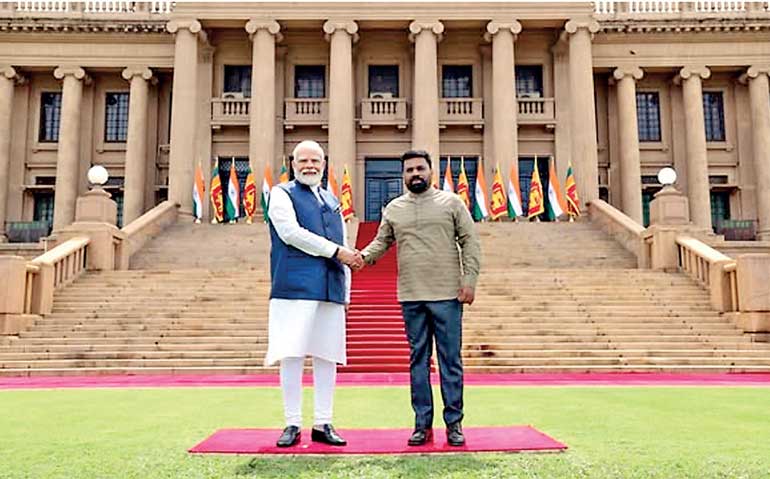
Indian Prime Minister Narendra Modi with President Anura Kumara Dissanayake during the former's visit to Sri Lanka in April 2025
 More than 2,300 years of civilisational exchange have bound India and Sri Lanka together. Today, India's economic ascent presents another historic opportunity. But the greatest threat to
Sri Lankan sovereignty may not be India's growing influence; it may be Lanka's failure to develop the economic strength necessary to negotiate that influence
More than 2,300 years ago, an encounter between Arahat Mahinda and King Devanampiya Tissa at Mihintale transformed Sri Lankan civilisation. According to Buddhist chronicles, Arahat Mahinda arrived during Emperor Ashoka’s reign, introducing a philosophical tradition that profoundly influenced the island’s religious, intellectual and political institutions. Buddhism shaped the monasteries of Anuradhapura, the sacred Sri Maha Bodhi and traditions central to Sri Lankan identity. Yet this civilisational relationship extended beyond Buddhism. Hindu devales became incorporated into Buddhist religious complexes, while deities including Vishnu, Kataragama and Pattini acquired distinctive positions within Sinhala Buddhist worship. At Kandy, the Temple of the Sacred Tooth Relic and neighbouring devales embody centuries of religious interaction. These influences were not merely imported; they became inseparable from Sri Lanka’s cultural identity.
There is a political lesson in this history. Sri Lanka absorbed external influences without becoming an extension of India, yet contemporary foreign policy frequently approaches economic proximity through anxieties about sovereignty and unequal power. That anxiety now confronts an extraordinary transformation. India has emerged as an economic giant whose industrial expansion is reshaping South Asia, while Sri Lanka continues rebuilding after sovereign default. The question is no longer whether India will influence Sri Lanka’s economic future, but whether Sri Lanka possesses the productive strength to shape that relationship rather than remain vulnerable to it.
History must inform foreign policy, not imprison it
India–Sri Lanka relations cannot be reduced to civilisational friendship. India’s involvement in Sri Lanka’s ethnic conflict, the Indo-Lanka Accord of 1987, the Indian Peace Keeping Force and unresolved Tamil political grievances have left enduring consequences. Fisheries disputes demonstrate that geographical proximity can generate conflicting interests. These experiences warrant scrutiny, but allowing historical grievances to determine the limits of economic cooperation risks transforming foreign policy into a permanent negotiation with the past.
India is not Tamil Nadu alone. Its economic geography encompasses Maharashtra’s industrial centres, Gujarat’s manufacturing networks, Karnataka’s technology ecosystem and Telangana’s pharmaceutical industries. A mature foreign policy must distinguish legitimate concerns about interference from opportunities for industrial development. Sri Lanka’s cultural history demonstrates that exchange and autonomy have long coexisted; modern economic diplomacy requires comparable confidence, accompanied by stronger institutional safeguards.
India’s rise was constructed, not inherited
India’s economic prominence is measurable. The International Monetary Fund’s October 2026 projections place its nominal gross domestic product at approximately $4.06 trillion, with real growth projected at 7%. Measured through purchasing power parity, its economy approaches $19.2 trillion, accounting for approximately 8.6% of global output. India is therefore not merely South Asia’s dominant economy but an increasingly consequential centre of international economic activity.
Its transformation reflects decades of reform, entrepreneurship, technological development and integration into global markets. Liberalisation introduced in 1991 reduced restrictions and enabled domestic enterprises to expand internationally. Tata Consultancy Services, Infosys and Wipro became globally competitive technology businesses, while Tata Motors, Mahindra and Bharat Forge developed manufacturing capabilities extending beyond India’s borders. Tata’s acquisition of Jaguar Land Rover in 2008 demonstrated an important transition: Indian corporations were no longer merely participating in global production networks but acquiring technological capabilities, established brands and international distribution systems.
India’s growth remains uneven, with informal employment and regional inequalities exposing the limitations of aggregate expansion. Nevertheless, the comparison with Sri Lanka is uncomfortable. The island liberalised its economy in 1977, fourteen years before India’s major reforms, but failed to consolidate that advantage into sustained industrial competitiveness. Regulatory uncertainty, political instability and repeated policy reversals constrained diversification. India’s rise demonstrates what institutional continuity and industrial capability can achieve; Sri Lanka’s experience exposes the consequences of repeatedly failing to develop them.
Sri Lanka must stop merely trading with India and start producing with it
Sri Lanka’s bilateral trade relationship reveals the limitations of an economic strategy centred predominantly on market access. Department of Commerce figures show exports to India reached approximately $1.04 billion in 2025, while imports amounted to $4.33 billion, producing a merchandise trade deficit of approximately $3.3 billion. A trade deficit does not inherently indicate economic weakness, particularly when imported machinery and intermediate goods support production. The more consequential question is whether trade creates skilled employment, technological capabilities and competitive industries.
The India–Sri Lanka Free Trade Agreement offers a revealing historical lesson. Following its implementation in 2000, exports expanded rapidly, but much of the initial growth became concentrated in vanaspati and copper. Research by the Institute of Policy Studies found that these products accounted for more than half of exports to India by 2005. Their competitiveness depended substantially on tariff advantages rather than durable industrial strengths. Following Indian restrictions and regulatory changes, vanaspati exports ceased, while copper exports fell from approximately $145 million in 2005 to $13 million in 2008. The episode exposed the difference between temporary market access and sustainable industrial capability.
A contrasting example exists in the CEAT–Kelani partnership. Established through an alliance in 1999, the venture combined Indian industrial expertise with Sri Lankan manufacturing assets, subsequently expanding production capacity and technological capabilities. CEAT’s documented investments included radial-tyre manufacturing and truck-and-bus tyre production. Unlike businesses dependent principally on temporary tariff advantages, manufacturing partnerships require equipment, skilled labour, technical knowledge and continuing investment.
The opportunity extends further. India’s automotive-component industry generated approximately $85.9 billion in turnover during 2025–26, including $24 billion in exports, according to the Automotive Component Manufacturers Association of India. Sri Lanka already manufactures rubber products, electrical assemblies and specialised automotive components. Rather than attempting to replicate India’s industrial scale, its enterprises could become qualified suppliers within Indian manufacturing networks through certification, technological partnerships and efficient logistics.
CEAT–Kelani demonstrates industrial feasibility, not evidence of contracts Sri Lanka has already lost. The failure lies in the absence of a sufficiently sustained national strategy to replicate such capabilities across sectors. Bilateral cooperation should ultimately be measured not simply by how much the countries trade, but by how much they produce together and sell internationally.
Has sovereignty become an excuse for economic failure?
This raises a politically uncomfortable question: have successive Sri Lankan governments invoked sovereignty to defend national independence while neglecting the industrial reforms necessary to exercise it? Concerns about Indian influence are legitimate, but the country’s broader economic record reveals a contradiction between protecting domestic markets and developing competitive domestic industries.
The World Bank’s 2024 analysis identified Sri Lanka’s trade regime as exceptionally restrictive, with an average tariff, including para-tariffs, of 17.6% in 2022. It found that high and unpredictable import duties increased manufacturers’ input costs and discouraged export-oriented production. A policy framework defended partly through domestic protection was therefore making it harder for domestic businesses to compete internationally.
The controversy surrounding the proposed Economic and Technology Cooperation Agreement illustrates the political dimension. During negotiations in 2016 and 2017, opposition parties and professional organisations raised concerns about competition, employment and national interests. Some objections warranted serious consideration, yet the debate frequently centred on whether economic opening endangered sovereignty rather than how Sri Lanka could develop industries capable of benefiting from expanded access. Negotiations resumed in 2023, but the underlying challenge of industrial competitiveness remains.
This is the paradox of defensive sovereignty: a State may seek independence by insulating its economy while simultaneously weakening the productive foundations on which meaningful independence depends. Sri Lanka’s industrial shortcomings cannot be attributed exclusively to anti-Indian politics; civil conflict, fiscal instability and governance failures are central explanations. Nevertheless, sovereignty cannot become a substitute for economic strategy, nor can protection be presumed beneficial merely because it is presented as patriotic.
Economic integration must strengthen national capability
Global production networks are being reorganised amid geopolitical competition, technological change and supply-chain diversification. Smaller economies struggle to compete independently against established industrial powers, but regional manufacturing networks offer opportunities for specialised production. Sri Lanka’s maritime location, workforce and existing industrial capabilities could support integration if accompanied by technological upgrading and consistent investment policy.
Indian investment already provides opportunities for cooperation, but investment volume alone cannot establish developmental success. Partnerships must be assessed through skilled employment, domestic procurement, technology transfer and export performance, supported by transparent contracts, predictable taxation and competition safeguards. Sri Lanka’s geographical advantages require similar discipline. Colombo’s transshipment role and investments such as the Colombo West International Terminal create opportunities for logistics and maritime services, while Trincomalee’s potential in energy infrastructure warrants transparent commercial assessment. Without complementary industries, Sri Lanka risks becoming a location through which regional commerce passes rather than an economy that contributes meaningfully to its production.
Cultural proximity is an advantage, not an economic strategy
The civilisational relationship provides an unusually deep foundation for cooperation. Buddhism’s transmission from India, the incorporation of Hindu-associated deities into Buddhist practice and centuries of architectural and commercial exchange demonstrate interconnected societies capable of transforming external influences into local traditions. Contemporary relationships retain substantial people-to-people connections, including tourism, education and professional exchange.
Nevertheless, historical familiarity cannot guarantee equitable economic outcomes. Shared culture does not automatically generate competitive industries or responsible political leadership. Cultural diplomacy gives bilateral relations depth, but institutional capacity determines their economic value.
Sovereignty begins with productive strength
Sri Lanka’s economic collapse in 2022 exposed the vulnerability of a state possessing formal political independence but insufficient economic resilience. India’s emergency assistance of approximately $4 billion demonstrated the importance of cooperation, yet financial support cannot substitute for sustainable prosperity. The World Bank’s October 2026 assessment reported that Sri Lanka had returned to pre-crisis economic output levels, while poverty remained elevated at an estimated 16.9% in 2025. Stabilisation remains indispensable, but recovery without productive transformation risks preserving underlying vulnerabilities.
This suggests a broader principle of international relations: productive sovereignty. Building upon the established distinction between interdependence and asymmetric dependence, the concept holds that a smaller state’s strategic autonomy depends not exclusively on its capacity to resist external influence, but on its ability to generate economic capabilities that strengthen its bargaining position. Interdependence reinforces sovereignty when it produces technology, export markets and negotiating alternatives; it undermines sovereignty when it concentrates economic power without developing domestic productivity.
Sri Lanka must consequently maintain diversified international partnerships while developing industries that make cooperation mutually valuable. The objective is not freedom from economic relationships, but freedom from negotiating them through structural weakness. Integration with India should therefore be neither unconditional nor instinctively rejected; it must be judged by whether it expands Sri Lanka’s long-term economic and strategic choices.
An ancient relationship deserves a more ambitious future
Sri Lanka’s civilisational history demonstrates that engagement with India need not entail the erosion of national identity. Religious, intellectual and architectural influences crossed the Palk Strait and became part of a distinctly Sri Lankan civilisation. Modern economic diplomacy demands comparable confidence, strengthened by transparent negotiations and institutions capable of protecting national interests.
For decades, political debate has questioned whether closer relations with India threaten sovereignty. The more consequential question is whether successive governments have constructed an economy sufficiently productive to exercise sovereignty meaningfully. India’s ascent will reshape South Asia regardless of Sri Lanka’s participation, but the island retains the ability to determine whether its enterprises become valuable participants in that transformation or remain peripheral to it.
Sri Lanka’s greatest strategic vulnerability may not be that India is becoming too powerful, but that Sri Lanka has remained too economically unprepared to negotiate confidently with that power. More than two millennia of history have made the countries neighbours in civilisation, and geography has made them neighbours in commerce. Whether they become genuine partners in prosperity will depend not on sentimental friendship or political rhetoric, but on Sri Lanka’s willingness to transform proximity into productive strength.
(The author specialises in political accountability, governance, human rights, democracy, public policy and international affairs. She is also the Founder and Executive Director of Gamindi Foundation, a Sri Lankan non-governmental organisation)



