Friday Oct 16, 2026
Friday Oct 16, 2026
Friday, 3 April 2026 00:42 - - {{hitsCtrl.values.hits}}
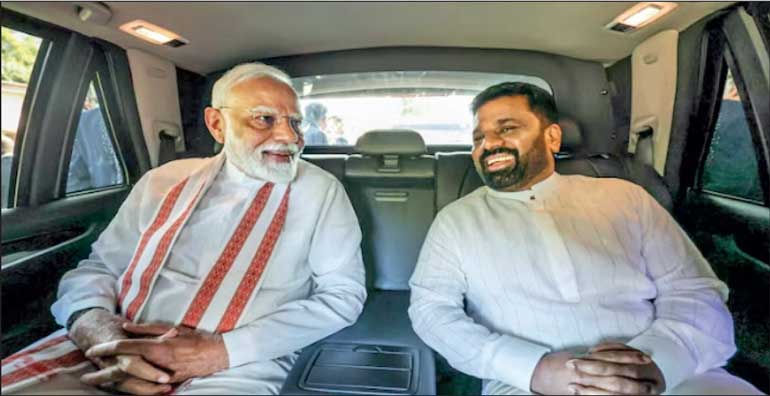
Indian Prime Minister Narendra Modi (left) and Sri Lankan President Anura Kumara Dissanayake. The time has come for India to be a trusted partner from which Sri Lanka
benefits, while India too benefits from the relationship
 The war in the Middle East is destabilising the world, and South Asia is no exception. The key concern is ‘energy security’. With fuel supplies in the Strait of Hormuz being restricted, Sri Lanka too has faced uncertainty regarding fuel supplies, and fears of increasing prices that could derail economic growth. Sri Lanka has imposed rationing and a weekday public holiday to address the issue.
President Anura Kumara Dissanayake spoke to PM Modi of India, after which 38,000 metric tons of fuel made its way to Sri Lanka. A cursory look at the comments under the announcement on a news website shows that some segments of the Sri Lankan population resent this action. People are berating the Government for not ‘directly’ buying from Iran and Russia. Others suggest that Sri Lanka was ‘begging’ and should not do so. Many say India itself is ‘struggling’, so why should Sri Lanka seek India’s assistance.
Of course, a more informed response will show that Sri Lanka, with its limited refining capacity, needs refined fuel, and India has the capacity to provide it. Also, Sri Lanka can trade in non-USD currencies with India and benefit from lower costs than if it had to find a vessel to fetch the fuel and pay the incredibly high insurance premiums. The proximity of India plays a role in swift and efficient transport at lower costs.
But the fact is, over the last few years, India has emerged as the first responder in times of need for Sri Lanka. Be it during the pandemic, with the first infusion of vaccines under the Maitri vaccine program, or after the economic crisis, with the prompt infusion of funds to stabilise the economy, or most recently, when Cyclone Ditwah hit, India mounted a prompt rescue and relief operation and provided significant infrastructure support to reconnect inaccessible areas cut off due to the cyclone.
As Indian leaders have recently said, “This is a natural response. As a civilisational twin, when one is in trouble, the other will respond with speed and scale to help.” India should and will be there to help in cases such as these.
It is completely natural for the people of a proud and ancient civilisation such as Sri Lanka to feel a certain disquiet at the seeming over-dependence on India, and the obligatory strings they think are likely to be attached to such patronage. 
Yes, the time has come to create an engagement with India such that it is done on the basis of a well thought-out plan that is a win-win, rather than one borne of India’s patronage.
Countries such as New Zealand and Canada have very strong agreements with their larger neighbours, Australia and the USA. These are based on mutually beneficial deals designed to provide the smaller country with a safety net from climate or geopolitical shocks, while equally benefiting the larger country. It is a partnership of equals, though there is no equality in size.
In the case of Australia and New Zealand, due to their CER (Closer Economic Relationship) and SEM (Single Economic Market) agenda, both countries together are able to take on larger Asian economies such as India and China (the Asian Century strategy, as it is called). Australia benefits from tourists coming in from New Zealand and has significant protocols to establish common standards in compliance for food and investments, making it very easy to do business in New Zealand and thus adding value to the Australian economy.
From an India–Sri Lanka perspective, the time has come to accelerate a formal engagement between the two countries—one that positions Sri Lanka alongside India as a partner benefiting from India’s size and scale, while at the same time utilising its own strengths for India’s benefit.
From an energy security perspective, an oil pipeline and the connection of the two electrical grids are of critical importance. In the short term, this could ensure that Sri Lanka does not suffer as a consequence of geopolitical shocks such as the current war. In the medium to long term, Sri Lanka could provide valuable power to the southern states of India once its solar and wind power potential is fully exploited. This could become a significant revenue earner and make Sri Lanka a critical and equal partner in the relationship.
Digital connectivity and investments go hand in hand. Once Indian rupee and Sri Lankan rupee exchanges are fully formalised and executed through UPI and similar platforms, Sri Lanka could be cushioned from the unpredictability of the USD and its fallout. Equally, Indian investments should flow seamlessly, as Sri Lanka can become the first ‘port of call’ for Indian investors seeking to internationalise their operations. In 2025 alone, Indian businesses invested close to $ 30 billion worldwide.
Sri Lanka playing such a role will make it a ‘partner in global growth’ for Indian businesses. Creating synergies and protocols for investment, legal, and food standards is another set of steps critical to business integration. Connectivity, through activating all ports in Sri Lanka in the North and East and building the much-feared physical bridge, could help create significant value for international businesses looking to access the vast South Indian market.
In these times of unprecedented uncertainty, creating a formal engagement with India can help shield Sri Lanka, whether from geopolitical shocks or climate-related risks. This is the need of the hour.
The time has come for India to be a trusted partner from which Sri Lanka benefits, while India too benefits from the relationship. The right steps taken now will transform India from being seen as a patron doing ‘good things’ for a civilisational twin into an equal partner engaged through a mutually beneficial trade agreement in a win-win relationship. Let’s get this done. Now!
(The author is the President of the Lanka India Business Association that promotes closer business and trade ties between the two
countries)