Saturday Oct 03, 2026
Saturday Oct 03, 2026
Monday, 16 February 2026 02:39 - - {{hitsCtrl.values.hits}}
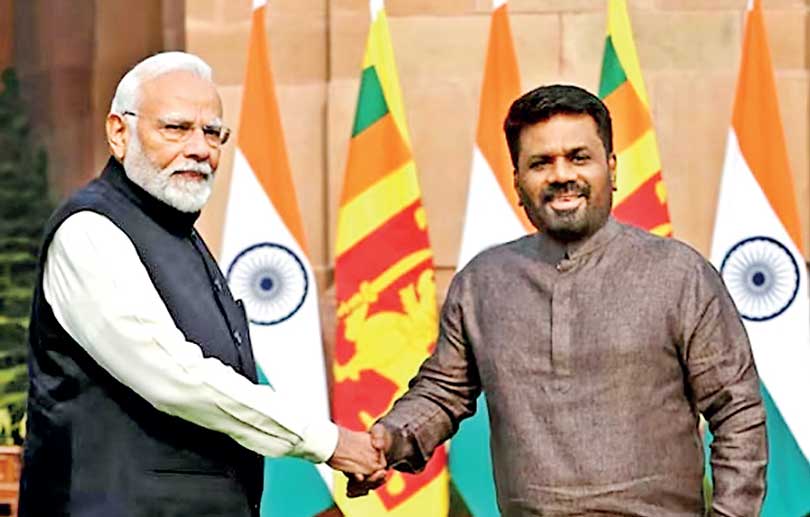
President Anura Kumara Dissanayake with Indian Prime Minister Narendra Modi
The Sri Lanka Unique Digital Identity project is also steadily progressing. A secure and inclusive digital identity framework is not merely an administrative reform; it is a structural enabler. It strengthens service delivery. It improves targeting of welfare. It facilitates financial inclusion. And it lays the groundwork for trusted data ecosystems. Yet digital identity is only the beginning. In an AI-driven world, foundational digital infrastructure becomes the platform upon which intelligent systems operate
Sri Lanka’s commitment to digital transformation therefore positions it well for the next phase. AI can support agricultural development, enhance disaster preparedness, enable diagnostic tools in healthcare, multilingual educational support and smarter urban planning. These applications are practical. They are measurable. They can directly improve lives
AI must be leveraged as a force for global good. It must expand human agency, not narrow it. It must widen access and not concentrate power. For the Global South, this is not a philosophical rhetoric. It is a developmental imperative
We must engage seriously with governance. Democracies have a particular responsibility in shaping AI norms. Transparency, accountability and safeguards are not optional add-ons. They are integral to public trust. India’s approach emphasises ethical frameworks and consultative policy development, ensuring that innovation proceeds alongside regulation that protects citizens. The choices made today will influence economic hierarchies for decades
 When India hosts the forthcoming AI Impact Summit on 18-20 February 2026, it will do so with clarity of purpose. Artificial Intelligence is not an abstraction for us. It is a tool. A capability. A responsibility. And above all, an opportunity to reshape development pathways for those who have too often been rule-takers in technological revolutions.
India’s position is straightforward: AI must be leveraged as a force for global good. It must expand human agency, not narrow it. It must widen access and not concentrate power. For the Global South, this is not a philosophical rhetoric. It is a developmental imperative.
India’s own trajectory underscores this commitment. According to the Stanford University Global AI Vibrancy Tool 2025, India ranks third globally in AI competitiveness. This is not accidental. It reflects sustained investments in research, Digital Public Infrastructure, startup ecosystems and institutional capacity. More importantly, it reflects a policy framework that views digital public goods as foundational to equitable growth.
Under the leadership of Prime Minister Narendra Modi, India has moved decisively to strengthen its AI ecosystem. The Indian Cabinet has approved over $ 1 billion under the India AI Mission to build advanced computing capacity. In parallel, 38,000 GPUs have been onboarded to expand national AI compute infrastructure at scale. Compute is power in the AI age. India has chosen to make that power accessible.
The AIKosh platform illustrates the same approach. Today, it hosts more than 5,500 datasets and 251 AI models, available to researchers, startups and institutions. This is about democratising innovation. It is about ensuring that AI solutions are not confined to a handful of laboratories but are built and refined across society. Indian experts are also advancing Small Language Models tailored for human-centric applications — systems that function effectively in multilingual and resource-constrained settings and that respond to real societal needs.
This architecture of openness matters for countries across the Global South. Many face similar constraints: limited compute capacity, fragmented datasets, linguistic diversity and uneven digital access. The AI Impact Summit will therefore focus not only on frontier technologies but on frameworks that enable shared progress — interoperable systems, trusted data flows, responsible governance and affordable compute.
In this context, India’s partnership with Sri Lanka assumes renewed significance. Our relationship is anchored in civilisational ties and strengthened by contemporary cooperation. It is further energised by the warm and constructive engagement between the President of Sri Lanka, H.E. Anura Kumara Dissanayake, and Prime Minister Shri Narendra Modi. Their dialogue reflects mutual respect and a shared conviction that digital transformation is central to economic development and resilience. This is also demonstrated by the forthcoming participation of the President of Sri Lanka in the AI Impact Summit, at the invitation of Prime Minister of India.
During the April 2025 State Visit of Prime Minister Narendra Modi, our two countries signed a Memorandum of Understanding on Digital Transformation. This was a substantive step. It signaled an intention to align strategies, share expertise and co-create digital infrastructure that serves citizens efficiently and transparently.
The Sri Lanka Unique Digital Identity project is also steadily progressing. A secure and inclusive digital identity framework is not merely an administrative reform; it is a structural enabler. It strengthens service delivery. It improves targeting of welfare. It facilitates financial inclusion. And it lays the groundwork for trusted data ecosystems.
Yet digital identity is only the beginning. In an AI-driven world, foundational digital infrastructure becomes the platform upon which intelligent systems operate. Clean datasets, interoperable systems and secure authentication mechanisms allow AI applications to scale responsibly. Without these, ambition outpaces capacity.
Sri Lanka’s commitment to digital transformation therefore positions it well for the next phase. AI can support agricultural development, enhance disaster preparedness, enable diagnostic tools in healthcare, multilingual educational support and smarter urban planning. These applications are practical. They are measurable. They can directly improve lives.
India stands ready to deepen collaboration with Sri Lanka in these domains. Our expanding compute capacity, open datasets and experience in building population-scale digital platforms create space for joint research, startup linkages and skills partnerships. Universities, innovation hubs and public institutions in both countries can work together to develop solutions calibrated to our realities.
At the same time, we must engage seriously with governance. Democracies have a particular responsibility in shaping AI norms. Transparency, accountability and safeguards are not optional add-ons. They are integral to public trust. India’s approach emphasises ethical frameworks and consultative policy development, ensuring that innovation proceeds alongside regulation that protects citizens.
The choices made today will influence economic hierarchies for decades. AI can centralise advantage in a few geographies. Or it can enable leapfrogging by those prepared to act with foresight. India’s conviction is clear: the technology must serve humanity at scale, especially in developing societies where the gains from efficiency and inclusion are most transformative.
The forthcoming AI Impact Summit is therefore not only a convening. It is a statement of intent. India seeks partnerships that are practical, equitable and forward-looking. With Sri Lanka, we already have the foundations — trust, ongoing digital cooperation and shared developmental priorities.
The task before us is to build on that base. The future will be shaped by those who design it. India and Sri Lanka have the opportunity to do so together — ensuring that artificial intelligence remains anchored in human purpose and directed toward shared prosperity.
(The author is the High Commissioner of India to Sri Lanka)



