Sunday Sep 27, 2026
Sunday Sep 27, 2026
Wednesday, 12 August 2026 04:14 - - {{hitsCtrl.values.hits}}
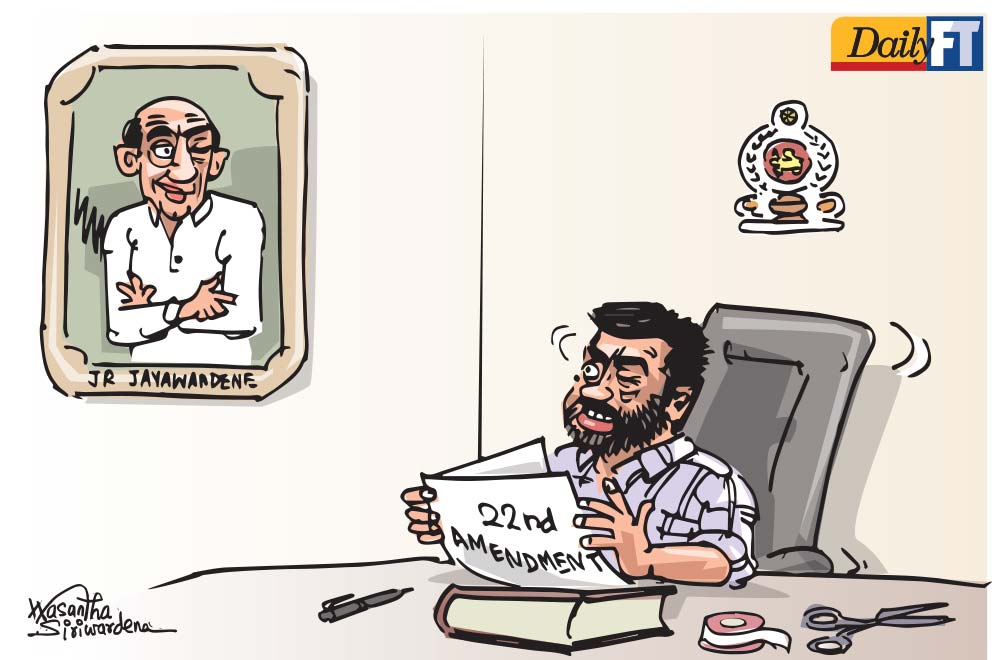
 Add a clause to the proposed 22nd Amendment stating that the changes will not apply to the current members of the Supreme Court and the Court of Appeal but will apply only to appointments made after its enactment. For a currently serving judge or someone from the Attorney General’s Department, or from the unofficial bar who is appointed to the Supreme Court of the Court of Appeal after the enactment of the 22nd Amendment, the retirement age would be higher than those of the judges appointed to that Court prior to the change. Over time, all the judges in the Supreme Court and the Court of Appeals would enjoy the higher retirement age. The carrot would not be offered to those currently appointed. The retirement age of currently serving judges will not be changed
 The age of retirement of judges of the Supreme Court and the Court of Appeals is specified in Article 107(5) in the section of the 1978 Constitution entitled “Independence of the Judiciary.” Article 108 states that the salary payable to such judges cannot be reduced after appointment. Is there an analogy that can be drawn? It seems reasonable to conclude that the retirement age cannot be reduced. In both cases, something is being taken away from the judges. But what is at issue at present is whether something can be given to the judges.
I have some familiarity with the challenges of creating the conditions for the independence of persons entrusted with the making of decisions that are of greatest import; Where it is important not only that justice is done, but also that justice is seen to be done. My experience comes from involvement in the drafting of legislation on regulation in the Global South drawing from the long experience with independent regulation in the United States and from teaching the subject.
Sticks and carrots
The 1978 Constitution and good practices in regulatory design are unequivocal in constraining the ability of the executive or the legislature to take away anything from those whose independence is sought to be safeguarded. No use of sticks. But what of carrots? Inducements, incentives, rewards?
The authors of the 1978 Constitution did not explicitly prohibit the raising of salaries or the retirement age. In the legislation I am familiar with, we tend to block these too, by limiting discretion on renewal of appointments. Salaries tend to be pegged to external objective factors and are not left to the discretion of the legislature or the executive.
Is the increase of the retirement age a benefit, similar to a salary increase? In a country where average life expectancy is 80 for women and 76 for men, it is. Work is not just about money. It gives meaning to one’s life and generates social recognition and respect. Especially in the case of appointments that come with relatively strict conditions on post-retirement activities, retirement is likely to be viewed with trepidation.
Does this mean that the ages of retirement specified in Article 107 are immutable?
The solution
Add a clause to the proposed 22nd Amendment stating that the changes will not apply to the current members of the Supreme Court and the Court of Appeal but will apply only to appointments made after its enactment.
For a currently serving judge or someone from the Attorney General’s Department, or from the unofficial bar who is appointed to the Supreme Court of the Court of Appeal after the enactment of the 22nd Amendment, the retirement age would be higher than those of the judges appointed to that Court prior to the change. Over time, all the judges in the Supreme Court and the Court of Appeals would enjoy the higher retirement age. The carrot would not be offered to those currently appointed. The retirement age of currently serving judges will not be changed.
This gets around a critical problem. Damaging allegations of conflict of interest on the part of sitting judges of the Supreme Court who are asked to rule on whether or not the 22nd Amendment should be approved by a referendum will be avoided. They cannot all recuse themselves because of conflict of interest. Someone has to rule on that question.
Compromise on the retirement age on the part of the Government will lower the temperature and create the conditions for the necessary national conversation on extending the retirement ages of all in the labour force, free of partisan posturing.
Compromise on the retirement age on the part of the Government will lower the temperature and create the conditions for the necessary national conversation on extending the retirement ages of all in the labour force, free of partisan posturing
Ideally, the Government will take the opportunity afforded by the need to further amend the proposed 22nd Amendment to include provisions on what kinds of post-retirement appointments may be offered to retired judges. The practice of offering ambassadorial appointments to some (but not all) retired judges is quite problematic. Specifying the permitted appointments to those open to all retired judges such as membership in arbitration panels, governing bodies of universities, and commissions of inquiry would avoid the perception that some judges are being selectively rewarded by the executive and thereby influencing decisions prior to retirement.




