Wednesday Sep 30, 2026
Wednesday Sep 30, 2026
Wednesday, 30 September 2026 00:22 - - {{hitsCtrl.values.hits}}
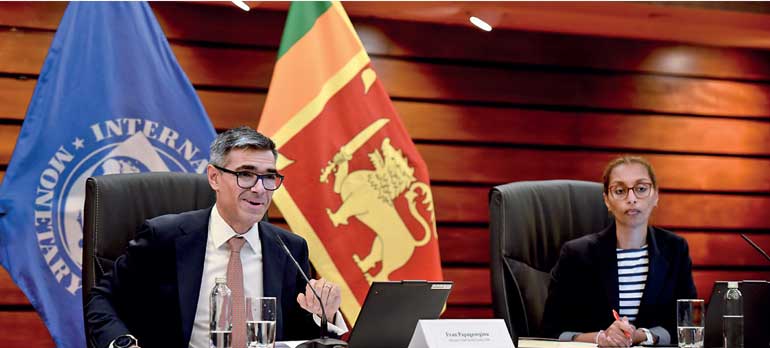
IMF Mission Chief Evan Papageorgiou (left) and IMF Resident Representative in Sri Lanka Martha Woldemichael
 The IMF staff team that concluded its visit to Sri Lanka on 23 September, relating to the seventh review of the IMF Extended Fund Facility, left behind an end-of-mission written statement in the register of relief: growth has held for eleven consecutive quarters, gross reserves have been rebuilt to $6.9 billion, which the statement folds into its account of an economy that ‘has proved remarkably resilient to successive shocks’, inflation expectations remain broadly anchored even as the headline rate runs at 8%, the banking sector reports healthy profitability, and debt restructuring is, in the Fund’s own phrase, ‘largely completed’. What the statement’s priorities do not carry – beyond a single clause each committing to reduce poverty and protect the vulnerable – is any reckoning with what these numbers have cost, and who has paid for it. Nor, despite naming Cyclone Ditwah related reconstruction work as something to accelerate, does it ask whether a country still repaying one crisis can afford the next, and what will happen when the reconstruction bill collides with the resumption of debt repayments in 2028.
Key priorities
The IMF’s ‘key priorities’ for Sri Lanka have not changed much since the crisis began, and they arrive in the vocabulary of technical necessity: a medium-term revenue strategy, broadening the tax base, strengthening revenue administration, and ‘upholding cost-recovery energy pricing’, which it says ‘will help minimise fiscal risks arising from state-owned enterprises’. Each of these, however, is a political choice.
Cost-recovery pricing means the consumer absorbs the full cost of electricity and fuel, whatever that cost happens to be in a given month. When global oil prices climbed earlier this year and the Government maintained a Rs. 91.8 billion relief package rather than passing the full increase on to consumers, the IMF described the resulting measures as temporary relief rather than a permanent departure from cost-recovery pricing. The distinction matters: relief is treated as temporary; cost recovery as the rule.
Rising poverty
The households absorbing that cost have little room left to absorb more. Sri Lanka’s poverty rate roughly doubled between 2019 and 2023, leaving about four million people below the poverty line. Income poverty captures only part of the damage. The UNDP’s vulnerability index from 2023 found that 55.7% of the population was multidimensionally vulnerable across a wider set of indicators covering education, health and disasters, and living standards. Despite all this, the IMF’s September statement mentions poverty exactly once, in a clause promising to ‘reduce poverty’ and the vulnerable once more, in a promise to ‘strengthen social safety nets’. Both are folded into a document otherwise built out of bullet points, targets, and the word ‘prudent’.
The same document performs a similar manoeuvre with its other headline claim that debt restructuring is ‘largely completed’. Whilst this is technically accurate, completion of the restructuring does not mean that the debt burden itself has disappeared. Restructuring describes the terms and schedule under which debt is repaid; the more important question is what those new terms leave Sri Lanka able to spend elsewhere. External debt repayments resume in 2028, adding about a billion dollars a year to the country’s external obligations. The Central Bank’s own figures put the short-term drain on reserves from foreign currency debt servicing at close to $6 billion over the coming twelve months. In addition, the Government’s fiscal documents, tabled separately in parliament, project $2.5 billion in foreign debt servicing for 2026 alone. Built into the restructuring itself are further mechanics that compound this: macro-linked bonds, owned by private creditors, that trigger higher payments if the economy performs well kick in. Calling a country’s debt restructuring ‘largely completed’ allows a declaration of success in the present while leaving a different question – what servicing that restructured debt will cost – to the years ahead. That question becomes particularly difficult from 2028, when bilateral and private creditor repayments resume and the adjustment may fall, once again, on health, education, and social protection.
Growth
Growth is asked to carry a similar weight. Eleven consecutive quarters of expansion and 4.2% growth in the second quarter sound like recovery, until they are set against Sri Lanka’s real GDP remaining below its 2019 level. And what is being counted as recovery is still, over the longer term, an economy that has barely grown. The growth that has occurred also needs to be measured against what has happened to ordinary households. In August 2026, the Central Bank bought a record $579 million in foreign currency to rebuild reserves. The IMF statement considers reserve accumulation more evidence of the ‘resilience’ it has already claimed. But it is important to note that reserves are a buffer against the next external shock; they are not, in themselves, evidence of prosperity or of a recovery in household welfare, in a country where four million people already live below the poverty line.
That buffer will need to stretch further still. Cyclone Ditwah caused damage worth roughly 4% of GDP, and its reconstruction bill will arrive as Sri Lanka approaches the same 2028 resumption of bilateral and private creditor debt repayments – a collision the statement never names. Downside risks are named as uncertainty over the Middle East war, global trade policy, and ‘the impact of El Niño’ – three items on the same list, as though climate were an occasional external risk to Sri Lankan agriculture, tourism and hydropower rather than one of the conditions under which they operate. Inside the priority on capital spending, the statement adds one more line: ‘address bottlenecks to capital spending execution, including to accelerate Cyclone Ditwah-related recovery and reconstruction’. This, incidentally, is the only other place Ditwah appears in the statement, where it has been reduced to an execution problem, with nothing said about how it will be paid for, or whether climate adaptation can be squared with debt service. Debt sustainability cannot be assessed without accounting for climate shocks and fiscal consolidation cannot be designed without considering adaptation needs. Reconstruction will be paid for the way everything else is: out of a budget that, from 2028, must also make room for renewed payments to external creditors.
Inflation
The statement’s answer to all of this is a single word – prudence. ‘Unwavering commitment to prudent policies and reforms,’ it says, ‘is critical to safeguard macroeconomic stability’, and the word returns later alongside the Fund’s insistence on maintaining the inflation target at 5% while headline inflation runs at 8. The word itself does a great deal of work. It presents revenue mobilisation, cost-recovery pricing and fiscal restraint as what any responsible Government would do, and so takes them out of the realm of choice. But prudence for whom? The statement does not ask whether the burden of adjustment has been fairly shared, whether the debt being serviced was legitimately incurred, or whether the growth it wants can survive the climate it operates in.
Whilst these are also political and ethical questions, the Fund treats them as lying outside the immediate frame of this statement. But it is more forthcoming about where it wants Sri Lanka to go. ‘Shifting from stabilisation to transformation,’ the statement says, requires structural reforms, and the ones it lists are liberalising trade, modernising business and labour regulation, broadening access to finance and advancing digitalisation. Poverty reduction heads the summary, but the concrete structural reforms specified beneath it are overwhelmingly concerned with the conditions for investment and private-sector growth.
Debt Sustainability Analysis
The priorities in this statement acquired their force through a document with many shortcomings: the IMF Debt Sustainability Analysis. The DSA sets the debt targets the restructuring was built to meet and the parameters within which the Fund judges Sri Lanka’s debt sustainable. Its assumptions about growth, revenue, primary balances and debt service therefore shape how much fiscal space remains, in practice, for health, education, social protection and climate investment. It is produced by the Fund, on the Fund’s own assumptions about growth and revenue, and it does not itself measure what adjustment has cost women, who have carried a disproportionate share of it, or fully answer what repeated climate shocks will demand of the state. The questions this statement leaves unasked – whether households can afford food, medicine and electricity; whether the 2028 resumption of debt service will force fresh cuts; how adaptation is to be financed when debt service already absorbs nearly a quarter of Government revenue – are precisely the ones that have to sit alongside any claim that the debt is sustainable. If they do not, then what is being tested is ultimately Sri Lanka’s capacity to repay, rather than its capacity to repay without reproducing the conditions of the crisis.
That is why Sri Lanka needs an assessment of its own. An independent Debt Sustainability Analysis, built by its own institutions and capable of bringing gender and climate into the assessment from the start, could test the Fund’s assumptions rather than simply inherit them. It could ask whether Sri Lanka can meet a given debt-service path, and what different debt and fiscal paths would mean for households, public services, reconstruction and the state’s capacity to absorb the next climate shock. And it would give the Government what it has lacked since the default – a basis on which to argue, before 2028 arrives, that debt serviced at the expense of the poorest households and the country’s capacity to withstand the next disaster is not sustainable at all.
(Charith Gunawardena is a co-founder of the Institute of Political Economy (ipe-sl.org) and a former local councillor in London. He can be reached at [email protected].)
Dr. Thiruni Kelegama is a Lecturer in Modern South Asian Studies, Oxford School of Global and Area Studies, University of Oxford, UK)



