Wednesday Oct 14, 2026
Wednesday Oct 14, 2026
Wednesday, 14 October 2026 00:23 - - {{hitsCtrl.values.hits}}
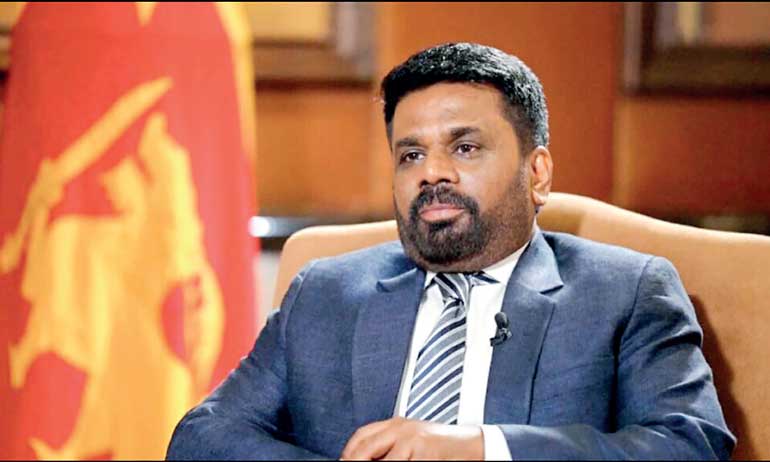
President Anura Kumara Dissanayake
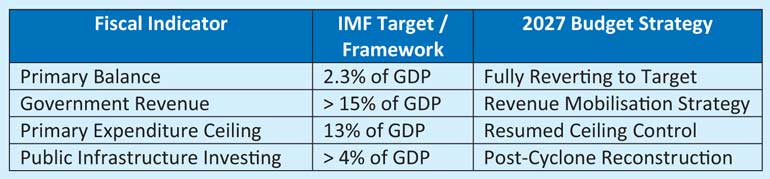
 The IMF staff led by Evan Papageorgiou visited Sri Lanka and held discussions with the Sri Lankan authorities during their visit to Sri Lanka in September 2026, relating to the seventh review of the IMF’s Extended Fund Facility (EFF). Discussions will continue in the near term toward reaching agreement on parameters and policies needed to conclude the Seventh Review.
Some of the highlights in the statement issued following the visit are as follows:
The inflation rose to 8% y/y in August due to the global oil price shock, expectations are broadly anchored. This means long-term economic forecasts (like inflation or growth) remain stable and close to a central bank’s target, showing little sensitivity to short-term market shocks.
The report also provides following observations:
Decision to seek a bailout from the IMF
It was President Gotabaya Rajapaksa (Gotabaya) who made the official decision to seek a bailout from the IMF in March 2022. He firmly decided on the move in spite of many key members of his own Government advising and resisting going to IMF despite worsening economic conditions in the country. In November 2023, the Supreme Court of Sri Lanka ruled that some of them including Gotabaya were personally responsible for mishandling the economy and specifically cited their deliberate delay in seeking IMF assistance, massive tax cuts, and reckless money printing as direct violations of public trust that led to the nation’s bankruptcy.
The initial delay in approaching the IMF by Gotabaya was driven by internal Government factions who favored relying on bilateral credit lines from countries like India and China.
However, following the decision by President Gotabaya Rajapaksa, Finance Minister Ali Sabry who was appointed shortly after the initial announcement, led the Sri Lankan delegation to Washington D.C. in April 2022 to officially initiate the emergency financial assistance talks. Central Bank Governor Dr. P. Nandalal Weerasinghe, appointed in April 2022, oversaw the historic decision to suspend foreign debt payments (sovereign default), which was a critical prerequisite for structuring the IMF program.
After Gotabaya Rajapaksa fled the country and resigned amid mass protests in July 2022, Ranil Wickremesinghe took over as president and continued the rigorous negotiations to finalise the $ 3 billion IMF - EFF program.
President Ranil Wickremesinghe (Ranil) implemented a series of stringent legislative acts and fiscal policies aimed at stabilising the economy. The primary acts and policies brought forth during his tenure include:
Key Legislative Acts for structural reform
Fiscal and Monetary policies
Social safety net and trade adjustments
Aswesuma Welfare Scheme: The administration replaced the politicised Samurdhi welfare scheme with Aswesuma, a targeted, data-driven cash transfer system designed to cushion poorest segments against severe subsidy cuts and high living costs. (The Aswesuma Welfare Benefit Scheme was officially implemented on July 1, 2023.
While the nationwide identification, screening, and application process for vulnerable families initially began in August 2022, the program formally launched and began its direct bank account credit system to replace the old Samurdhi program starting with the July 2023 financial cycle.
Ranil’s structural and financial reforms shifted Sri Lanka from bankruptcy and severe shortages toward macroeconomic stabilisation. Inflation plummeted from a historic peak of nearly 70% in September 2022 to stable single digits—hovering around 8% in late 2026. His administration successfully negotiated agreements to restructure roughly $25 billion in foreign debt with major bilateral lenders (such as India, Japan, and China) and private bondholders, pulling the country out of default. After shrinking by 7.3% in 2022, the economy stabilised, registering a 5% GDP growth rate in 2024 and maintaining consistent quarterly expansions.
He gave full backing to few young ministers from Gotabaya regime and deployed them to assist him in his effort in putting the derailed economy back on track. The introduction of systems like the QR-code fuel rationing successfully ended the kilometers-long queues for fuel, gas, and medicine, restoring a baseline of daily normalcy.
High income tax regime
While inflation stopped rising rapidly, actual prices remained locked at extremely high post-crisis levels. Massive tax hikes and utility price increases squeezed the middle class and lowered purchasing power. According to data monitored by the World Bank, despite macroeconomic stabilisation, poverty levels remained elevated at around 33%, highlighting that top-level economic numbers have been slow to translate into improved conditions for ordinary households. The combination of heavy income taxes and reduced domestic purchasing power prompted a massive wave of professionals—including doctors, engineers, and IT specialists—to leave the country.
Many criticised Ranil for using harsh crackdowns to suppress protests and for delaying local Government elections during his tenure, prioritising state stabilisation over political dissent.
These challenges and negative impacts cost him the top job in the last Presidential elections held on 21 September 2024. People decided to elect Anura Kumara Dissanayake (AKD) of the National People’s Power (NPP) as the 10th Executive President of Sri Lanka.
A Bachelor of Science (BSc) in Physical Science, specialising in Physics, knows Newton’s Laws and continued with the reforms brought about by Ranil and the IMF program.
This is the first time in Sri Lanka’s political history that three different leaders have continued the economic policies of previous Governments. All indications are that NPP Government will continue with Open Economy introduced by J.R. Jayewardene Government in 1977.
AKD was prudent enough to retain two key officials, Finance Ministry and Treasury Secretary Mahinda Siriwardana, and Central Bank Governor Dr. Nandalal Weerasinghe, to ensure a seamless continuation of the IMF’s - EFF program and to reassure international financial markets. Siriwardana served under the new administration until his planned retirement at the end of June 2025. Upon his departure, AKD publicly praised Siriwardana for his critical role in navigating the economic crisis, rebuilding the country’s tax system, and spearheading difficult institutional reforms.
Past experience
Successive governments in Sri Lanka have frequently reversed the economic and social policies of their predecessors. This lack of political consensus and constant policy flipping has been a primary driver of structural instability, ultimately culminating in the historic 2022 sovereign debt default.
All key legislative acts for structural reform and fiscal and monetary policies, established on the advice of the IMF, would ensure continuity, as future Governments are legally bound to follow them unless amended by Parliament.
Those Sri Lankan citizens who are perceived to be objective, just, and unswayed by extreme partisanship, corruption, or ethnic and religious bias would embrace the changes that took place with IMF assistance without hesitation.
Safeguarding macroeconomic stability
According to IMF report published it was mentioned,
“However, Sri Lanka continues to face downside risks from uncertainty over the duration and intensity of the Middle East war, global trade policy, and the impact of El Niño. Safeguarding macroeconomic stability in a shock-prone environment requires continuing with prudent policies and bold reforms to protect the hard-won gains of the program.”
The Government has however indicated it will formulate the 2027 Budget (scheduled for presentation on 12 November) within strict IMF guardrails, balancing fiscal discipline with targeted social relief.
“There Is a long way for us to go” but there is a silver lining in the horizon
Economic Development Deputy Minister Nishantha Jayaweera said in Parliament that Sri Lanka has imported more than 800,000 vehicles worth around $3. 8 billion since vehicle import restrictions were lifted in 2024. The surge in imports followed the phased lifting of restrictions originally imposed during the 2020 economic crisis. EconomyNext highlights that vehicle imports generated over 904 billion rupees in tax revenues during 2025 alone, far exceeding initial Government expectations. These figures indicate how people were starved for vehicles.
This also suggests that the country’s severe foreign currency shortage has eased enough since the 2022 default to allow normal trade flows to resume.
Some may criticise allowing vehicle imports because they directly drive high retail consumer spending, but in the same period the country has imported over $ 4.5 billion in machinery and investment equipment since 2024, marking a critical return of private and public sector infrastructure spending.
Capital goods imports are primarily for automated looms and fabric-processing units to sustain the island’s premier export engine, the Textile and Garment Industry, and for goods needed to restart delayed civil engineering projects, including heavy equipment, building materials, and components and tooling machinery required for local industrial value chains.
Bringing in modern industrial equipment signals those local manufacturers are upgrading and automating their production lines. This directly increases output per worker, lowers operating costs, and improves factory efficiency. The results are already visible, with industrial activity expanding by 7.3% and manufacturing rising by 3.2%, partly driven by machinery deployment.
Capital imports are also critical to achieving the National Export Development Plan 2026–2030, which targets total export earnings of $20 billion by expanding the capacity of the top export sectors launched by the Export Development Board (EDB).
Another positive development is the addition of 1,513 megawatts (MW) of solar power to the national grid between 2025 and August 2026 alone. If Sri Lanka can significantly accelerate its transition to clean energy through solar and wind, the fuel import bill could be drastically reduced and even provide free electricity to households, improving the standard of living for our people.
(The author can be reached on [email protected])



