Saturday Oct 03, 2026
Saturday Oct 03, 2026
Friday, 12 June 2026 00:22 - - {{hitsCtrl.values.hits}}
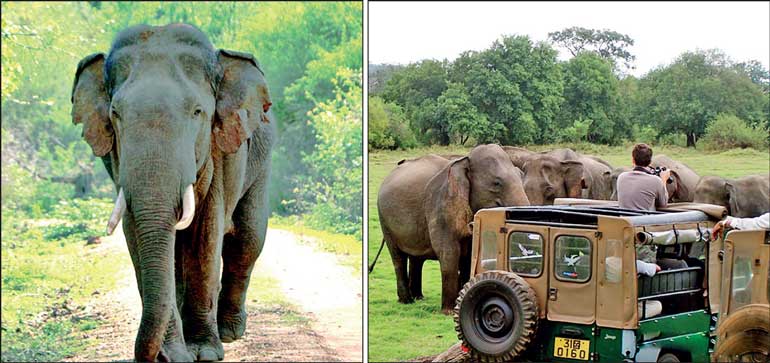
 Sri Lanka possesses one of the largest remaining populations of wild Asian elephants in the world, estimated at approximately 6,500 individuals. Simultaneously, the country faces one of the highest rates of elephant mortality globally, due to the escalating Human-Elephant Conflict (HEC). While extensive research has been undertaken on ecological and conservation aspects of elephants, relatively little work has focused on evaluating their direct economic contribution to Sri Lanka’s tourism industry.
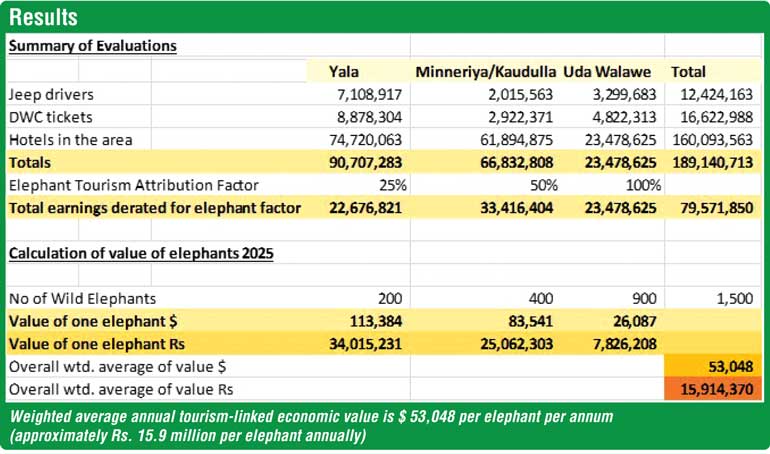
This article summarises a study done to attempt a preliminary tourism-economic valuation of wild elephants in three of Sri Lanka’s most prominent wildlife tourism ecosystems, Yala National Park, the Minneriya-Kaudulla ecosystem, and Uda Walawe National Park. Using a combination of tourism accommodation revenue, safari jeep earnings, and Department of Wildlife Conservation (DWC) park entrance revenue, adjusted through a tourism-attribution factor, the study estimates the annual tourism-linked economic value generated by wild elephants.
In 2020 I published a similar study, which has now been further refined and updated based on new research and data, and adjusted for enhanced dollar parity rates.
Introduction
From ancient times to the present day, Sri Lanka’s elephants have fascinated naturalists and tourists alike. The sheer majesty, intelligence, size and behavioural complexity of the Asian elephant continue to make it one of the most charismatic wildlife species in the world.
Wildlife tourism has now become one of the most important segments of Sri Lanka tourism. Among wildlife attractions, elephants occupy a particularly significant position in Sri Lanka due to the relative ease of sightings, large elephant densities and globally recognised wildlife spectacles such as “The Gathering,”
In 2025 (the year in which this study is based) almost 50% of all tourists arriving to Sri Lanka, visited at least one wildlife national park. In Sri Lanka wildlife based tourism supports a wide range of stakeholders, including hotels, restaurants, safari jeep drivers, guides and local SME communities.
At the same time, Sri Lanka faces an intensifying Human-Elephant Conflict (HEC), which is increasing due to habitat fragmentation, encroachment, haphazard development and agricultural expansion and weak wildlife management policies. The country currently records one of the highest annual wild elephant death rates globally, with over 400 elephant deaths recorded annually in some recent years.
While the ecological and ethical dimensions of elephant conservation are widely discussed, comparatively little attention has been paid to the economic contribution generated by living wild elephants to Sri Lanka’s tourism industry.
The study
The study focuses on three major elephant-related tourism ecosystems in Sri Lanka, namely Yala, Minneriya-Kaudulla ecosystem and the Uda Walawe National Park ecosystems for the year 2025.
They were chosen because they represent the country’s most prominent elephant-viewing destinations, attract substantial foreign and domestic visitation and support extensive tourism infrastructure. (In 2025 these three ecosystems attracted about 50% of all tourists visiting Sri Lanka’s wildlife parks)
Evaluation of tourism revenue components
The analysis incorporates only three primary tourism revenue streams:
1. Safari jeep revenue: Estimated annual revenue generated by safari jeep operators associated with each ecosystem.
2. DWC entrance revenue: Annual park entrance fee revenue accruing to the Department of Wildlife Conservation.
3. Accommodation revenue: Estimated annual accommodation revenue generated by tourism establishments operating within the wider tourism ecosystem associated with each park.
Of course there are many other informal tourism inflows but they are difficult to capture.
Accommodation estimates include luxury lodges, conventional hotels, safari camps, guesthouses and homestays, and informal tourism establishments visible through online booking platforms and local market assessment. Accommodation inventories and rates were compiled using a combination of SLTDA statistics, online booking platform inventories, Google Travel listings and market observations of informal accommodation establishments
Elephant tourism attribution factor
Not all tourism revenue generated within a destination can be attributed solely to elephants. Therefore, an “Elephant Tourism Attribution Factor” was applied to estimate the proportion of tourism activity directly linked to elephant attraction.
The attribution factors that were used are as follows:
Yala National Park - 25%
Yala tourism is significantly a leopard centric wildlife park, and is said to have the highest density of leopards in block 1 of the park. However elephants form an important but secondary component. The elephant population within the park is also relatively less. (In Sri Lanka it is estimated that some 65% of wild elephants reside outside national parks which leads to high HEC)
Minneriya-Kaudulla - 50%
The elephant “Gathering” forms one of the primary drivers of visitation, although cultural tourism and Sigiriya-related circuit tourism also contribute substantially. Moreover the “the Gathering” is a very season phenomena occurring generally between the months of July-October, where a large number of elephants congregate at the Minneriya and Kaudulla reservoirs.
Uda Walawe - 100%
Tourism within the Uda Walawe region is overwhelmingly dependent on elephant viewing. The park is well known as one of the best places to see wild elephants the year round.
Estimated elephant populations
The analysis used estimated tourism-visible resident wild elephant populations associated with each ecosystem.
These figures do not necessarily represent total ecological elephant populations, but rather economically active, and relatively resident, tourism-visible elephant populations regularly contributing to tourism activity. They are based on research done by leading elephant experts.
Discussion
The findings clearly demonstrate that living wild elephants generate substantial recurring economic value for Sri Lanka tourism. It should be noted that the valuation derived in this study applies primarily to tourism-visible elephant populations within major tourism ecosystems, and should not be directly extrapolated to the entire national elephant population.
The valuation highlights the differences between ecosystems.
Yala
Yala demonstrates the highest per-elephant value due to premium safari pricing, high accommodation rates, well-known international branding and intensive wildlife tourism demand. However it has a lower density of elephants in relation to visitation.
Minneriya-Kaudulla
The globally recognised “Gathering” phenomenon creates concentrated tourism value through high seasonal elephant aggregation. There are many star class hotels, and large number of smaller accommodation establishments in the area.
Uda Walawe
Uda Walawe has the largest elephant population but has only a few high end conventional hotels in the area. But there a number of smaller establishments. Hence the per-elephant value is lower, but the destination demonstrates how a large elephant population can sustain a broad-based and inclusive tourism economy built around relatively affordable wildlife tourism.
On an overall basis the study highlights that wild elephants are major economic assets. They should be viewed not only as wildlife requiring protection, but also as recurring economic generators supporting regional economies and livelihoods.
Limitations of the study
This study represents a preliminary tourism-economic valuation model and has several limitations.
The analysis does not include the revenue accruing to numerous other informal service providers such as wayside restaurants, souvenir sellers etc. Nor does the study take into consideration the biodiversity and international brand values of the attraction.
In addition, some tourism revenue assumptions are based on market estimates and online accommodation inventories, due to limited availability of comprehensive formal tourism statistics.
Accordingly, the findings should be interpreted as indicative rather than absolute valuations.
Conclusion
Sri Lanka’s wild elephants represent one of the country’s most important natural tourism assets.
This analysis indicates that elephant-related tourism ecosystems generate tens of millions of the dollars annually and support extensive tourism-related livelihoods.
The weighted average tourism-linked economic value of a single wild elephant within selected tourism ecosystems is estimated at approximately $ 53,000 (Rs. 16 million) annually.
(A similar study undertaken by the author in 2020 estimated the tourism-linked value of a wild elephant at approximately $ 21,400 annually. The higher valuation derived in the present study reflects growth in wildlife tourism, increased accommodation inventory, higher tourism receipts, higher dollar parity rates and refinement of the methodology)
At a time when Sri Lanka continues to lose hundreds of elephants annually through the Human-Elephant Conflict, these findings underline the urgent need for stronger conservation measures and recognition of wildlife as a strategic component of the national economy.
In economic terms, a living elephant generates recurring value year after year, while a dead elephant generates none. The findings of this study therefore reinforce the proposition that elephant conservation is not only an environmental responsibility but also a sound economic investment for Sri Lanka.
The next time we hear of another elephant death, perhaps we should remember that Sri Lanka has not merely lost an animal, but a valuable economic asset.
(The full paper can be accessed at ResearchGate and Academia)



