Sunday Sep 13, 2026
Sunday Sep 13, 2026
Friday, 10 July 2026 00:26 - - {{hitsCtrl.values.hits}}
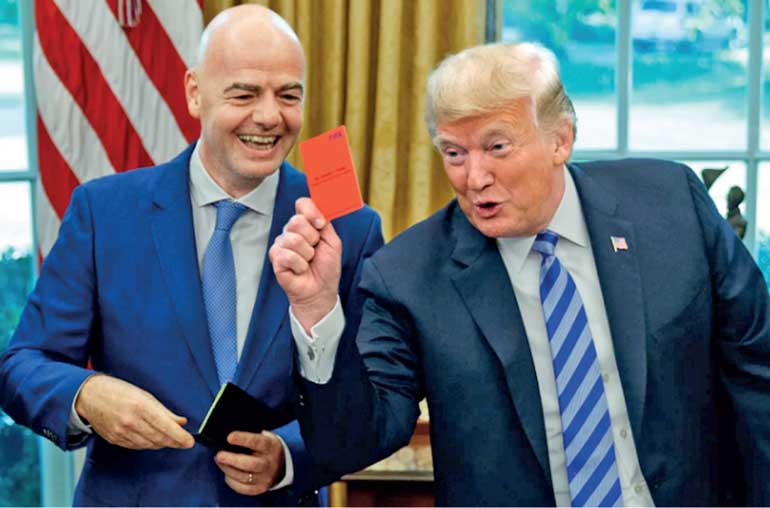
Gianni Infantino (left) and Donald Trump have contributed significantly to making politics in football more visible
 There was a time when the FIFA World Cup was simply about football. It was a month-long festival in which the world’s finest footballers competed for the game’s ultimate prize while the rest of humanity suspended its differences in favour of ninety minutes of shared passion.
And politics, if it intruded at all, was expected to remain outside the touchline. But not anymore.
The FIFA World Cup 2026 may ultimately be remembered less for the team that lifts the trophy than for the uncomfortable questions it has raised about power, legitimacy and the state of the international order.
In that sense, ‘the beautiful game’ has become an uncomfortable mirror held up to the world.
For one, does this World Cup showcase America’s confidence in its supremacy in many arenas – or does it expose the anxious underbelly of US sabre-rattling?
For another, does the overturning of a US forward’s suspension say more about the spine of FIFA or the show of force by the United States against a small but formidable nation?
Then again, has football become another proxy arena where the sport of geopolitics is played out before a watching world – perhaps the latest twist of “the prosecution of war by other means”?
Last but not least, does this tournament reflect a transition away from a rules-based international order to one increasingly shaped by personalities, spheres of influence, and the intrusion of transactional politics into sports – or are we simply seeing at large a very public version of dynamics that have always existed?
The tournament itself has unfolded against the backdrop of wars, geopolitical rivalry, migration disputes, and rising nationalism. These realities have seeped into football itself. And FIFA’s long-standing assertion that there is “no politics in sport” has become increasingly difficult to sustain.
That is not because football has become political overnight, but because politics never really left the bounds of the stadium. It has merely become more visible.
Fie on your fiefdoms
Consider the contrasting treatment of Russia and Israel. FIFA suspended Russia following its invasion of Ukraine, while calls to sanction Israel over the war in Gaza – to say nothing of allegations of genocide – have thus far not resulted in comparable action. FIFA argues that each case has its own legal, procedural and factual circumstances.
Yet many observers see a different picture: not one of consistent principles, but one of selective application. Therefore whether that perception is entirely fair is almost beside the point.
Institutions derive authority not merely from the correctness of their decisions, but from public confidence that similar situations are treated according to similar standards. Once that confidence begins to erode, every subsequent decision is viewed through a lens of suspicion.
To wit: Is FIFA capable of acting as an independent global institution? Or is it also beginning to behave like a bevy of other international institutions? Which publicly vow to remain neutral but privately bow in response to power and pressure?
A bane on the beauty of it
The United States’ role as one the hosts of the 2026 Cup has further complicated matters by blurring the boundaries between a beautiful game and the bane of geopolitics.
America remains the world’s foremost military, economic and cultural power. And its dominance is simultaneously manifest and yet, often challenged, or suspected to be on the cusp of a slide towards decline. Dominating the largest sporting event on the planet inevitably becomes an exercise in soft power to restore or reassert its erstwhile image. And hosting the FIFA Football World Cup 2026 has rapidly become part of the US’s soft power arsenal. It is the projection of national prestige through spectacle rather than force.
There is nothing inherently unusual about that. Every host nation seeks to present itself in the best possible light. However this tournament has prompted wider questions about where hospitality ends and influence begins.
Controversies surrounding visa arrangements, security measures, access to facilities and the treatment of particular delegations have fuelled debate about the extent to which a host Government’s domestic and foreign policies inevitably shape an ostensibly global sporting event.
Then came the controversy over the reversal of US forward Folarin Balogun’s suspension following high-level political intervention. Whatever the legal merits of the decision, the episode created an impression that football’s judicial processes were vulnerable to political pressure.
Belgium’s emphatic victory over the United States may have settled the matter, and the little European nation rubbing it in after their victory – “reverse that!” chortled the memes – but it did little to quieten questions about FIFA’s governance off the pitch.
Matters have become Messi
The refereeing controversies have only added to the unease.
Supporters of Egypt remain aggrieved by the disallowing of what many regarded as one of the tournament’s finest goals after an earlier infringement was identified by VAR, while other incidents involving leading teams have generated accusations of inconsistency. Germany, whom I for one followed, left the game aggrieved at dodgy decisions.
Then there is Lionel Messi; who, as football’s greatest living icon (sorry, all you fans of Cristiano Ronaldo!), inevitably attracts extraordinary scrutiny. Every decision involving him is interpreted by some as evidence of favouritism and by others as the unavoidable consequence of refereeing under intense public pressure.
Football supporters have always believed that the game’s giants receive the benefit of the doubt. Argentina are always right! Brazil has the blue-eyed boys! Colombia can do no wrong! Perhaps they always will back their guys… even if Germany or Portugal or England were simply outplayed on that day?
VAR the FIFA is going on?
The point is not whether every controversial decision reflects bias. Human error remains part of football despite technological assistance. The point is that inconsistency, or the appearance of inconsistency, corrodes trust.
That matters because FIFA is not merely a tournament organiser. It is one of the world’s most recognisable international institutions. Like the United Nations, the World Bank and the International Monetary Fund, or the International Olympic Committee, its authority depends upon a belief that rules are applied fairly and transparently.
Once people cease to believe that, every decision becomes political by default. Rules appear to exist only until they inconvenience or irritate – maybe even embarrass a bit – the great powers. Perhaps that is the larger lesson of World Cup 2026. Geopolitics wears football boots these days…
And in such a milieu, the standing order – where institutions depend on legitimacy, legitimacy depends on consistency, and consistency is hard to sustain in the face of superpower insistence – crumbles.
Things fall apart
For decades, the post-war international order rested on the assumption that institutions could moderate power. Rules would constrain the strong as well as protect the weak. It was never a perfect system, but it represented an aspiration towards impartiality.
However, we increasingly appear to inhabit a world in which many citizens instinctively assume the opposite: that institutions adapt themselves to accommodate the powerful.
Sometimes that assumption is justified. Sometimes it is not. Either way, it reflects a profound crisis of confidence.
Sport has always reflected society more faithfully than we care to admit. During the height of the Cold War, for instance, Olympic medal tables became proxies for ideological competition. In Apartheid’s darkest hours, sporting boycotts became instruments of moral pressure.
Today the boot is on the other foot. The IOC as much as UEFA and FIFA have discovered what political theorists have known for centuries: neutrality is itself a political choice.
The centre cannot hold
And today, football also finds itself caught in a world of sanctions, contested narratives, social media outrage and geopolitical rivalry. The pitch has become another arena in which international politics is performed. This is not merely FIFA’s problem. It is our under-challenge civilisation’s dilemma.
The institutions built after the Second World War were founded on the conviction that rules mattered more than raw power. Those institutions are now under pressure from every direction. There is resurgent nationalism, transactional diplomacy, technological disruption and declining public trust. Things fall apart, the centre cannot hold.
Football cannot escape these anarchical currents. Nor should FIFA, its critics or the game’s fans pretend that it can.
What it can do is recognise that legitimacy remains its most valuable asset. Every disputed disciplinary decision, every opaque governance process and every perception of unequal treatment chips away at that legitimacy.
Mere anarchy is let loose
Ultimately, the greatest danger facing FIFA is not that supporters disagree with its decisions. It is that they cease to believe its decisions are made according to the same rules for everyone.
George Orwell captured the danger of this truth with chilling simplicity in his prophetic Animal Farm: “All animals are equal, but some animals are more equal than others…”
No international institution can afford to let that become its epitaph.
With ten days to go, the Football World Cup of 2026 is still producing moments of extraordinary athletic excellence. The goals are spectacular, perhaps some saves more so, the thronging crowds breathtaking and gobsmacked at the same time, and the football often sublime if occasionally ridiculous.
Yet beyond the roar of the sports stadiums, another contest is taking place. It is a contest for the credibility of controlling bodies and countries represented in the middle alike.
And the outcome of who wins – or is perceived to have done so – may prove the most consequential result of all.
(The writer is the Editor-at-large of LMD and is a senior journalist with a Post-graduate Diploma in Politics and Governance)




