Saturday Oct 03, 2026
Saturday Oct 03, 2026
Wednesday, 18 February 2026 00:24 - - {{hitsCtrl.values.hits}}
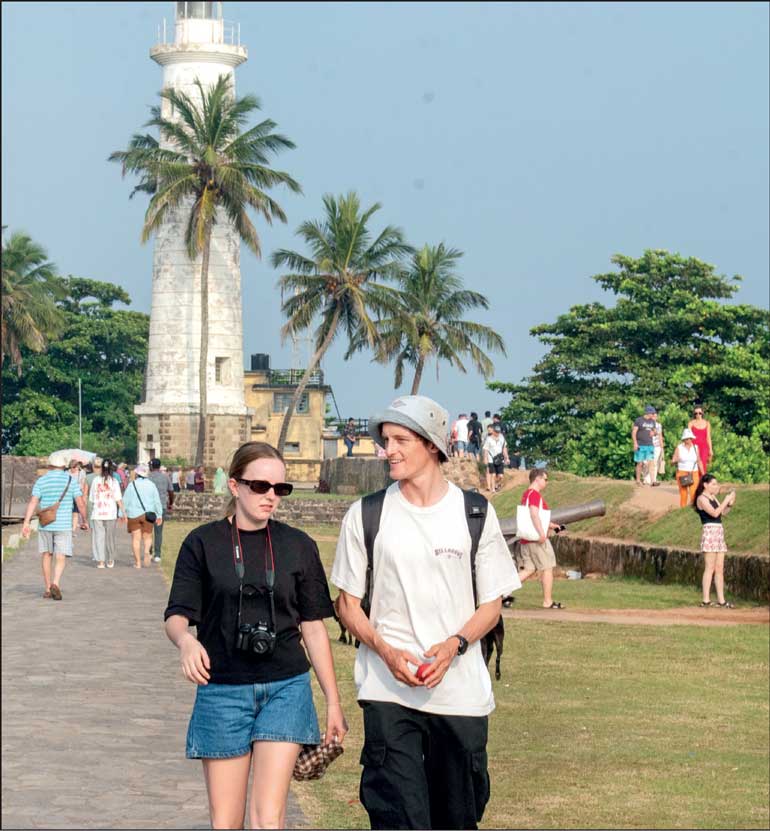
Tourists enjoying Galle Fort – Pic by Ruwan Walpola
 Sri Lanka stands at a critical crossroads in its tourism development. As visitor numbers steadily increase, we face a fundamental choice: pursue volume-based tourism that prioritises quantity over quality or implement a premium tourism model that maximises revenue per visitor while preserving our natural and cultural assets.
The math is clear: it is far more profitable to attract 500 high-spending tourists than 5,000 budget travelers. This article presents a business case for transforming Sri Lanka into a premium tourism destination, drawing on successful models from the UAE, Bhutan, and Maldives.
Business case: Quality over quantity
Current tourism revenue in Sri Lanka significantly underperforms our potential. While we attract tourists with reasonable spending power, our infrastructure, positioning, and marketing strategies fail to capture maximum value from each visitor.
The mathematics are straightforward: doubling tourism revenue does not require doubling tourist arrivals. Instead, we need to attract visitors who spend 2-3 times more per day and stay longer. Premium tourists not only spend more on accommodation and dining but also on experiences, wellness services, cultural activities, and high end shopping.
The UAE model: $ 70 billion in annual tourism revenue
The United Arab Emirates provides the most relevant blueprint for Sri Lanka. Despite having fewer natural attractions than Sri Lanka, the UAE generated over $ 70 billion in tourism revenue in 2025 from approximately 20 million visitors which is about $ 3,500 revenue per tourist.
Key success factors:
 Strategic foreign investment controls: The UAE requires local partnerships and Emirati ownership stakes in many sectors. This ensures profits remain in the country and nationals benefit from tourism wealth through business opportunities and government revenue distribution.
Premium infrastructure development: Rather than building basic accommodation for mass tourism, the UAE invested in luxury hotels, world class shopping, and premium entertainment venues that command higher prices.
Targeted marketing to high-value segments: The UAE specifically markets to luxury travelers, business tourists, and high-net-worth individuals and not backpackers or budget travelers.
The Bhutan model: Minimum daily fees for maximum value
Bhutan implements a sustainable development fee of $100 per tourist per day. This generates substantial revenue from a limited number of visitors, funding free healthcare and education for citizens while ensuring tourists receive exclusive, uncrowded experiences.
The strategy achieves multiple business objectives simultaneously: higher per visitor revenue, reduced environmental impact, preservation of cultural authenticity, and enhanced visitor satisfaction due to uncrowded attractions.
Sri Lanka’s competitive advantages
To command premium prices, we must deliver premium experiences. Sri Lanka possesses significant competitive advantages that remain underdeveloped:
1. Natural assets
Sri Lanka offers diverse landscapes within a compact area: pristine beaches, mountains, rainforests, and wildlife. However, our coastal areas suffer from cleanliness issues and lack of organisation. Significant investment in cleaning, maintaining, and developing these beaches is essential. The Maldives transformed their islands into luxury destinations commanding $500-2,000 per night. Our beaches, with proper development, can compete in this market.
2. Cultural and historical heritage
Ancient cities like Sigiriya, Polonnaruwa, and Anuradhapura are world class archaeological sites. Currently, these locations lack the infrastructure and organisation seen at comparable sites in other countries. Investment in site management, visitor facilities, and professional guide services would justify premium entry fees and extended visits.
3. Authentic ayurveda and wellness
Global wellness tourism is projected to reach $1.3 trillion by 2025. Sri Lanka’s authentic Ayurvedic traditions provide a unique selling proposition. Premium wellness resorts in India charge $300-500 per day for similar treatments. We should be competing with these price points, not offering budget alternatives.
4. Medical tourism opportunity
Sri Lanka has highly skilled doctors and surgeons but lacks modern medical equipment. Turkey’s medical tourism industry generates $2.5 billion annually by combining quality healthcare with tourism. Investment in high-tech medical equipment would allow Sri Lanka to attract wealthy patients seeking elective procedures, dental work, and specialised treatments at competitive prices while receiving care in a tropical paradise.
Strategic implementation framework
Phase 1: Infrastructure and standards (Years 1-2)
Immediate investment in cleaning and maintaining key tourist areas. Establish and enforce cleanliness standards for beaches, archaeological sites, and tourist towns. Develop professional training programs for hospitality staff to deliver five-star service. Upgrade facilities at major attractions to international standards.
Phase 2: Market repositioning (Years 2-3)
Shift marketing focus from budget travelers to premium segments. Target wealthy retirees seeking cultural experiences, luxury travelers wanting unspoiled beaches, wellness tourists seeking authentic Ayurveda, and adventure tourists wanting uncrowded surf and hiking.
Cease marketing to backpackers seeking cheap experiences, party tourists looking for beach clubs, and long-term digital nomads. These segments generate minimal revenue while consuming significant resources.
Phase 3: Premium product development (Years 3-5)
Develop luxury accommodations in key locations. Create exclusive experiences (private archaeological site tours, luxury wildlife safaris, high-end Ayurvedic retreats). Establish world class medical tourism facilities in partnership with international hospital groups. Implement carrying capacity limits to prevent overcrowding and environmental damage.
Phase 4: Investment controls (Ongoing)
Require majority Sri Lankan ownership in tourism ventures. Mandate local employment and training programs. Ensure tourism profits circulate within the Sri Lankan economy through local procurement requirements. Create incentive structures for Sri Lankan entrepreneurs to develop premium tourism businesses.
Revenue projections: The path to $ 8 billion
Current scenario (approximate): 1.5 million tourists spending an average of $150 per day for 10 days = $2.25 billion annual revenue.
Premium tourism scenario: 1.2 million tourists spending an average of $400 per day for 12 days = $5.76 billion annual revenue.
Add medical tourism revenue: 100,000 medical tourists spending $5,000 per visit = $500 million.
Add wellness tourism premium: 200,000 wellness-focused visitors spending extra $1,000 per trip = $200 million.
Total projected revenue: $ 6.46 billion
With continued growth and premium positioning, exceeding $8 billion by 2030 is achievable with fewer tourists than a mass-market approach would require.
Ensuring economic benefits remain in Sri Lanka
Tourism revenue means nothing if profits leave the country. The UAE model demonstrates that foreign investment can be welcomed while ensuring local ownership and benefit:
Require majority Sri Lankan ownership in hotels, resorts, and major tourist facilities. Allow foreign management expertise and investment but mandate controlling stakes for Sri Lankan partners. Implement regulations requiring employment of Sri Lankan staff at all levels, with mandatory training and development programs.
Establish local procurement requirements: hotels must source food, supplies, and services from Sri Lankan businesses where possible. Create favorable financing for Sri Lankan entrepreneurs to develop tourism businesses. Use tourism revenue to fund infrastructure improvements in tourist areas that benefit local communities.
Vision 2030: Premium destination, maximum revenue
If we implement this premium tourism model, Sri Lanka in 2030 will be:
A destination known for exclusivity and quality, not cheap prices. Every major hotel and resort will be majority-owned by Sri Lankans. Tourism revenue will exceed $8 billion annually with fewer environmental and social pressures than mass tourism.
Arugam Bay, Mirissa, and Tangalle will be recognised as world-class luxury destinations. Archaeological sites will be properly maintained with carrying capacity limits ensuring preservation. A thriving medical tourism sector will provide world-class care in a tropical setting.
Local communities will benefit from well-paid employment and business opportunities. The natural environment will be preserved through sustainable tourism practices. Cultural heritage will be protected and valued, not commodified.
A professional hospitality industry with international standards and Sri Lankan ownership will emerge. Tourism profits will be reinvested in education, healthcare, and infrastructure for citizens.
The choice is economic
This is not about rejecting tourism, but it is about maximising tourism revenue while preserving the assets that make Sri Lanka attractive. The business case is clear, premium positioning generates higher returns with less environmental and infrastructure stress than mass tourism.
The UAE and Bhutan prove that smaller tourist numbers can generate greater revenue. The Maldives demonstrates that premium pricing works for island destinations. Turkey shows that medical tourism can add billions to tourism revenue.
We have the natural assets, cultural heritage, and human capital to compete at the premium level. What we need is strategic investment, proper regulation, and commitment to quality over quantity.
The choice before us is economic: build an $8 billion tourism industry that benefits Sri Lankans, or chase tourist numbers that generate less revenue while creating more problems. The smart money is on premium tourism.
(The author is an entrepreneur running an AI agency and have been analysing tourism economics and sustainable development models)
References
UAE Tourism Revenue
Times of Dubai (2025). “UAE Tourism Industry Shatters Records: Revenue Soars Past $70 Billion in 2024.” https://timesofdubai.ae/uae-tourism-industry-shatters-records-revenue-soar/
UAE Ministry of Economy and Tourism (2024). “The Contribution of the Travel and Tourism Sector to the UAE’s GDP 2024.” https://www.moet.gov.ae/en/-/the-contribution-of-the-travel-and-tourism-sector-to-the-uae-s-g-1
World Travel and Tourism Council (2025). “International Traveller Spend in the UAE to Reach a Record AED 228BN This Year.” https://wttc.org/news/international-traveller-spend-uae-to-reach-a-record-aed-228bn
Bhutan Sustainable Development Fee
VisitBhutan.com. “Sustainable Development Fee.” https://www.visitbhutan.com/page.php?id=68
CNBC (2024). “Bhutan May Revise Its Sustainable Development Fee if Travel Picks Up.” https://www.cnbc.com/2024/05/21/bhutan-may-revise-its-sustainable-development-fee-if-travel-picks-up.html
TravelAge West (2023). “Bhutan Halves Daily Tourism Fee Through September 2027.” https://www.travelagewest.com/Travel/Asia-Pacific/bhutan-sustainable-development-fee
Global Wellness Tourism Market
Global Wellness Institute (2022). “New Data on Wellness Tourism: Projected to Hit $817 Billion This Year, $1.3 Trillion in 2025.” https://globalwellnessinstitute.org/global-wellness-institute-blog/2022/01/11/industry-research-new-data-on-wellness-tourism-projected-to-hit-817-billion-this-year-1-3-trillion-in-2025/
Global Wellness Institute (2025). “The Global Wellness Economy Hits a Record $6.8 Trillion and Is Forecast to Reach $9.8 Trillion by 2029.” https://globalwellnessinstitute.org/press-room/press-releases/the-global-wellness-economy-hits-a-record-6-8-trillion-and-is-forecast-to-reach-9-8-trillion-by-2029/
Straits Research. “Wellness Tourism Market Size, Global Trends & Growth Forecast by 2033.” https://straitsresearch.com/report/wellness-tourism-market
Turkey Medical Tourism
TRT World (2024). “Turkey Ranks Among Top 10 Health Tourism Destinations Globally.” https://www.trtworld.com/article/17798805
Fine Up Clinic (2024). “Health Tourism Statistics in Turkey 2024.” https://fineupclinic.com/blog/health-tourism-statistics-in-turkey-2024/
Mordor Intelligence. “Turkey Medical Tourism Market Size.” https://www.mordorintelligence.com/industry-reports/turkey-medical-tourism-market
Sri Lanka Tourism Statistics
Sri Lanka Tourism Development Authority (2024). “Annual Statistical Report 2024.” https://www.sltda.gov.lk/storage/common_media/Annual_Statistical_Report_2024.pdf
Daily FT (2025). “Tourist Arrivals Grow by 38% to 2 Million in 2024.” https://www.ft.lk/front-page/Tourist-arrivals-grow-by-38-to-2-m-in-2024/44-771305
Skift (2024). “Is This the Comeback of Sri Lanka’s Tourism? $1.5 Billion Revenue Suggests So.” https://skift.com/2024/07/10/is-this-the-comeback-of-sri-lankas-tourism-a-1-5-billion-revenue-suggests-so/
Road Genius (2025). “Sri Lanka Tourism Statistics.” https://roadgenius.com/statistics/tourism/sri-lanka/



