Wednesday Oct 21, 2026
Wednesday Oct 21, 2026
Tuesday, 31 March 2026 04:21 - - {{hitsCtrl.values.hits}}
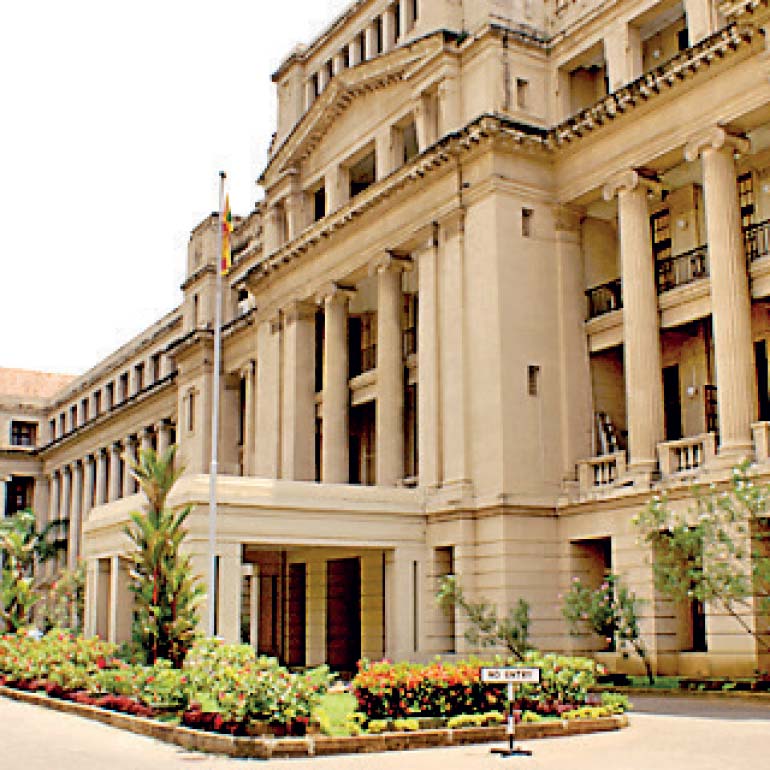
Finance Ministry
 Sri Lanka’s current debt situation is not merely a numerical issue, but the outcome of a deep systemic imbalance among economic structure, public financial management, and policy decisions
This article presents a quantitative and critical analysis of the volume, composition, and utilisation of public debt in Sri Lanka during the period 2024–2026. In general discourse, attention is primarily focused on the size of debt alone. However, this article reveals a broader economic reality by examining the interconnections among debt sources, patterns of utilisation,and repayment capacity.
In particular, when factors such as high debt-to-national-income ratios, limited revenue-generating capacity, and a heavy reliance on recurrent expenditure are considered together,
Sri Lanka’s debt problem appears not merely as a numerical issue, but as the outcome of a systemic imbalance. Furthermore, the article highlights that external factors—such as geopolitical instability in the Middle East—are likely to further intensify these challenges.
 Introduction
During the period from September 2024 to March 2026, a multi-layered discourse has emerged regarding the volume of debt obtained by the Government of Sri Lanka and the manner in which it has been utilised. Within these discussions, particular attention has been given to the increase in debt levels. While this is a valid and necessary concern, it is essential not to accept the issue at face value, but rather to analyse it critically within a broader economic context.
The primary focus should not be limited to the narrow question of “how much debt has the Government borrowed?” but should instead extend to a broader set of questions: “from where has this debt been obtained, for what purposes has it been used, and what is the country’s capacity to repay it?” In other words, a complete and accurate understanding of the economic picture can only be achieved by analysing the interconnections among debt volume, utilisation, and revenue-generating capacity.
Within this context, it is estimated that by the end of 2023, Sri Lanka’s total public debt stood between Rs. 27–30 trillion (Central Bank of Sri Lanka, 2023; IMF, 2024). At the same time, the debt-to-GDP ratio is observed to be in the range of 110%–128%, while the burden of debt servicing relative to Government revenue remains at a high level of approximately 60%–70%. In addition, the revenue-to-GDP ratio stands at only around 8%–10%, which is considered a structural fiscal weakness (World Bank, 2023).
Against this backdrop, it becomes evident that during the period 2024–2026, Sri Lanka is not on a path of deleveraging, but rather in a transitional phase centred on debt restructuring and economic stabilisation. Therefore, this article seeks to provide a deeper and more comprehensive understanding by analysing not only the size of debt, but also its utilisation, structure, and policy implications.
Total Public Debt as at end-2023
As at the end of 2023, Sri Lanka’s total public debt is estimated to be between Rs. 27–30 trillion. The debt-to-GDP ratio exceeds the commonly accepted safe threshold of 70% and remains within the range of 110%–128% (CBSL, 2023; IMF, 2024). In addition, the burden of debt servicing relative to Government revenue is at a very high level, in some instances reaching approximately 60%–70% of revenue. At the same time, Government revenue as a percentage of GDP stands at only around 8%–10%, which is below the required level for emerging economies.
When these indicators are considered together, a clear imbalance emerges between the rising debt burden and the country’s limited revenue-generating capacity.
Furthermore, the composition of debt and external economic linkages intensify this vulnerability. It is estimated that approximately 40%–45% of total debt is external, making the country highly sensitive to exchange rate fluctuations. Moreover, imports account for around 25%–35% of GDP, while exports remain at only about 20%–22%, resulting in a trade deficit and increasing the demand for foreign exchange (World Bank, 2023).
Consequently, external debt repayments depend heavily on export earnings and foreign employment income. Under these conditions, new borrowing often appears to be used for servicing existing debt, thereby creating a debt cycle that does not contribute to long-term economic growth.
Therefore, Sri Lanka’s debt problem should not be understood merely as a numerical issue, but rather as a manifestation of a deep structural imbalance among revenue capacity, economic structure, and patterns of debt utilisation.
Debt situation during the 2024–2026 period
An analysis of Sri Lanka’s debt utilisation patterns during the period 2024–2026 clearly indicates that new borrowing has been used primarily not to generate economic growth, but to manage existing debt and support short-term stabilisation.
Under the International Monetary Fund program, a significant portion of the funds obtained has been directed toward debt servicing, interest payments, and requirements related to debt restructuring (IMF, 2024). In addition, based on the composition of Government expenditure, a high proportion is allocated to recurrent expenditure, while capital expenditure remains relatively limited. Typically, nearly 70% of total Government expenditure is directed toward recurrent expenditure, while capital expenditure accounts for around 20%–30% (CBSL, 2023).
This pattern of utilisation demonstrates that borrowing is being used to sustain existing fiscal pressures rather than to enhance revenue-generating capacity. In particular, the use of new borrowing to repay existing debt (debt rollover) further reinforces a debt cycle, thereby constraining long-term economic growth. Moreover, the import-dependent economic structure and shortages in foreign exchange further reduce the efficiency of debt utilisation.
Accordingly, during the period 2024–2026, Sri Lanka’s borrowing can be characterised not as growth-oriented borrowing, but rather as survival-oriented borrowing. This clearly represents a significant challenge to long-term economic stability.
Future challenges
An analysis of Sri Lanka’s current economic condition clearly indicates that the country has not yet fully emerged from the crisis. It is not in a phase of debt reduction, but rather has entered a stage of debt restructuring and stabilisation. Total public debt remains at a high level, and a debt-to-GDP ratio exceeding 100% raises serious concerns regarding debt sustainability.
Although debt restructuring has been implemented under the International Monetary Fund program, it primarily serves as a short-term relief measure, and a comprehensive long-term solution has yet to be achieved. Furthermore, the fact that new borrowing is largely used for debt rollovers and short-term economic stabilisation indicates that the country remains in a debt stabilisation stage.
Moreover, the current pattern of debt utilisation and the overall economic structure further deepen future challenges. A significant portion of borrowed funds is directed toward servicing existing debt, financing recurrent Government expenditure, and maintaining short-term stability, thereby limiting productive investment. At the same time, despite efforts to increase Government revenue, the high burden of debt servicing and expenditure levels constrain fiscal space.
In terms of foreign exchange, reliance on export earnings and foreign employment income, combined with an import-dependent economic structure, continues to expose the country to external economic risks.
Within this context, ongoing geopolitical instability in the Middle East represents an additional source of pressure for an import-dependent economy such as Sri Lanka. In particular, volatility in fuel prices, security risks along key maritime routes, and potential impacts on foreign employment income could weaken the country’s foreign exchange position and overall economic stabilisation process.
In effect, the interaction between internal economic imbalances and external instability creates a condition of double vulnerability for Sri Lanka.
Despite positive signals such as declining inflation, exchange rate stabilisation, and support from the International Monetary Fund, economic growth remains weak, private investment is low, and cost-of-living pressures persist. These conditions confirm that significant and complex policy challenges lie ahead.
“The interaction of internal imbalances and external instability creates a condition of double vulnerability for Sri Lanka.”
Moving forward requires not only controlling the volume of debt, but also transforming the manner in which it is utilised and the policy decision-making framework that underpins it. Only through productive investment, revenue growth, and strong public financial management can Sri Lanka transition from a debt-dependent economy to one characterised by stable and sustainable long-term growth
Conclusion remarks
This analysis demonstrates that Sri Lanka’s current debt situation is not merely a numerical issue, but the outcome of a deep systemic imbalance among economic structure, public financial management, and policy decisions. During the period 2024–2026, the country is not on a path of debt reduction, but rather in a stabilisation phase based on debt management and restructuring.
New borrowing is largely used not to generate economic growth, but to manage existing fiscal pressures. This further intensifies the imbalance between the quality of debt utilisation and the country’s revenue-generating capacity.
However, when one reads between the lines of these figures and reports, many unspoken realities become evident. Decisions related to borrowing and its utilisation are closely linked to policy priorities, political objectives, and the quality of governance. Therefore, analysing numbers alone is insufficient; it is essential to critically examine the decisions, priorities, and responsibilities that lie behind them.
Accordingly, moving forward requires not only controlling the volume of debt, but also transforming the manner in which it is utilised and the policy decision-making framework that underpins it. Only through productive investment, revenue growth, and strong public financial management can Sri Lanka transition from a debt-dependent economy to one characterised by stable and sustainable long-term growth.
In conclusion, Sri Lanka’s debt narrative is not merely a story of numbers—it is a comprehensive reflection of the country’s economic decisions, patterns of utilisation, and often unspoken priorities.
References
Central Bank of Sri Lanka (CBSL) (2023) Annual Report 2023. Colombo: Central Bank of Sri Lanka.
International Monetary Fund (IMF) (2024) Sri Lanka: Debt Sustainability Analysis and Program Review. Washington, DC: IMF.
Ministry of Finance (2026) Sri Lanka Government Debt Report: September 2024 – March 2026. Colombo: Ministry of Finance, Sri Lanka.
World Bank (2023) Sri Lanka Development Update: Restoring Stability and Growth. Washington, DC: World Bank.
International Energy Agency (IEA) (2023) Sri Lanka Energy Profile. Paris: IEA.




