Sunday Sep 13, 2026
Sunday Sep 13, 2026
Wednesday, 29 July 2026 00:25 - - {{hitsCtrl.values.hits}}

For decades, macroeconomics in Sri Lanka has operated in a Government of reactive panic. Sudden commodity price spikes, severe supply shortages, localised farming failures, and massive capital leakages within social safety nets are frequently diagnosed as isolated market anomalies or unpredictable natural disruptions. This diagnosis is profoundly incorrect. Sri Lanka’s fundamental failure is not one of resource scarcity, but an analytical crisis: the Government is structurally blind, guided by flawed data generated by fundamentally ineffective institutional arrangements.
The anatomy of a systemic failure
In the year 2026, the Government officially presented its landmark framework titled Prioritisation of Research for Sri Lanka – 2026 to the Presidential Secretariat. While this document represents a historic, well-intentioned baseline effort to coordinate national scientific investments across fifteen ministries, its structural layout inadvertently exposes the deep-seated legacy defects of the country's governance model. Spearheaded by the National Science and Technology Commission (NASTEC), the framework brought together over a hundred domain experts across various ministries to define broad priority research areas.
The report is explicitly partitioned into isolated, ministry-specific subcommittees, ensuring that the research pipeline mirrors the exact bureaucratic fragmentation it aims to fix.
This structural fragmentation ensures that the research and data pipelines mirror the exact bureaucratic divisions they are meant to cure. In an era where global markets and development agendas are governed by automated algorithms, predictive data science, and secure distributed ledgers, Sri Lanka continues to rely on static, descriptive statistics. The Government remains functionally blind, attempting to navigate a hyper-competitive global economy using corrupted data generated by ineffective institutional arrangements and data collection methods.
Ineffective institutional arrangements and sectoral tribalism
The primary barrier to rigorous scientific governance in Sri Lanka is institutional tribalism. When public research organisations and data collection arms operate directly under line ministries—such as the isolated frameworks governing Tea, Rubber, Coconut, and general food crops—the data they harvest ceases to be an objective economic indicator. Instead, it transforms into an instrument of advocacy for that specific sector’s political and economic survival.
Under the status quo, data collection is decentralised and heavily guarded. For example, an agricultural research institute functions to validate its own institutional existence and secure continuous Government subventions. Consequently, their data streams are inherently biased toward self-preservation. If a particular crop ecosystem is failing or completely inefficient compared to global markets, the parent institution is structurally disincentivised to report the raw macroeconomic truth. They will never recommend uprooting their target crop to make way for a high-return industrial zone or an alternative agricultural practice, because doing so is a declaration of their own obsolescence.
The Macroeconomic Axiom: The Government must view the entire country’s land and Government assets as a single, integrated production unit. A rational governance framework must continuously calculate the highest Return on Investment (ROI) per square meter of national territory, completely divorced from historical sentimentality or sectoral biases. Whether a plot of land should support an export crop, localised food synthesis, tech incubation infrastructure, or renewable energy grids must be determined purely by data-driven global trade variables and domestic equilibrium formulas, not by which line ministry holds the legacy title deed.
The flawed data paradigm: The sanitised hierarchy
The unscientific nature of Sri Lanka’s national database stems directly from how data is gathered within the civil service. Former Government employees and field specialists consistently document a phenomenon known as the "Sanitised Data Pipeline."
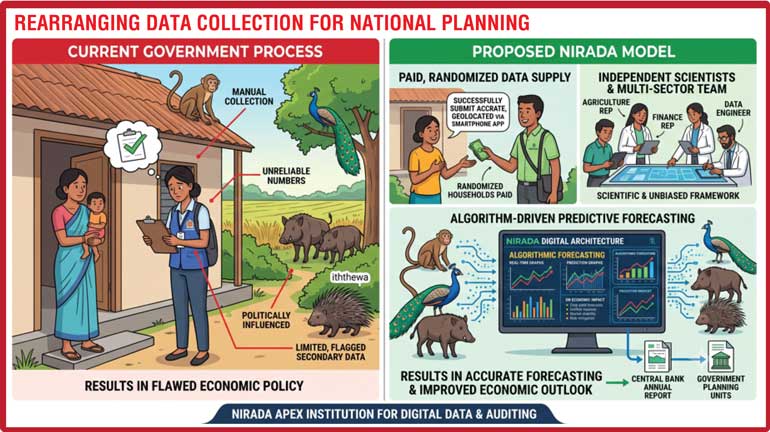
Data collection at the grassroots level is frequently executed by underpaid, non-specialised village officers or department representatives. Because this data collection is treated as a zero-accountability, bureaucratic checking exercise—leveraging unverified secondary data or unscientific verbal estimates— the raw input is fundamentally corrupted. As this data moves upward through the administrative strata, it undergoes successive layers of filtering, smoothing, and intentional sanitisation. Each level of the hierarchy modifies the data to please the leadership immediately above them, ensuring that final reports match political/official mandates rather than empirical realities.
The real-world consequences of this flawed data loop are catastrophic:
The tech frontier: Algorithmic Governance (AI, ML, and Blockchain)
The global marketplace has transitioned from descriptive analytics to prescriptive, algorithmic execution. Historical data has zero economic value unless it can be used to construct high-fidelity predictive models for future shocks, resource allocation, and market trends. Sri Lanka’s structural delay in adopting Artificial Intelligence (AI), Machine Learning (ML), and Blockchain (BC) tools permanently handicaps its global competitiveness.
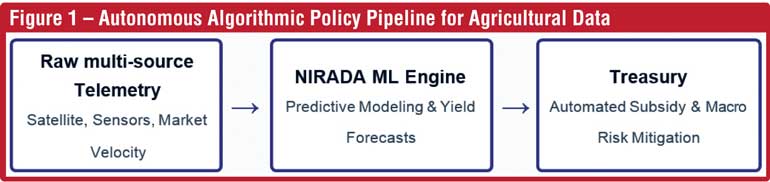
By embedding ML algorithms into national databases (should not take garbage in), the Government can bypass bureaucratic guesswork entirely. Predictive neural networks can synthesise multi-spectral satellite imagery, real-time climate telemetry, and micro-economic transaction velocities to forecast agricultural outputs with a high degree of mathematical certainty months before harvest. This eliminates the price volatility that routinely exploits both rural producers and urban consumers.
Furthermore, the implementation of Blockchain technology is no longer an optional innovation—it is a regulatory prerequisite for international trade. For instance, the European Union Deforestation Regulations (EUDR) require verifiable, immutable supply chain traceability down to the exact geolocated plot of land for commodities like tea and rubber. A fragmented, paper-based, or siloed ministerial database cannot comply with these standards, placing billions in export revenue at immediate risk. Utilising a decentralised, cryptographic ledger ensures tamper-proof compliance, automated data validation, and absolute international trust.
Institutional transformation: The NIRADA blueprint
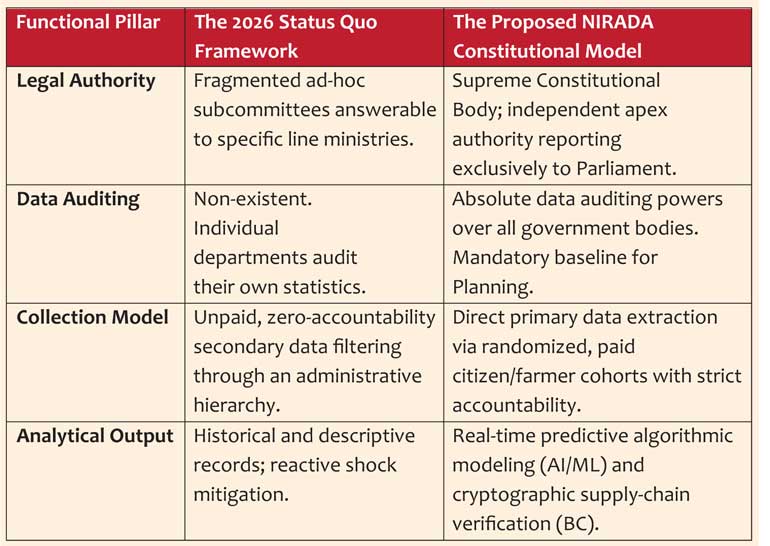
To dismantle this legacy of failure, Sri Lanka requires a total structural mutation of its data infrastructure. We propose the establishment of a National Intelligence, Research & Data Agency (NIRADA). NIRADA must be built as a supreme constitutional body, completely decoupled from the executive cabinet and line ministries, matching the independence of the Central Bank of Sri Lanka (CBSL) on monetary governance and the Auditor General on financial oversight.
Legislative framework and apoliticisation
NIRADA must be established via a constitutional amendment to prevent political interference. All leadership and scientific positions must bypass executive appointment completely, relying instead on blind, ultra-competitive recruitment processes managed strictly on pure merit, documented scientific publication, and explicit quantitative Key Performance Indicators (KPIs). The tenure of top management must be legally insulated from changing political regimes; a director or chief data scientist can only be removed mid-term if they fail to meet objective institutional KPIs, subject to a supermajority vote in Parliament.
The 70/30 independent peer cross-examination core
To permanently eradicate sectoral tribalism, NIRADA’s core research units must operate under a strict anti-silo configuration. For any national project for research data or sectoral study, the analytical team must follow a rigid 70/30 human resource rule:
This structural arrangement legally prevents self-serving, siloed conclusions. For example, a tea industry representative is blocked from producing a biased recommendation because the neutral core and the alternative sector representatives will ruthlessly cross-examine the data through a national macroeconomic lens, prioritising raw, unvarnished ROI over institutional sentimentality.
Paid, randomised micro-data architecture
Free data lacks accountability. NIRADA will completely abandon reliance on unverified secondary statistics compiled by line departments. Instead, it will implement an autonomous primary data collection network leveraging randomised statistical blocks.
Every year, NIRADA will systematically select thousands of ordinary citizens, farmers, and small-scale entrepreneurs across changing statistical grids to act as paid micro-data contractors. These selectees will receive direct financial compensation from the Government to provide precise, verifiable primary data loops regarding input costs, actual consumption, soil dynamics, and trade velocities. Because they are explicitly paid, their data submission carries legal accountability; any submission of falsified or sanitized data results in the immediate termination of the financial incentive. Rotating these cohorts annually or biannually prevents the formation of localised administrative corruption pockets and provides a continuous stream of pure, neutral data points directly into NIRADA’s forecasting algorithms.
Fiscal viability: The self-funding data loop
The traditional bureaucratic counter-argument to the deployment of high-end data agencies is fiscal constraint. In a resource-constrained economy, the allocation of Government funds to pay thousands of randomised citizen data suppliers and maintain elite data engineering infrastructure is often viewed as a luxury. This argument is fundamentally short-sighted. NIRADA is not a fiscal liability; it is an immediate self-funding mechanism.
The financial resources required to power NIRADA represent a tiny fraction of the billions of rupees currently lost through unscientific capital leakages. By cleaning up national data channels, NIRADA plugs these leakages instantly at the source:
Exposing subsidy fraud: Blanket agricultural subsidies are routinely exploited by ghost entities, corrupt suppliers, and inaccurate regional estimations. NIRADA’s audited, geolocated data blocks these leakages, ensuring that input subsidies match exact micro-soil requirements and legitimate producers.
Eliminating social welfare theft: Programs like Aswesuma bleed massive amounts of cash due to political manipulation and outdated beneficiary lists. Algorithmic verification via randomised cohort cross-checks automatically purges fraudulent entries from national systems. It is commendable that the Government has already given thoughts on this through Welfare Benefits Board (https://wbb.gov.lk/)
Proactive market stabilisation: Instead of executing delayed, macro-scale financial bailouts after a market crash occurs, NIRADA’s predictive alerts allow the Government to deploy micro-targeted incentives strictly for short-term shock absorption during verified climatic or international trade updates.
The verdict
Has Sri Lanka failed because of flawed data? Or ineffective institutional arrangements? The diagnostic conclusion of this paper is that it has failed because of both, as they exist in a symbiotic loop of inefficiency. Ineffective institutional arrangements deliberately produce flawed, sanitised data to protect their bureaucratic silos, and this flawed data, in turn, makes any rational restructuring of these institutions impossible.
The Prioritisation of Research for Sri Lanka – 2026 report proves that while the Government's intellectual capital recognises the desperate need for coordination, it remains imprisoned within legacy administrative boundaries. Paper-based policies and ad-hoc ministerial committees are utterly defenceless against an automated global economy governed by predictive analytics and competitive algorithms.
If Sri Lanka is to secure structural resilience, protect its citizen base, and survive international market competitions, it must execute a radical administrative mutation. The line ministries must be stripped of their data monopoly. The Government must legislate the creation of NIRADA as an independent, constitutional, algorithmic engine. Only when national data is collected scientifically, audited absolute, and modeled predictively can Sri Lanka transform from a blind, reactive Government into a thriving, advanced digital economy.
(The author, a Digital Agriculture Strategy Expert, a former top agriculture and policy specialist for the Sri Lankan and US governments, is currently leading a number of agriculture sector policy and digitalisation initiatives locally and internationally. His considerable experience combines policy formulation and the use of digital tools to improve efficiency and sustainability in the agricultural sector)




