Friday Oct 16, 2026
Friday Oct 16, 2026
Friday, 16 October 2026 00:26 - - {{hitsCtrl.values.hits}}
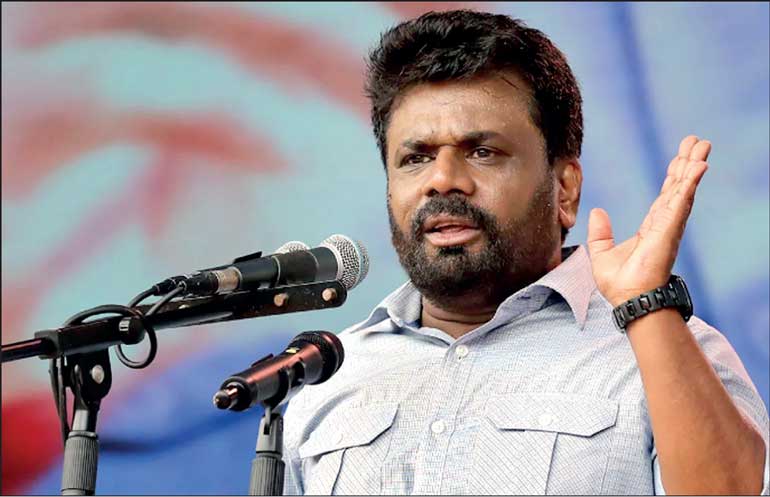
President Anura Kumara Dissanayake has identified a gap between Government objectives and its implementation arm (File pic)

Introduction
After reading my previous article, “What Produces Economic Growth — and What Does Economic Growth Produce?”, my friend Pali sent me this message: “Chandre. In your next article, can you outline what we should do about these paradoxes of ‘growth’?”
I agreed. But only after starting this piece did, I realise what Pali meant by his diplomatic language: “Buddy, being constructive is not as easy as being critical.”
In my previous article, I presented six numbers:
These numbers illustrate the paradox. The economy is growing, but the benefits of growth are not reaching all households equally. What we should do to ensure growth benefits are widely and fairly shared?
The NPP philosophy
The NPP election manifesto, A Thriving Nation – A Beautiful Life, ends its preface with: “It is our goal to involve all communities in the process—from designing a production economy to ensuring fair distribution of its benefits.”
Presenting the Policy Statement at the inauguration of the Tenth Parliament on 23 November 2024, President Anura Kumara Dissanayake said that the growth model would reflect “a production-oriented, regionally balanced economy.” His maiden Budget speech in 2025 carried the same philosophy: “Growth for the sake of growth has little value to society unless it is a means to uplifting the lives of all members of society.”
He further stated that growth should be inclusive, providing enhanced economic opportunities and ensuring that its benefits are fairly shared among all strata of society.
These statements reiterate the paradox of growth. Question is who and how translates the Government philosophy into action to address the paradox?
Gap between objectives and implementation
However noble the intentions, their realisation depends on implementation, follow-up and monitoring. That responsibility rests largely with the public service—the implementation arm of Government.
The President has identified a gap between Government objectives and its implementation arm. In his Policy Statement, he observed: “No matter how ambitious the goals and expectations of political leaders may be, those goals can only be realised if there is a well-structured and responsive public service to implement them.”
Addressing the District Secretaries and Divisional Secretaries Conference in December 2024, he said the public service had deviated from its intended objectives and required significant reforms to restore its effectiveness.
At the Economic Summit organised by the Ceylon Chamber of Commerce in February 2025, he also pledged to introduce policies, regulations, rules, procedures and processes to drastically shorten the time taken to get things done.
What the President states is: Ambitious policies require an implementation machinery capable of delivering them.
Is the public sector not capable of delivering?
Public perception of the public service is not very different from President’s view. It is often criticised as too large, bureaucratic, over-regulated, inefficient, indecisive and insufficiently responsive. There is also a perception that imagination, creativity and forward thinking have little room in the system. Every criticism may not be justified. But the message in it cannot be ignored.
The origins of our present public service go back to the nineteenth century. A centralised civil service was established under British rule in 1833. It was abolished in 1963 and replaced by the Ceylon Administrative Service, renamed the Sri Lanka Administrative Service in 1972.
Public Service was designed to fulfill the needs of a different country and a different era. Since then, the public sector has expanded enormously in size, layers, responsibilities, functions and workload. Yet much of its institutional framework continues to operate under old Acts, Ordinances, Regulations and practices.
Is the problem with the people or with the system?
The problem is not simply with the people working in the system. It may be the system itself. Hierarchy is deeply embedded in public-sector culture and leaves little room for teamwork and coordination.
I was once told an interesting story by the late Ken Balendran when he was Chairman of the Bank of Ceylon. His office was on the topmost floor of the bank’s headquarters, popularly known as “Pittu Bambuwa”, then the tallest building in Colombo. One day he walked down to the floor below to discuss something with the General Manager. When he returned, his personal assistant rushed in, surprised. “Sir, why did you walk down to the GM’s office? It never happens. If you want to discuss something with the GM, you can summon him to your office.”
That small incident illustrates the hierarchy built in to the system. The problem, however, goes beyond the hierarchy. The public sector has accumulated a set of ready-made explanations for delays and shortfalls—bad weather, elections, pandemics, delays in funds, conflicts in the Middle East or somewhere else. Officials are busy in chasing events rather than outcomes.
Tasks are often vertically assigned to individuals, units or divisions without assigning clear targets. The system is more concerned with following rules than achieving results.
The public sector is famously bound by AR and FR. Later came JR, followed by GR. More recently, there is ACR—Anti-Corruption Regulations.
All these rules have legitimate purposes. But when rules multiply without corresponding flexibility, discretion begins to look like an offence.
When I joined the public service as a clerk in 1964, the first document I received was a duty list. I continued issuing duty lists throughout my career until retirement. This raises the question: Is the public sector managing duties, or managing results?
With an ailing implementation machinery, no Government can overcome the paradoxes of growth.
The first step, therefore, should be to repair and revitalise the implementation machinery.
Towards a people-centric public service
The paradoxes of growth cannot be resolved merely by producing a higher GDP growth rate. Growth must translate into benefits: jobs, incomes, productivity, investment, regional development, better services and improved household welfare. Sri Lanka wants a production-oriented, regionally balanced and inclusive economy. For that, policies must be implemented effectively. The implementation machinery of Government must be capable of delivering. Public-sector reform is not merely an administrative issue. It is an economic-growth issue.
Sri Lanka needs a well-structured, responsive, competent, coordinated and people-centric public service. State delivers its promises to the citizen through the public service machinery.
1. From silos to systems
Government agencies often prepare annual plans around budgetary allocations and immediate issues. Agriculture provides a good example. During cultivation, attention is given to seeds, planting material, fertiliser and other inputs. At harvest time, attention shifts to disposal and marketing of the product. But agriculture is a value chain—covering production, inputs, finance, technology, storage, transport, processing, marketing and exports. Different agencies are involved in each stage. Responsibility goes beyond Ministry of Agriculture.
What is required is a holistic, coordinated and needs-based approach that considers the entire value chain rather than its fragmented components. The public service must move from silos to systems. Public agencies should work with the private sector, chambers, universities and other stakeholders. Regular monitoring should be in place to identify not only delays but also their causes and the remedial action required.
Responsibility for major tasks should be assigned to teams rather than individuals, with clear targets and Key Performance Indicators. Teams should report periodically on what has been completed, what is delayed, the difficulties encountered and proposed solutions.
This requires performance-based systems, simplified approvals, simpler documentation, digital platforms and mechanisms for inter-agency coordination.
2. Revisit outdated laws and regulations
The role and responsibilities of the public sector have changed dramatically, but many institutions still operate under legislation designed for another era.
Examples include the Railways Ordinance of 1902, Forest Conservation Ordinance of 1907 and Fauna and Flora Protection Ordinance of 1937. Other major legislation dates from the 1970s, while free education itself was introduced in the 1940s.
Old legislation is not necessarily bad. The question is whether it remains fit for purpose. Sri Lanka’s economic, technological, social and international environment has changed profoundly. Its public sector cannot move forward along with these changes siting on obsolete acts and ordinances.
A genuine transformation therefore requires a systematic review of Acts, Ordinances and Regulations and their modernisation where necessary.
3. Simplify procedures
Complicated time-consuming procedures are a major source of delay in areas such as foreign investment, exports, taxation, local investment and SME participation. The burden falls particularly heavily on ordinary citizens and small businesses that lack lawyers, accountants and administrative staff to navigate complex systems.
Complexity has become a barrier. It can create opportunities for excessive bureaucracy, delays, bribery and corruption. The answer is Keep things simple. Procedures, approvals and documentation should be simplified wherever possible to reduce cost, delay, stress and inconvenience while improving productivity and fast-tracking decision-making.
4. Decentralise services
Many public services remain heavily centralised in and around Colombo, including obtaining identity cards, passports, driving licences, EPF/ETF benefits and pensions. This imposes unnecessary travel, cost and inconvenience on citizens while contributing to congestion, pollution and fuel consumption.
Until digitalisation is fully operational, functions that can reasonably be decentralised should be handled closer to citizens. For example, receiving applications, checking documents and making recommendations could, where appropriate, be undertaken through District Secretariats. This would move the Government closer to the citizen instead of citizens move towards Government.
From title to action
Over the years titles of public servants have changed. A General was added to titles of Directors, Commissioners, and Controllers. Peon is a KKS; Clerk is a Management Assistant; Watcher is a security officer. Whether the outlook, attitude and efficiency have changed along with titles is questionable. The public service attracts the cream of the education and people of considerable calibre, competence and capacity. Whether an environment is created to capitalise on that capacity is questionable.
Public servants need a framework with clear objectives, guidance and the freedom to deliver. Today, seniority matters. What should matter is the performance. Specific tasks should be assigned with clear time targets, and performance tracked against them. A public servant should know: What am I expected to deliver? By when? How will my success be measured? Is my performance recognised?
The objective should be to create a culture in which achievement attracts recognition and responsibility produces results and accountability. That would strengthen commitment, improve delivery and restore public confidence.
Conclusion
This is only the first step of a long journey to explain what we should do about paradoxes of ‘growth’. I have offered these ideas partly from my experience in the public service and partly from what I believe is required to address the present challenges. I would not have covered the turf well. There can be many gaps. I wanted to intrigue a dialogue with the objective of creating a public service with public servants not by title, but in action to revitalise the implementation machinery.
Continued with part II to suggest other steps.
( The author is the former Secretary, Ministry of Plan Implementation. He can be reached at [email protected])




