Thursday Oct 22, 2026
Thursday Oct 22, 2026
Monday, 5 January 2026 01:45 - - {{hitsCtrl.values.hits}}
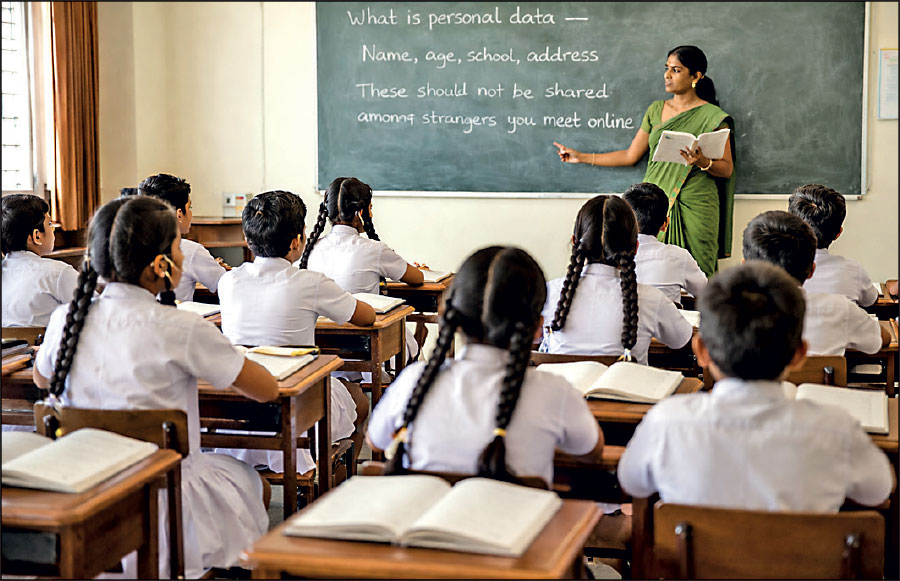
Image Courtesy – AI Image Generated by Digital Safeguarding Centre
 Crucially, curriculum development—particularly where digital interaction is involved—should include child protection specialists, online safety experts, psychologists and educators from the outset. Safeguarding should not be an afterthought added once concerns arise. A more appropriate approach would be to frame lessons around online awareness rather than participation
 The recent public concern over the inclusion of an inappropriate website link in the Grade 6 English Textbook has understandably triggered public concerns. Parents, educators and child protection advocates have raised serious questions about how such material found its way into learning resources intended for 11-year-old children. While investigations will determine whether this was an intentional act or an editorial oversight, it is crucial that this incident is not weaponised for political revenge or institutional blame games. Instead, it should be treated as a critical learning moment to strengthen online safety, child safeguarding and digital wellbeing across Sri Lanka’s entire education sector.
Grade 6 students in Sri Lanka are, on average, around 11 years old. At this stage of development, children are naturally curious about the world around them. They are eager to explore identities, relationships and social connections. This curiosity is not inherently problematic; however, when educational content is not carefully curated with age-appropriateness and online safety in mind, it can expose children to risks far beyond their emotional and cognitive readiness.
In the past, children were encouraged to find “pen friends” as a way to improve language skills, build global understanding and foster intercultural friendships. While even then there were isolated cases of exploitation, these interactions were largely slower, mediated, and less risky. Letters took time, identities were less easily fabricated and parental or teacher oversight was more common.
Today’s digital environment is vastly different. Online platforms allow instant communication, anonymity and rapid sharing of personal information, significantly increasing the risks of grooming, manipulation, cyberbullying and other forms of online harm.
From a child protection perspective, encouraging children to introduce themselves through social media-style profiles raises serious safeguarding concerns. This issue extends beyond the accidental or careless inclusion of a single inappropriate website. Promoting social media-related activities at the age of 11 may unintentionally encourage children to create accounts, interact with strangers, or share personal details without fully understanding the consequences.
These concerns are increasingly recognised worldwide. Several countries have taken steps to limit children’s exposure to social media and digital risks. Australia has enacted a legal ban on social media accounts for children under 16, European Parliament passed a resolution recommending a harmonised minimum age of 16 for social media access (non-binding), France, the Netherlands, Denmark and Norway are debating or advising higher age limits or discouraging use of social media under 15.
Even technology companies themselves acknowledge these risks. Platforms such as Facebook, Instagram, WhatsAp, Youtube, SnapChat and TikTok state that their services are intended for users aged 13 and above. These measures reflect a growing international consensus that children’s digital engagement must be carefully managed and developmentally appropriate. Introducing social media concepts in the national curriculum for younger children therefore contradicts both global child safety norms and platform standards.
If such topics are introduced in educational materials, they must be accompanied by clear guidance on risk avoidance. Children should be taught how strangers may misrepresent themselves online, why personal data should not be shared, how online manipulation occurs, and how excessive screen time can negatively affect mental health and wellbeing. Online interaction may be presented as enjoyable, but it must also be framed honestly in terms of potential harm.
Crucially, curriculum development—particularly where digital interaction is involved—should include child protection specialists, online safety experts, psychologists and educators from the outset. Safeguarding should not be an afterthought added once concerns arise.
A more appropriate approach would be to frame lessons around online awareness rather than participation. Children should be advised to interact online only with people they already know in real life. Any discussion about social media or online friendships should be reserved for older adolescents, ideally those aged 15 and above, who have greater maturity and critical thinking skills. For younger children, content should actively discourage independent social media use and instead focus on digital wellbeing, healthy boundaries, and supervised online learning.
While investigations will determine whether this was an intentional act or an editorial oversight, it is crucial that this incident is not weaponised for political revenge or institutional blame games. Instead, it should be treated as a critical learning moment to strengthen online safety, child safeguarding and digital wellbeing across Sri Lanka’s entire education sector
What should be done immediately
In light of the current incident, several immediate actions are necessary:
1. Immediate suspension of access to the affected learning material until a full safeguarding review is completed.
2. Blocking the website link, while recognising that technical blocks alone are insufficient, as children can bypass them using VPNs.
3. Establishing an independent editorial and child safeguarding review committee, including online safety and child protection experts.
4. Introducing mandatory safeguarding and digital wellbeing assessments for all national curriculum content involving technology or online interaction.
5. Embedding child online safety education as a structured, age-appropriate subject, rather than fragmented lessons across unrelated modules.
6. Clear accountability and quality assurance mechanisms within institutions such as the National Institute of Education to prevent future lapses.
This incident should not be treated as an isolated error or a short-lived controversy. It is an opportunity to strengthen policies, processes, and expertise to ensure that Sri Lanka’s education system keeps pace with the realities of a digital world while placing children’s safety and wellbeing at its core.
Handled thoughtfully, this moment can lead to safer learning environments, stronger public trust, and a more resilient generation of digitally aware and protected children.
(The author is Founder and Chairman, Digital Wellbeing Centre and could be reached via email at [email protected])




