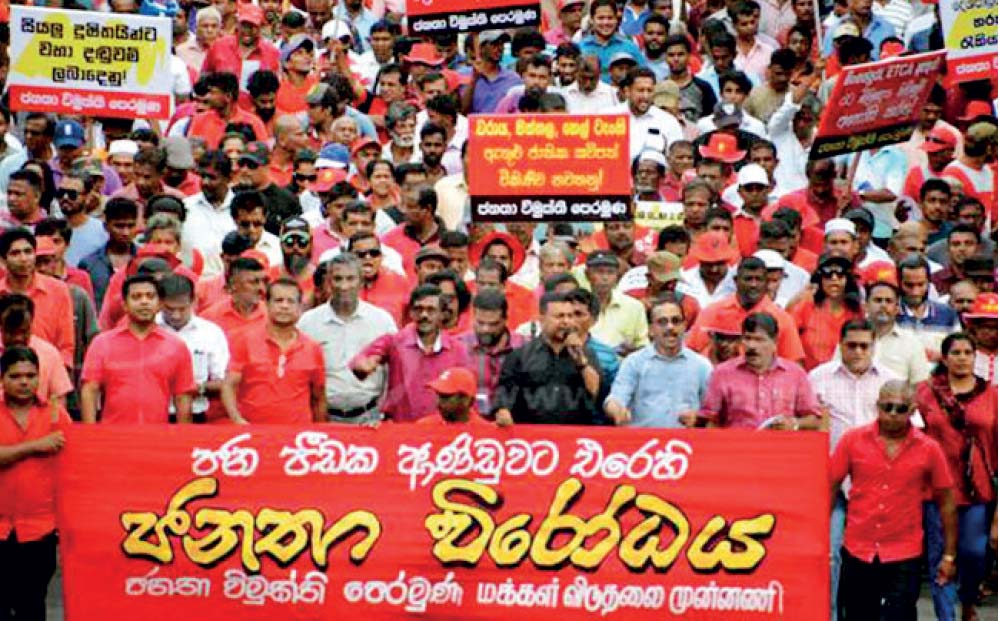
Anura Kumara Dissanayake, Tilvin Silva and Vijitha Herath and Bimal Ratnayake figure in a JVP protest when in the Opposition - File photo
 The JVP once understood the power of organised labour. The NPP must now demonstrate that it understands the responsibilities of governing. Trade unions must also recognise that the economic realities confronting the country cannot be wished away through industrial action. The Government may be able to withstand a strike. The trade unions may be able to demonstrate their strength. But if both sides emerge with diminished public confidence, disrupted essential services and a further loss of economic momentum, it is the country that will ultimately lose
- Sri Lanka stands at the threshold of another potentially disruptive labour confrontation, but this time the Government facing the unions is led by the very political movement that once made industrial action one of its most effective weapons
 Sri Lanka could be heading towards an uncomfortable Monday, November 30, as a coalition of public sector trade unions prepares to carry out its declared island-wide withdrawal of labour. What initially appeared to be another round of trade union agitation over salaries and allowances has now assumed much greater political, economic and institutional significance. The confrontation presents President Anura Kumara Dissanayake’s National People’s Power (NPP) Government with a particularly difficult dilemma: how does a Government born out of a powerful tradition of worker mobilisation respond when the very workers who helped bring it to power turn against it?
There is an undeniable irony in the present situation.
For decades, the Janatha Vimukthi Peramuna (JVP) perfected the art of mobilising public sector employees, trade unions and working-class communities against successive Governments. Demonstrations, strikes, picketing and street protests were integral to its political vocabulary. Its trade union network remained an important source of political influence even when its electoral fortunes were at their lowest.
The JVP is now on the other side of the barricade.
The NPP’s electoral success in 2024 was particularly impressive among public sector employees, securing nearly four-fifths of their postal votes. Its manifesto offered considerable expectations, including salary improvements, cost-of-living adjustments and better conditions for public servants. The promise of biannual salary increases was not an insignificant electoral commitment.
However, governing a country struggling with debt, constrained revenue, substantial interest payments and an inflexible public expenditure structure is considerably different from campaigning against those responsible for managing such constraints.
The Government’s fiscal argument cannot simply be dismissed. Sri Lanka’s public finances remain under considerable pressure. Interest payments, public sector salaries and pensions, welfare commitments and other recurrent expenditure leave limited fiscal space for substantial, unbudgeted salary increases.
Weak direct taxation and continued dependence on indirect taxes further complicate the situation. Any irresponsible expansion of recurrent expenditure could undermine fiscal consolidation and jeopardise the country’s economic recovery.
Nevertheless, fiscal constraints cannot become a permanent justification for failing to address legitimate grievances. Public servants have experienced years of declining purchasing power, higher utility bills, increased transport costs and the rising prices of essential commodities. The demand for an interim Rs. 25,000 cost-of-living allowance must therefore be examined not merely as a trade union demand but against the actual cost of living confronting ordinary households.
The Government’s dilemma is real. Granting substantial salary increases without sustainable revenue could destabilise public finances. Refusing to address legitimate demands, however, could destabilise public administration itself.
A potentially difficult Monday
The Government appears to have anticipated the consequences of the proposed industrial action. Directives have reportedly been issued to ministries, district secretaries and relevant institutions to maintain uninterrupted services. Schools have been instructed to continue scheduled educational activities and examinations, while the Examinations Department has been asked to ensure that preparations for the forthcoming GCE Ordinary Level examination remain unaffected. Railway, bus and health services have similarly been instructed to maintain operations.
On the surface, these are reasonable administrative precautions. A Government has an obligation to ensure that essential public services continue, particularly where education, healthcare and public transport are concerned.
Yet the manner in which these instructions are implemented will be critically important.
Will alternative arrangements be sufficient to maintain meaningful services? Will employees who report for duty face pressure from fellow workers? Will those participating in industrial action face disciplinary measures? Will the authorities seek to distinguish between essential services and ordinary administrative functions, or will the response become a broader attempt to undermine the trade union movement?
These are not imaginary questions. They are precisely the issues that could determine whether Monday remains a peaceful industrial dispute or develops into a much more serious confrontation.
President Dissanayake’s reported declaration that workers cannot obtain anything by shouting and protesting, coupled with Minister K.D. Lal Kantha’s strong criticism of protesting union leaders, has hardly helped to reduce tensions. Lal Kantha is no ordinary Cabinet member in this context. His longstanding association with the JVP’s trade union movement makes his intervention particularly significant.
The opposition, meanwhile, has accused the Government of hypocrisy and intimidation, recalling the very methods of protest that the JVP once employed against its political opponents.
What could happen on the streets?
If the declared withdrawal of labour attracts widespread participation, Colombo and its suburbs could experience considerable disruption.
Public transport could become irregular, with commuters struggling to reach workplaces and businesses. Schools may be compelled to suspend normal activities despite official instructions to remain open. Parents could face uncertainty over examinations and the safety of children travelling to and from school.
Hospitals present an even more sensitive concern. Emergency and essential medical services must remain available regardless of the political or industrial dispute. Patients requiring routine consultations, investigations, clinics and other non-emergency treatment could nevertheless experience delays.
Industrialists, exporters, commercial establishments and service-sector businesses may also face absenteeism, transport difficulties, delivery delays and reduced productivity. For a country attempting to restore investor confidence and maintain economic momentum, another episode of widespread industrial disruption would be particularly unwelcome.
There is also the possibility of competing demonstrations, counter-mobilisation and confrontations between striking employees, replacement workers and law enforcement authorities.
None of these developments is inevitable. Much will depend on the actual participation of workers, the discipline exercised by union leadership and the restraint demonstrated by the Government. But the possibility of isolated confrontations, arrests or disciplinary action cannot be excluded if both sides adopt uncompromising positions.
The Government must be particularly careful not to confuse its responsibility to maintain essential services with an entitlement to suppress legitimate industrial dissent. Equally, trade unions must recognise that the public cannot indefinitely be held hostage through the disruption of essential services. The right to protest carries responsibilities towards the wider community.
Lessons from history
Sri Lanka has experienced confrontations of this nature before. The 1972 bank workers’ strike, confronted by the United Front Government with the involvement of Finance Minister Dr. N.M. Perera, demonstrated how dramatically a political leader’s trade union background could be transformed by the responsibilities of Government.
The 1980 general strike under President J.R. Jayewardene provides an even more painful historical reminder. The dismissal of tens of thousands of striking workers and the devastating consequences for affected families remain a warning against the use of excessive state power in industrial disputes.
The NPP Government commands a substantial parliamentary majority. That political strength should not be mistaken for an unlimited mandate to confront organised labour.
A parliamentary majority is a means of governing democratically, not a substitute for dialogue, negotiation and accountability.
The way out of the Catch-22
There is a way forward, but it requires political maturity on both sides.
The Government should immediately establish a credible negotiating mechanism involving representatives of all major public sector unions, independent labour experts and relevant ministries. It should present a transparent assessment of available fiscal space, explain what can realistically be granted and establish a time-bound programme for reviewing salary anomalies and cost-of-living adjustments.
Trade unions, in turn, should recognise the country’s economic limitations and ensure that emergency healthcare, essential transport and other critical services are not compromised. Industrial action should remain peaceful, proportionate and within the law.
Above all, neither side should attempt to win a political contest at the expense of ordinary citizens.
For Monday, parents should verify arrangements with their children’s schools and examination authorities before travelling. Patients should check clinic and appointment arrangements where possible, while commuters should make alternative transport plans. Businesses should assess staffing and logistical arrangements in advance.
These are practical precautions, not an assumption that public services will necessarily collapse.
Ultimately, this confrontation is about more than Rs. 25,000, salary anomalies or the next Budget. It is a test of political credibility, public administration, industrial relations and the maturity of democratic institutions.
The JVP once understood the power of organised labour. The NPP must now demonstrate that it understands the responsibilities of governing. Trade unions must also recognise that the economic realities confronting the country cannot be wished away through industrial action.
The Government may be able to withstand a strike. The trade unions may be able to demonstrate their strength. But if both sides emerge with diminished public confidence, disrupted essential services and a further loss of economic momentum, it is the country that will ultimately lose.
That is the real danger of the Government’s Catch-22.



