Thursday Oct 08, 2026
Thursday Oct 08, 2026
Thursday, 8 October 2026 02:57 - - {{hitsCtrl.values.hits}}
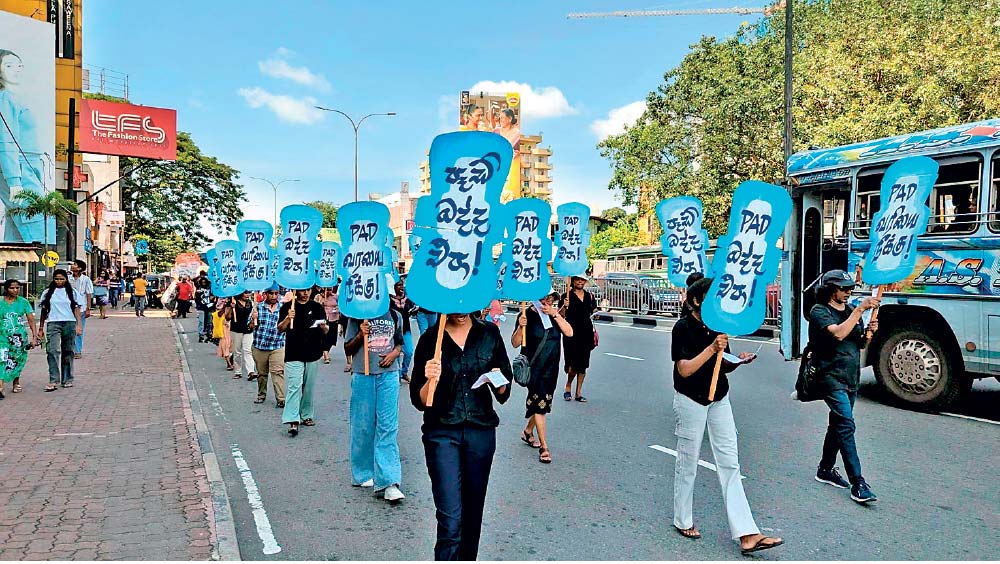
PSA demonstration had a contingent protesting tax on sanitary pads
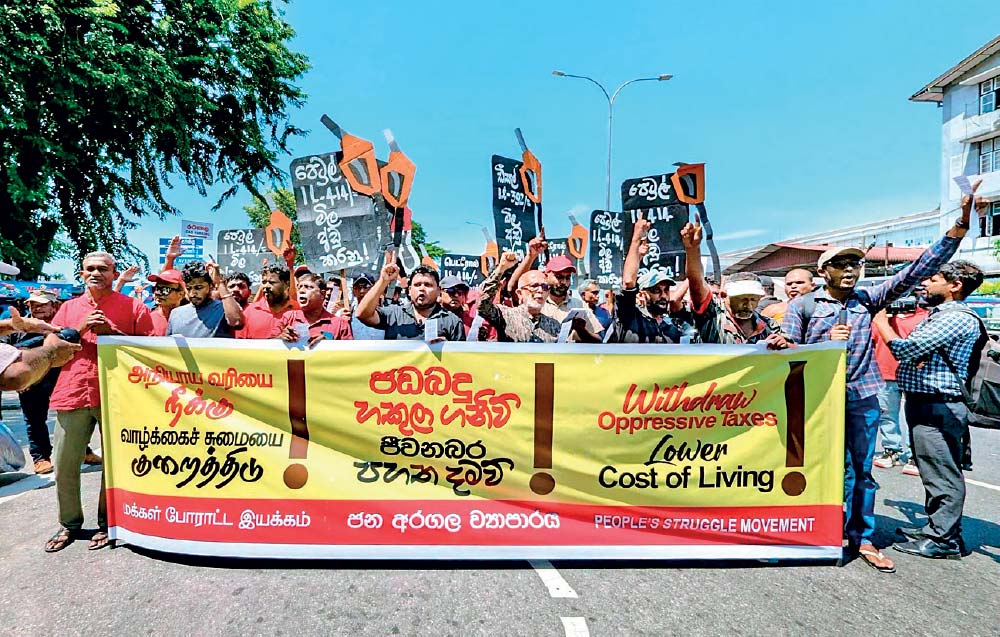
Leading Aragalaya figure Wasantha Mudalige at the forefront of the PSA’s protest march
 Obviously the AKD administration has no intention of holding Provincial Council elections under the existing 13th Amendment which was the outcome of the Indo-Sri Lanka Accord. In other words, there will be no revival of the Provincial Councils established under the 13th Amendment with the changes limited to the electoral system—which is what has so far been promised to the Parliamentary parties and the public by the Government
— Lionel Bopage, Groundviews —
 Sri Lanka’s political parties, especially but not only those representing the Tamil people, and the mainstream press including the Sunday papers, have missed a story of major, long-range significance with external ramifications. It pertains to the JVP-NPP’s Government’s stand on the Tamil Question, its decision concerning Provincial Councils and its political plans in general.
Lionel Bopage, the first General Secretary of the JVP, veteran of April 1971 and the party’s main theoretician in the late 1970s and early 1980s on the Tamil National Question, has placed on the record a conversation he had with the party’s current General Secretary Tilvin Silva—the second most powerful person in the country, if not the first.
Here’s the ‘money shot’:
“…But at the same time, it doesn’t accept the 13th Amendment. …During a discussion with Comrade Tilvin Silva, I asked about the change of constitution and the 13th Amendment. His answer was that the Government is still working towards a new constitution that it will adopt. It sees the 13th Amendment as a negative. It is trying to find an alternative. If I summarise, the Government agrees that there are grievances of Tamil people and it wants to address them but not through the Indo-Lanka Accord and the Provincial Councils. It is developing its own mechanisms. That will be good so long as it can provide equal opportunities for all the communities to live with dignity, I will be happy…”
(https://groundviews.org/2026/10/02/lionel-bopage-a-long-journey-into-light/)
Focusing closely on the operative parts, this is the
picture we get:
 The JVP Government rejects the 13th Amendment as a negative factor.
It is trying to find an alternative to the 13th amendment.
The Government agrees there are grievances of the Tamil people and wants to address them but not through the Indo-Lanka Accord and the Provincial Councils.
It is developing its own mechanisms.
|
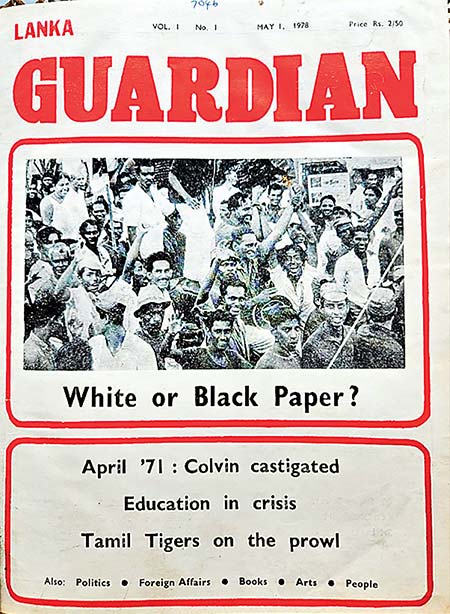
Lanka Guardian inaugural issue: could it have been banned under AKD’s PTA-successor Bill? |
What can we reasonably conclude?
The JVP Government remains opposed ideologically to the Indo-Sri Lanka Accord and the 13th Amendment as in the late 1980s during its campaign of barbaric violence. This Opposition is not limited to the coercive diplomacy of India because if it was so, then it should be opposed only to the Accord but not the 13th Amendment.
If in the eyes of the JVP the 13th Amendment is merely flawed, it could be revised, instead of rejecting it out of hand as negative, and an alternative sought.
The JVP has yet to articulate what its problem with the 13th Amendment is and why it cannot be addressed by structural rectification through a parliamentary consensus.
Obviously the AKD administration has no intention of holding Provincial Council elections under the existing 13th Amendment which was the outcome of the Indo-Sri Lanka Accord. In other words, there will be no revival of the Provincial Councils established under the 13th Amendment with the changes limited to the electoral system—which is what has so far been promised to the Parliamentary parties and the public by the Government.
Going by Lional Bopage’s revelation—and he’s the best possible ‘JVP Whisperer’—the existing Provincial Council system will be entirely changed. If at all there is a Provincial Council system, it will be a new one. There is no guarantee there will be a system of elected Provincial Councils.
Since the 13th Amendment was the product of prolonged negotiations for years (since 1984) between India and Sri Lanka and among Sri Lankan political parties (1986), and the JVP rejects it rather than aims to reform it, we can either expect its ‘own mechanism’ to necessitate open-ended deliberation and delay, or a swifter one which is unilateral rather than based on consultation and consensus.
The NPP election manifesto promised elections to Provincial Councils within a year, and did not promise an entirely new mechanism – its own—without, outside, and instead of the 13th Amendment and the existing system.
By unilaterally ignoring, overriding, and negating the Indo-Sri Lanka Accord and the 13th Amendment, the JVP Government is either going to involve this country in a renewed problem someday with India—which now has an assertive young Chief Minister in Tamil Nadu—or will concede even more strategic real estate on this small island to India as a trade-off.
Lionel Bopage’s signal that “equal opportunities for all the communities” will do the trick, we can deduce that the JVP’s ‘own mechanisms’ will not be based either on the devolution of power or territorial—provincial or regional—autonomy/quasi-autonomy (which are pretty much synonymous).
Possibly the JVP aims to go for a Referendum which entrenches it in office and even defers national elections, using as a carrot the abolition of the 13th Amendment, because it counts on the Sinhala ultranationalist vote on this issue.
This gamble would lead Sri Lanka into a minefield for two reasons:
There is likely to be backlash from the minorities and external players at the abolition of the 13th Amendment which leaves no politico-territorial autonomy/devolution of power to Province-sized units.
There is also likely to be the opposite backlash from the voters belonging to the majority who would oppose “equal opportunities for all communities” because, as Lord Soulbury said, one cannot turn a minority into a majority or a majority into a minority. Though non-discrimination is possible and desirable, “equal opportunities for all the communities” in political terms, i.e. in terms of State power, is impossible to ensure given a competitive democratic system and communities of unequal size. Furthermore, “equal opportunities for all communities” could be interpreted by both sides as incompatible with the privileged Constitutional status of Buddhism, and by the Tamil side as requiring a secular State.
According to Lionel Bopage, Tilvin Silva says “the Government is still working towards a new constitution that it will adopt”. If so, why isn’t there a single sign of a broad consultative process? Is it that the process will be unilateral and the Government expects a post-22A rubber stamp, bypassing a referendum? Or is that consultations have yet to start, which means that elections to Provincial Councils or their successor-bodies (‘district councils’?) will continue to be indefinitely delayed?
It is not that I don’t see the extreme edge of Tamil nationalism. The Thileepan commemoration says it all. Thileepan did NOT fast to death because of a massacre of Tamil civilians by Sinhala or Indian soldiers. He did so at Prabhakaran’s behest to disrupt the first real chance for peace that Sri Lanka had, and the first real chance of a measure of self-rule that the Tamil people had, namely the Indo-Sri Lanka Accord. Almost never in the history of national liberation struggles does protest erupt when there is a pause in the fighting and a real chance for progress with the mediation and backstop of an empathetic external power—but that is precisely what the LTTE did and disrupted. It is this anti-peace, pro-war fast by Thileepan on Prabhakaran’s orders that is commemorated today by Tamil ultranationalists in the Northern province and in the Diaspora. This is renewed proof of the fundamentalist, fanatical, separatist aspect (or core) of Tamil nationalism.
Even so, every ethnonational community which may be a minority in a country as a whole but has a compact presence in a given territory in which it constitutes a majority, deserves a measure of devolved power and self-administration in that territory. That is true of Sri Lanka’s Tamils too, and it is what the Indo-Sri Lanka Accord, the 13th Amendment and the system of elected Provincial Councils ensured.
To dismantle that sub-system and seek to replace it with something that is devoid of devolution of power to Provincial Councils, substituting that structural reform with a vague attempt at “equal opportunities for all communities”, removes the capacity to contain the secessionist impulse and allows the reactivation of external pressure on Sri Lanka, beginning with adjacent Tamil Nadu.
Contemporary history teaches us is that a State should never revoke/reverse the autonomous units that a territorial minority has already enjoyed. True, Modi’s India revoked the special status of Kashmir but while remaining within India’s quasi-federal system. By contrast, Milosevic revoked Kosovo’s autonomous status through a parliamentary majority, which began the process which ended Yugoslavia as a country.
Without elected Provincial Councils:
The Tamils are now back within, and will remain within, an overcentralised unitary system; not a unitary system with devolution/semi-autonomy.
The sovereign people of the whole country including the Sinhala majority remain without the intermediate (provincial) elected tier of its State, a democratic republic.
Even so, every ethnonational community which may be a minority in a country as a whole but has a compact presence in a given territory in which it constitutes a majority, deserves a measure of devolved power and self-administration in that territory. That is true of Sri Lanka’s Tamils too, and it is what the Indo-Sri Lanka Accord, the 13th Amendment and the system of elected Provincial Councils ensured
Third front
A third front has opened against the AKD administration. The first two fronts are the SJB and the SLPP, the third is the People’s Struggle Alliance, guided by the Frontline Socialist Party (FSP).
The FSP-PSA, decisive driver of Aragalaya 2022, is back.
The PSA’s demonstration and culminating speeches of 3 October were seen on TV news that evening. It was well-organised, sufficiently long, attractively packaged, enthusiastic though well-behaved, perfectly targeted—on the taxation policy—and in short, undeniably impressive.
Unlike the mainstream Opposition parties, the PSA demonstration had many young women.
With the economic critique of the Government having been developed on TV over weeks by FSP’s Education Secretary Pubudu Jayagoda, outstanding public intellectual and leading political activist, the main speakers on 3 October, Duminda Nagamuwa, Lahiru Weerasekara and Wasantha Mudalige were superb in their indignant speeches from the sidewalk, transmitted to the country over TV.
The nasty note came from the authorities: the arrest of six activists including the FSP’s Sujith Kuruwita, and the refusal to let them receive a visit and packets of food in their place of detention. Luckily, they made bail the next day.
The PSA’s 3 October demonstration proved that while there is marginal space to the right of the AKD administration to mount a mobilisation, there is plenty of space to the left of it to do so. The PSA has correctly placed at the centre of its discourse, the socioeconomic issue, the ‘affordability’ crisis (as New York’s Zohran Mamdani famously calls it). The PSA ‘brought the kitchen to the streets’ as one of its slogans claimed—and took on the AKD-JVP-NPP Government during its 2nd anniversary, on its own terrain.
It would be unfair to critically compare and contrast the SJB or SLPP with the PSA. That would be akin to a criticism of the US Democrats that they aren’t Black Lives Matter. However, it would be completely fair to compare the SJB with the UNP in Opposition in 1970-1977, and the SLPP and SLFP with the SLFP in Opposition.
By 1972-3, R. Premadasa, MP, had stepped outside the UNP, launched the populist Citizens’ Front and held public meetings including at Hyde Park in Colombo against the powerful Government. In 1973 he was invited back into the fold by the UNP’s new leader, J.R. Jayewardene and mandated to transform the UNP, which he did. From 1973 onwards, the UNP which had only 17 MPs to face a Government with a 2/3rds majority and two large leftwing parties as components, waged asymmetric political struggle by taking the battle outside Parliament through Satyagraha campaigns. This populist transformation won over the masses, turning a 17 MP United National Party into a Government with a 5/6ths majority within one term.
The SLPP, SLFP and ‘Joint Opposition’ seem to have forgotten that Sirimavo Bandaranaike, Vijaya and Chandrika Kumaratunga, Dinesh Gunawardena, and Mahinda Rajapaksa all distinguished themselves at the frontlines of peaceful direct action and ‘people’s power’ while in Opposition.
For its part, the FSP-PSA needs to avoid the sectarian ‘one-party’ political practice. The JVP-NPP is heading towards one-party rule, the SJB is preaching and practising a ‘One-party Opposition’ formula, and the FSP-PSA is presenting itself as the sole authentic alternative which seems to be a mono-party formation rather than a partnership or ‘action front’ at least of the FSP-PSA and the CPSL.
The dangerous lurch towards totalitarianism and the appalling absence of a combined Opposition effort to resist it, become manifest with the text of the incoming Protection of the State from Terrorism Bill. The Human Rights Commission of Sri Lanka (HRCSL) is completely correct in raising red flags
Black Bill
The dangerous lurch towards totalitarianism and the appalling absence of a combined Opposition effort to resist it, become manifest with the text of the incoming Protection of the State from Terrorism Bill. The Human Rights Commission of Sri Lanka (HRCSL) is completely correct in raising red flags. Calling on the Government to “substantially revise the definition of the ‘offence of terrorism’ by narrowing its scope”, it spotlights the following:
‘It is observed that the primary focus of the proposed Protection of the State from Terrorism Bill appears to be protecting the ‘State’ as opposed to the ‘People’ from acts of terrorism…A Bill that shifts the focus from protecting civilians to the ‘State’ risks overemphasis on the protection of State institutions from opposition and dissent as opposed to protecting civilians from indiscriminate violence…
In Clause 3(1), the Bill sets out the criteria for the offence of terrorism by introducing certain ‘intentions’ that can make ordinary offences amount to the offence of ‘terrorism’.
We note that intention ‘(b)’, i.e., ‘unduly compelling a Government or an international organisation, to do or to abstain from doing any act’ may include public protests and demonstrations, strike action, and acts of civil disobedience, which are integral to the fundamental rights of all citizens to the freedoms of expression, association, and peaceful assembly.
…The effects of the overbroad definition of the ‘offence of terrorism’ are compounded by other provisions of the Bill.
…This framework further jeopardises the people’s fundamental right to the freedom of speech and expression (guaranteed under article 14(1)( a) of the Constitution) which includes the right to call for peaceful protests against governmental policies.
…The same problem arises with regards to offences relating to ‘terrorist publications’ under Clause 10 of the Bill, as what constitutes a ‘terrorist publication’ includes a publication that is ‘a direct or indirect inducement to commit, attempt, abet, conspire to commit or prepare to commit the offence of terrorism. Therefore, considering the above example, any publication that encourages such a public protest, which falls within the technical definition of an offence of terrorism, may be treated as a ‘terrorist publication’, and may constitute a separate offence…’
AKD’s peacetime successor legislation is broader in scope and therefore worse than J.R. Jayewardene’s wartime PTA.
Had Anura’s proposed Bill been the original PTA, my father Mervyn de Silva’s celebrated fortnightly magazine the Lanka Guardian would have been shut down, and the man described by Radhika Coomaraswamy as “ the greatest journalist that Sri Lanka ever produced”, in whose name the pinnacle prize ‘Journalist of the Year’ is awarded by the Editors’ Guild and the Publishers Society at the climax of the annual journalism awards ceremony, would also have been indicted under the PTA—not only his son.
Unlike his son who was indicted ‘in absentia’, because he had gone underground, living and moving through the labyrinth for two years, with a third year in semi-clandestine self-exile, my father would have been jailed, leaving my mother Lakshmi with her husband imprisoned and son evading both the State and the JVP Death Squads.