Friday Oct 16, 2026
Friday Oct 16, 2026
Friday, 16 October 2026 00:23 - - {{hitsCtrl.values.hits}}
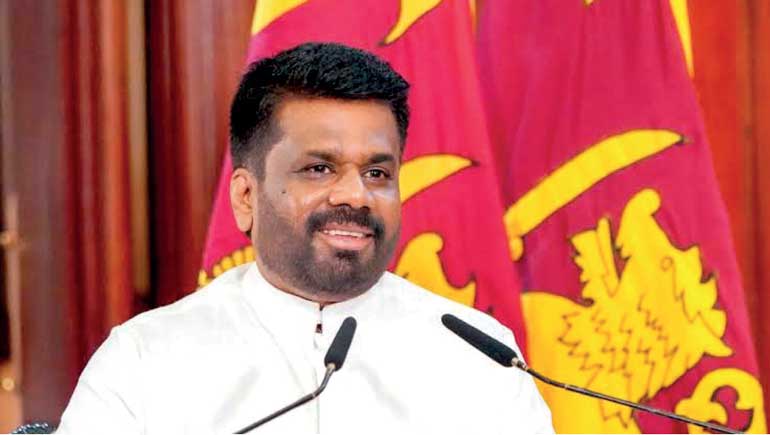
President and Finance Minister Anura Kumara Dissanayake
 The streets of Colombo are echoing with the cries of the working class agitating for fairer taxes. The Jana Aragala Movement and the Frontline Socialist Party staged a protest march in Colombo on 3 October, demanding the removal of unfair tax policies and relief from the rising cost of living.
The National Power (NPP) Government must not treat this as just a minor political disturbance. It must treat it as the desperate gasp of ordinary people for economic survival. Ordinary men and women of Sri Lanka are hurting from the impacts of a double-edged sword. On one side is a direct taxation formula that has scant respect for the modest earnings of professionals and workers who keep the nation's engine running. On the other side is the jagged edge of indirect taxes such as value-added taxes (VAT) that tax the flour in a mother’s kitchen, the books in a child’s bag, and the medicine on a pensioner’s table with total disregard for the ability of the individual to pay. The NPP was swept into office on the solemn promise of justice, equity, and relief for a weary populace. Tom, Dick and Harry have been patient. They want Sri Lanka to prosper. Yet, when the state unceasingly balances its ledgers on the broken backs of the poor, this social contract will fracture. The subject protest is a stark reminder that true economic recovery cannot be built on the slow starvation of the common man. Whilst I applaud the key achievements of the NPP, I believe that it is time for it to re-examine the human cost of its tax arithmetic. There is a need to quell the storm before it becomes a cyclone.
The challenges faced by the NPP in maintaining fiscal discipline to satisfy international obligations are enormous. However, ignoring tax relief for ordinary citizens carries severe risks. The NPP’s victory was powered by the working and middle classes. Hardships emanating from persistent tax pressures risk alienating this core base, breeding cynicism and public disillusionment. When applied indiscriminately, regressive indirect taxes severely curb disposable income, stifle domestic consumption, lower savings capacity, drag down small business growth, and impede national recovery. Unaddressed cost-of-living grievances also threaten political and social stability, risking street protests and labour strikes that can severely damage investor confidence. Furthermore, high direct income tax burdens on skilled professionals and technical experts accelerate a devastating brain drain that erodes national capacity. Delivering targeted tax relief is therefore not merely a social gesture, but it is a political and economic imperative for the long-term prosperity of Sri Lanka.
Opinions may differ, but the facts are stubborn in noting that, in its first two years, the NPP Government has achieved substantial progress in stabilising a fragile nation. There were skeptics who thought that the new Government would crumble within a year. But, in truth, it has successfully halted economic collapse, avoided hyperinflation, brought transparency to state spending, and dismantled long-standing political privileges and systemic corruption. By expanding targeted social safety nets and maintaining fiscal discipline, the administration has demonstrated the political maturity required to steady the economy and rebuild international credibility. However, macro-level stability remains incomplete if it fails to translate into micro-level relief for ordinary citizens. The current cost of living crisis is the painful, inevitable residue of decades when Sri Lanka systematically lived beyond its means, relying on unsustainable debt, consuming unearned wealth, and enjoying meaningless subsidies. The necessary structural adjustments, fiscal consolidation, and currency corrections have been largely taken and/or are being taken. Great!
With the economy now reset on a firmer baseline, there must be a fundamental shift in the strategy for revenue generation. For years, the state has relied disproportionately on regressive indirect taxes, such as VAT, which unfairly burden low- and middle-income families because they are applied uniformly to essentials regardless of the earning capacity of the subjected individuals. Therefore, to make relief sustainable, the NPP must aggressively shift the tax composition toward direct taxation by widening the direct tax net, rationalising non-strategic tax concessions and ensuring that high earners pay their fair share.
Broadening the national taxpayer base is a fundamental structural necessity for achieving long-term fiscal stability, economic resilience, and social fairness. Extracting additional revenue from a narrow pool of compliant taxpayers depresses private investment, encourages capital flight, and drives economic activity into the informal domain. Transitioning to a broad-based, lower-rate tax environment requires a systematic sequence of actions including digital integration, administrative modernisation, targeted enforcement, and low-friction identification frameworks. The actions must move beyond simply issuing mandatory Taxpayer Identification Numbers (TINs) and pivot toward data-driven enforcement. By integrating the Inland Revenue Department (IRD) with key Government departments, customs, financial institutions, land registries, and motor traffic databases, the state can map wealth against declared incomes. Automated cross-referencing of high-value transactions, such as luxury vehicle purchases, primary real estate transfers, and offshore credit card spending, can allow the more effective identification of undisclosed wealth.
Additionally, better coverage of high-income earners can be achieved if professional bodies covering medical, legal, engineering, and accounting fields can be requested to condition annual practicing license renewals on active tax registration and compliant filing status. After all, a professional’s primary allegiance is to the public! So what is the problem?
Bringing micro, small, and medium enterprises as well as independent self-employed professionals into the formal economy requires eliminating administrative complexity. Complex filing requirements, obscure regulations, and fear of arbitrary assessment drive small business owners into unrecorded cash operations. To lower this barrier, tax authorities must introduce simplified compliance regimes featuring user-friendly, mobile-based filing applications, transparent turnover declarations, and flat-rate tax options. Lengthy, jargon-heavy return forms discourage voluntary participation, especially among first-time taxpayers and micro-enterprises. Returns should be condensed into plain-language digital documents that citizens can complete confidently without hiring expensive consultants. Digital transactions, as opposed to cash transactions, must be encouraged through incentives or by regulation. Expanding the direct tax base in this way will boost state revenue, reduce the dependency on indirect tax, and foster public trust in fiscal equity. Bringing unregistered wealth into the formal net is challenging but not impossible. If there is a will, there is always a way! The NPP Government has the will.
The rapid expansion of cross-border e-commerce, digital entertainment, ride-hailing platforms, and freelance digital work has created substantial revenue potential that remains largely uncaptured by traditional tax rules. Establishing simplified digital registration portals and platform-based withholding mechanisms will allow the state to capture consumption and vendor taxes at the source without imposing heavy administrative burdens on individual gig workers. Concurrently, specialised audit teams equipped with forensic accounting capabilities can be established to review complex corporate structures, multi-layered trusts, and offshore assets. Fully leveraging international tax transparency frameworks, such as automatic exchange of information networks, can also ensure better monitoring of offshore accounts and foreign holdings.
Administrative reform
Executing a successful taxpayer expansion plan requires managing administrative capacity and public perception. Expanding enforcement during periods of high living costs can trigger public resistance if citizens feel overburdened without seeing improvements in public services. Public communication must frame tax enforcement around equity and shared responsibility, demonstrating that expanding the base protects vulnerable populations and creates space to lower direct tax rates on formal wage earners in the future. The IRD can also include automated risk-scoring algorithms within its core software systems to quickly identify significant revenue gaps, enabling staff to focus on substantial tax discrepancies rather than on petty, low-value issues. It must be a policy of management by exception. Digital innovation must drive this transition.
Expanding the national tax base also requires an attitudinal change in the IRD. It must shift from a punitive personality to a customer-centric service personality grounded in empathy, soft skills, and administrative simplification. For decades, the relationship between the IRD and the public has been defined by friction, distrust, and confrontation. Taxpayers view the administration as an adversarial body focused on penalties and audits rather than public service. Unregistered citizens and small business owners avoid entering the tax net out of fear that registration will expose them to arbitrary assessments and hostile scrutiny. Reframing the IRD requires developing social soft skills across its workforce. Frontline tax officers and auditors must undergo training in clear communication, dispute de-escalation, and conflict resolution. Taxpayer interactions should feel like collaborative consultations rather than interrogations, guiding citizens toward corrective action rather than issuing immediate penalty notices. Establishing a supportive tone will demystify tax administration and transform compliance from legal coercion into a shared social responsibility.
Reforming tax dispute resolution is equally vital. The IRD must distinguish between honest mistakes and deliberate fraud by offering fast-track review mechanisms, mediation, and penalty-waiver programs for voluntary self-correction. Finally, transparent public education campaigns must frame taxation as a mutual civic commitment funding healthcare, education, transportation, and infrastructure. Changing the IRD’s culture to embrace empathy and accessibility is vital in rebuilding public trust and sustainably broadening Sri Lanka’s taxpayer base.
Tax adjustments
Economic stabilisation under the IMF program has restored macroeconomic stability, but at a severe cost to middle-class professionals and fixed-income earners. The current statutory personal income tax threshold is woefully inadequate, as costs of basics like food, utilities, transport, and healthcare immediately absorb household earnings. Furthermore, narrow tax bands starting at low-income levels push ordinary workers quickly into top-tier brackets, eroding savings, dampening consumer spending, and inducing a brain drain of skilled talent. To deliver tangible relief, the Government must implement a multi-pronged adjustment to the direct tax structure.
First, raising the tax-free threshold and widening lower tax brackets would align taxation with post-inflation living costs, preventing middle-income earners from losing over a third of their marginal income. Second, introducing targeted tax deductions for essential outlays such as education, health insurance, and renewable energy would directly ease financial pressure on working families while incentivising formal economic activity and social investment. Achieving this domestic tax relief without destroying fiscal targets and fiscal discipline is fraught with challenges and requires careful, holistic thought. There will be winners and losers.
Ending the regime of arbitrary corporate tax exemptions for projects, irrespective of their strategic importance, is one that fits directly into this thinking. By ensuring that large foreign and domestic corporations contribute their fair share to the treasury, the state can build the fiscal space necessary to lighten the tax burden on its working population. Tax concessions granted under frameworks like the Strategic Development Projects (SDP) Act were intended to attract transformative, high-technology foreign direct investment (FDI) that yields spillovers in industrial capacity, technology transfer, and job creation.
Global evidence demonstrates that serious, high-value investors prioritise structural factors such as transparent legal systems, policy consistency, efficient logistics, streamlined contract enforcement, and a skilled workforce, far above fiscal incentives. However, ill-thought-out tax concessions have frequently diverted vital public revenue into speculative or low-yield sectors.
A prime example is the real estate and luxury apartment sector. Granting SDP status, along with decade-long corporate tax holidays and import duty waivers on construction materials, to luxury residential developments misaligns with core national priorities. Luxury apartments predominantly serve high-net-worth capital preservation and yield speculative returns rather than driving export-led growth or high-skilled industrial employment. When luxury real estate projects receive blanket tax exemptions, the state effectively forfeits billions in potential revenue from a sector that relies heavily on public infrastructure, municipal services, and domestic land resources. The NPP must introduce strict, deliberate criteria for granting strategic concessions. Tax incentives should be reserved strictly for pioneering manufacturing, green technology, export-oriented and foreign exchange-earning ventures, and critical supply-chain infrastructure. Consumer real estate and luxury residential projects should be explicitly excluded from strategic status. Ending these unnecessary tax holidays ensures that high-value commercial ventures contribute their fair share to the treasury, relieving pressure to tax ordinary citizens.
The Government should also tap another readily available revenue source. Under current fiscal policy, gains from Colombo Stock Exchange (CSE) shares are fully exempt from Capital Gains Tax (CGT), while land, private shares, and real estate are taxed. Though intended to boost liquidity and portfolio investment, this exemption creates a stark imbalance. Wealthy investors realise millions tax-free while working families pay high VAT on essential goods. It may also divert savings from productive investment. To address this disparity without undermining liquidity, the Government could replace the blanket exemption with a modest 5–10% CGT rate or adopt a structure exempting gains if a share has been held for a minimum period. Such a low-friction tax would generate stable revenue from accumulated financial wealth and signal a commitment to progressive taxation by ensuring financial capital contributes alongside labour income.
It is time for the Government to reward the patience of the ordinary citizens. This must be done without delay. To build a resilient economic foundation, the Government must urgently widen its domestic tax base to distribute the fiscal burden equitably across society. Broadening the tax net is essential to protecting the purchasing power of ordinary citizens who form the backbone of the economy. Revenue generation must be founded on systemic fairness. The system must not browbeat the compliant and overtax the vulnerable. In tandem with this domestic shift, foreign direct investment should be actively pursued but strictly guided toward strategic national priorities through a transparent, infrastructure-led model rather than wasteful, untargeted tax concessions. Bringing capital gains on listed shares into the tax base can further reinforce fiscal equity by requiring financial wealth generation to contribute fairly. By making a broader, more inclusive tax base the pillar of domestic policy, alongside targeted foreign capital inflows and capital gains taxation, Sri Lanka can establish a sustainable economic model that drives long-term growth while safeguarding social welfare.
(The author is, currently, a Leadership Coach, Mentor and Consultant and boasts over 50+ years of experience in very senior positions in the Corporate World – local and overseas. www.ronniepeiris.com)




