Friday Oct 23, 2026
Friday Oct 23, 2026
Friday, 23 October 2026 03:34 - - {{hitsCtrl.values.hits}}
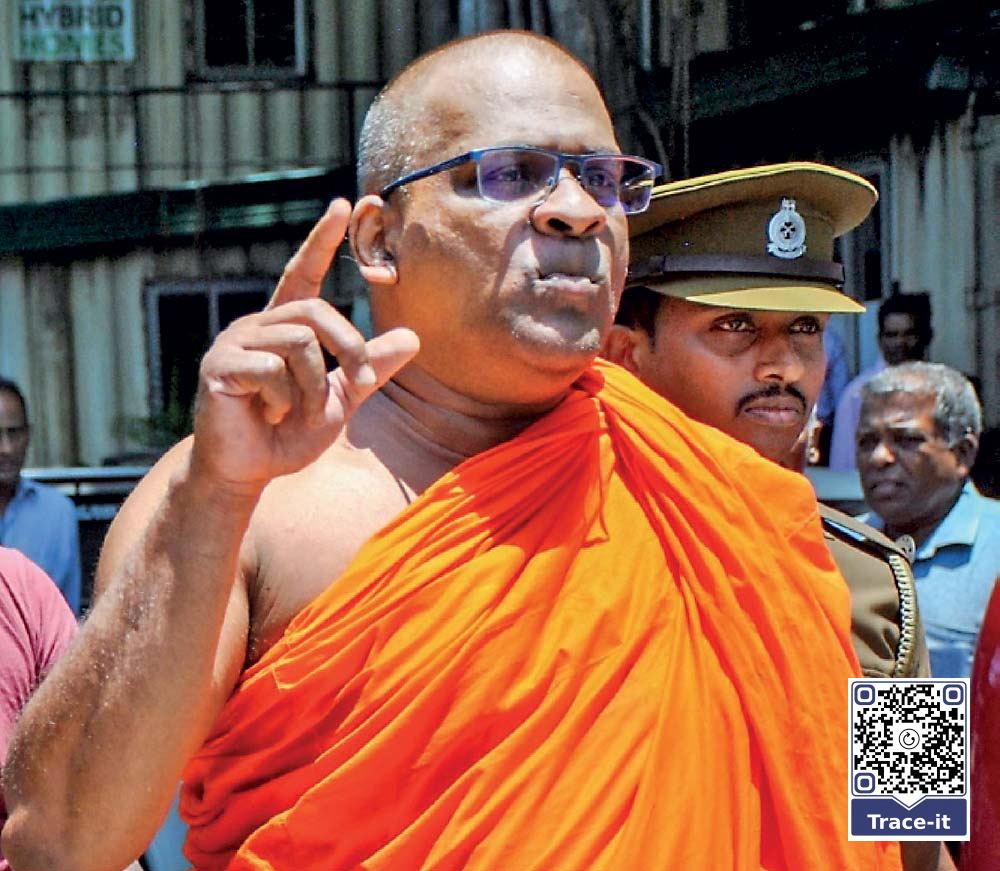
The imprisonment, presidential pardon and subsequent re-imprisonment of Galagoda Aththe Gnanasara Thero have exposed an uncomfortable contradiction in Sri Lanka’s administration of justice. His original conviction affirmed judicial authority, while the Supreme Court’s decision to invalidate his pardon reinforced the constitutional limits of executive power. Yet the Court has expressly recognised that another presidential pardon remains legally possible. When the State grants freedom unlawfully and takes it away years later, does correcting its mistake necessarily amount to complete justice?
 In August 2018, Sri Lanka’s Court of Appeal sentenced Galagoda Aththe Gnanasara Thero, the controversial general secretary of the Bodu Bala Sena, to six years’ imprisonment for contempt of court. Nine months later, former President Maithripala Sirisena exercised his constitutional authority to pardon him, bringing his imprisonment to an end. For more than seven years, Gnanasara remained free under the apparent legal protection of that presidential decision. Then, on 10 September 2026, the Supreme Court declared the pardon unlawful, and in October, the Court of Appeal ordered the remaining sentence to be enforced. The sequence presents an extraordinary constitutional predicament: an individual was imprisoned by the judiciary, released by the executive and returned to prison after the judiciary invalidated the executive’s intervention. These decisions invite a difficult examination of punishment, mercy, institutional accountability and the human consequences of State error.
The controversy surrounding Gnanasara should neither become an exercise in defending his conduct nor an opportunity to disregard the questions raised by his reimprisonment. His actions before the Homagama Magistrate’s Court in January 2016, during proceedings connected to the disappearance of journalist Prageeth Ekneligoda, were a serious affront to judicial authority. Entering proceedings in which he had no recognised legal standing, addressing the court without permission and challenging its authority were not merely imprudent acts of personal defiance, but conduct capable of undermining the administration of justice. The Court of Appeal convicted him on four counts of contempt, imposing sentences totalling 19 years that were to run concurrently, resulting in an effective six-year term. The judgment served a fundamental constitutional purpose: courts cannot function independently if their proceedings are vulnerable to intimidation, interference or attempts to exercise influence outside established legal procedure. Neither religious standing nor political prominence can provide immunity from that obligation.
Legal responsibility
Yet the original conviction and the subsequent presidential pardon belong to two different questions of legal responsibility. The former concerned Gnanasara’s own conduct; the latter concerned the executive’s exercise of constitutional power. Under Article 34 of Sri Lanka’s Constitution, the President possesses the authority to grant pardons, preserving a limited space for clemency within a system otherwise governed by judicial punishment. Its existence reflects an understanding that justice may, in exceptional circumstances, require consideration beyond the strict enforcement of a sentence. But clemency cannot become a substitute for constitutional procedure or a personal privilege of the President. When the executive alters the consequences of a judicial decision, it does so on behalf of the State, carrying obligations to the beneficiary, victims, the courts and the public.
The circumstances surrounding Sirisena’s decision consequently deserve close attention. The documentary record examined by the Supreme Court identified requests for Gnanasara’s release from senior Buddhist religious figures, including the chief prelates of the Malwathu, Asgiri and Kotte chapters, alongside representations from the Diyawadana Nilame and other individuals. The presidential files also recorded a request from Jainudeen Ameer, a Sri Lanka Freedom Party coordinating secretary in Muttur. What the judgment does not establish is that Gnanasara personally initiated the original request for clemency. This does not prove that he never desired or sought a pardon, but it raises a question about responsibility. If influential third parties petitioned the President and the President ultimately made the decision, how should the consequences of an unlawful exercise of that authority be understood in relation to its beneficiary? Receiving a pardon does not itself demonstrate responsibility for the constitutional deficiencies through which it was granted.
The Supreme Court’s September 2026 judgment exposed precisely those deficiencies. Examining the presidential records, the Court identified an inadequate explanation for the exercise of clemency and found that Sirisena had effectively adopted the recommendation of his Additional Secretary (Legal), rather than demonstrating the independent consideration required of the constitutional office. The Court also questioned whether representations opposing the pardon had received proper attention. Its conclusion was unequivocal: the decision was arbitrary, contrary to the public trust and natural justice, beyond the lawful exercise of his constitutional authority and inconsistent with the guarantee of equality under Article 12(1). The pardon was therefore declared null and void. This reasoning places the presidency firmly within the constitutional framework rather than above it. No elected officeholder should possess unquestionable authority to undo judicial punishment through an unexplained decision, particularly where judicial independence and public confidence are concerned.
The two judgments were not contradictory decisions about Gnanasara’s guilt, but complementary assertions of constitutional principle directed at different forms of misconduct. The 2018 Court of Appeal judgment, delivered under the contempt jurisdiction recognised by Article 105(3), addressed an individual’s interference with judicial authority. The 2026 Supreme Court judgment, by contrast, concerned a fundamental rights challenge to presidential clemency under Article 34. The former upheld respect for the courts; the latter prevented presidential discretion from undermining the rule of law. Crucially, the September judgment did not reopen the original contempt proceedings, impose a fresh sentence or determine that Gnanasara had committed another offence. It removed the legal foundation upon which his release had rested, leaving the remaining original sentence enforceable. The subsequent Court of Appeal order was therefore not a second conviction, but enforcement of an existing punishment. Permitting an unlawful pardon to acquire permanent legitimacy merely through the passage of time could weaken the constitutional accountability the Supreme Court sought to defend.
Nevertheless, the legal coherence of this outcome does not eliminate questions concerning its human consequences. Imprisonment disrupts personal autonomy, relationships, social responsibilities and ordinary expectations through which individuals organise their lives. A person released through an official presidential pardon may reasonably construct a future around its apparent legitimacy, particularly when years pass before it is invalidated. Reimprisonment after prolonged freedom could produce emotional uncertainty, distress and difficulties of adjustment, even where the original sentence remains valid. This does not establish that Gnanasara has suffered any clinically demonstrated psychological injury, nor should the hardships of lawful imprisonment invalidate punishment. Rather, the issue is whether the State must consider the foreseeable consequences of reversing its own decisions after they have shaped an individual’s circumstances for years.
The counterargument is equally compelling. If someone could retain the benefit of an unconstitutional pardon because cancellation would cause distress, the result might reward the very arbitrariness judicial review seeks to prevent. A convicted person cannot automatically acquire immunity from punishment because the executive acted improperly. Sandhya Ekneligoda, whose challenge to the pardon formed part of the Supreme Court proceedings, represents an interest that cannot be marginalised in discussions of compassion: the right of those affected by judicial proceedings to expect that court decisions will not be casually displaced by political influence. Her pursuit of accountability arises from circumstances of extraordinary personal significance, and the institutional protections affirmed in the judgment extend beyond Gnanasara. The dilemma is therefore not whether the judiciary should have tolerated an unlawful pardon, but whether invalidating it exhausts the State’s responsibility for the consequences of granting it.
 The controversy is not simply whether Gnanasara deserves imprisonment or another presidential pardon. It is a test of whether Sri Lanka understands justice as the enforcement of individual judgments alone or as a broader obligation requiring consistency, accountability and regard for human dignity throughout the exercise of State power
International comparisons
International comparisons illuminate this dilemma but also expose the danger of treating fundamentally different offences as interchangeable. In Peru, the invalidation of former President Alberto Fujimori’s humanitarian pardon concerned a man serving a 25-year sentence for grave human rights violations. In India, the Supreme Court’s 2024 reversal of remission in the Bilkis Bano case involved eleven men serving life sentences for gang rape and murder, whose release had been authorised by a State lacking the necessary legal authority. Both cases demonstrate that executive decisions relieving convicted individuals from punishment remain subject to judicial scrutiny and that their invalidation may require enforcement of existing sentences. Yet the gravity of those offences introduces considerations of accountability, victim protection and impunity that cannot simply be transferred to Gnanasara’s contempt conviction. The distinction does not diminish interference with judicial proceedings or justify an unconstitutional pardon. It instead requires a more precise understanding of justice: while the legality of executive clemency must be assessed independently of its beneficiary’s identity, the seriousness of the original offence, proportionality of punishment and consequences of prolonged reliance upon an official State decision may legitimately inform any subsequent consideration of mercy. Constitutional consistency does not require fundamentally different circumstances to produce identical clemency outcomes.
This distinction becomes particularly important when considering the accountability of the former President. Although the Supreme Court found Sirisena’s exercise of authority unlawful, it declined to make additional orders against him, observing that he had acted upon official instructions materially erroneous in law. The beneficiary of the pardon, meanwhile, faced the practical consequence of returning to custody. This does not necessarily reveal inconsistency, since constitutional findings, personal liability and enforcement of criminal sentences operate according to different legal principles. Nevertheless, the outcome raises an institutional question: when unlawful executive decisions are corrected, how does the legal system account for those who made, advised upon and relied on them? A judgment can establish constitutional responsibility without imposing identical consequences upon everyone involved, but the distinction between legal responsibility and its lived consequences deserves examination.
The protests
The protests by Buddhist monks demanding Gnanasara’s release have added another dimension, bringing religious influence and judicial authority into sharper focus. Their right to advocate mercy is no less legitimate than that of other citizens, but religious standing cannot itself justify disregarding a judicial sentence. The Supreme Court recognised the historical importance of the Buddhist clergy and the relevance of their representations while insisting that such requests could not replace the President’s independent constitutional judgment. Sri Lanka’s constitutional order must accommodate religious expression without allowing religious influence to determine who receives exceptional relief from punishment.
Indeed, the strongest test of the public arguments surrounding Gnanasara is whether they would remain persuasive if he were an ordinary prisoner without political connections, public recognition or influential religious supporters. If psychological distress arising from reimprisonment deserves consideration, that principle should extend to everyone affected by a comparable State error. Conversely, if equality requires enforcement of a lawful sentence notwithstanding an improperly granted pardon, that standard must also apply to individuals whose status might otherwise shield them from accountability. Mercy cannot be reserved for the powerful, just as punishment cannot become more severe because a convicted person is publicly unpopular. Fairness must be measured by the principles applied, not the identity of those before the law.
Perhaps the most consequential feature of the September judgment is the Supreme Court’s express recognition that invalidating Sirisena’s pardon does not prevent the President from granting Gnanasara another. On page 57, the Court clarified that its conclusions did not preclude a further pardon, provided any new decision was made according to law and after proper consideration of relevant material. This confirms that the constitutional defect lay not in presidential clemency itself, but in how Sirisena exercised that authority. Consequently, President Anura Kumara Dissanayake retains the constitutional power under Article 34 to consider a fresh pardon, although the Court neither recommended such intervention nor imposed any obligation upon him. The distinction is legally coherent but politically and morally difficult: a pardon was granted, declared unlawful and followed by reimprisonment, yet the same constitutional mechanism remains available to produce another pardon. Would fresh clemency, supported by proper reasons and transparent consideration, reconcile mercy with constitutional accountability or weaken the authority of the original judicial sentence? Conversely, should Gnanasara’s seven years of freedom under an official State decision be relevant to a new assessment, or would this allow the consequences of an unlawful decision to justify another? The Court’s qualification leaves responsibility for any future exercise of mercy with the President, who must distinguish constitutional discretion from political accommodation.
The question of State responsibility has gained urgency following former President Maithripala Sirisena’s statement of 19 October 2026, in which he acknowledged procedural failures while claiming that officials had misled him. Yet the Supreme Court’s ruling went beyond administrative error, finding that Sirisena failed to demonstrate independent constitutional judgment. Gnanasara consequently lost the freedom he had enjoyed for over seven years under an official State decision, although the constitutional failure arose from the exercise of presidential authority, not from any established wrongdoing by him in obtaining the pardon. Does this not present President Dissanayake with a critical opportunity to examine whether the consequences of the State’s own failure warrant reconsideration? A new pardon is neither legally required nor automatically justified; judicial independence, the original conviction and the public interest remain essential. But if constitutional accountability demands correcting unlawful executive action, should it not also demand scrutiny of the consequences that action created? When the State unlawfully grants liberty and subsequently withdraws it, does restoring the sentence fully restore justice, or merely correct the law while leaving the consequences of State error unresolved?
The present Government’s reluctance to yield to public pressure must be considered against Sri Lanka’s broader history of controversial presidential pardons, where decisions affecting liberty have repeatedly raised concerns about political patronage, unequal treatment and the limits of executive discretion. Yet Gnanasara’s case extends beyond whether President Dissanayake exercises Article 34. It exposes the need for a clemency process governed by transparent reasoning, proper consideration of relevant representations and safeguards protecting the public interest and those directly affected. The interval between the 2019 pardon and its invalidation in 2026 also raises concerns about prolonged constitutional litigation. Judicial scrutiny must be thorough, but where an executive decision determines whether a person remains free or returns to prison, the duration of uncertainty becomes part of the practical reality of justice.
Reconciling principles
The larger difficulty lies in reconciling principles that are individually defensible but not always easily accommodated together. The judiciary must protect its authority, the executive must remain accountable for discretionary powers, convicted individuals must face lawful consequences, and the State must recognise that its decisions can profoundly alter lives. Gnanasara’s contempt conviction should not be minimised, and invalidating his pardon affirmed constitutional Government. At the same time, neither conclusion eliminates the need to examine how an unlawful executive act remained operative for seven years, what responsibilities arose from that period of reliance and whether the legal system adequately addresses the consequences of institutional failures.
Ultimately, the controversy is not simply whether Gnanasara deserves imprisonment or another presidential pardon. It is a test of whether Sri Lanka understands justice as the enforcement of individual judgments alone or as a broader obligation requiring consistency, accountability and regard for human dignity throughout the exercise of State power. The original conviction protected the judiciary from an individual’s defiance, while the subsequent judgment protected the Constitution from an executive decision exceeding lawful authority. Both interventions served important purposes, yet their combined outcome leaves a question reaching far beyond the monk at the centre of the dispute: when the State punishes an individual for violating the law, but later violates the law in determining that individual’s freedom, where should responsibility ultimately rest, and what would a genuinely just resolution require?
(The author is an International Relations student at Monash University whose writing explores politics, governance, and international affairs)




