Saturday Nov 21, 2026
Saturday, 21 November 2026 00:10 - - {{hitsCtrl.values.hits}}
The 13th Amendment gave the regions a voice in 1987; the 12 June framework would give promises a penalty. Together they turn development from a gift into an opportunity, and opportunity into shared prosperity and trust. The question is whether Parliament will act before the street, and a generation, makes the argument for it
Human development is driven by people, not delivered to them. The State must do its part. The 13th Amendment already gives every province the means. A country that lets its citizens and regions build will be richer for it
This autumn, from Paris to Tirana and Belgrade, Europe’s young are marching against rising costs and failing services. Young protesters give the same explanation: nobody heard us.
Sri Lanka knows that sentence. The grievance is the same: sacrifice without a fair share, a real say, or anyone answerable when promises fail. More than 300,000 Sri Lankans left for foreign employment in 2024. A State that loses its young loses its future.
And the first rung of the ladder is breaking. Stanford researchers find that since late 2022, employment of 22- to 25-year-olds in the occupations most exposed to AI has fallen steadily behind their peers, a gap that has now widened to 19%, mainly because firms are simply not hiring them. The World Bank ranks Sri Lanka among South Asia’s most AI-exposed economies and last in jobs where AI complements workers rather than replaces them; nearly a quarter of our workforce is in exposed occupations. The clerical, call-centre and junior coding jobs our graduates queue for are the first to go. If Colombo cannot promise those first jobs, the regions must be free to create new ones, in work that needs local hands and local knowledge.
Recovery in the ledger, not yet in the kitchen
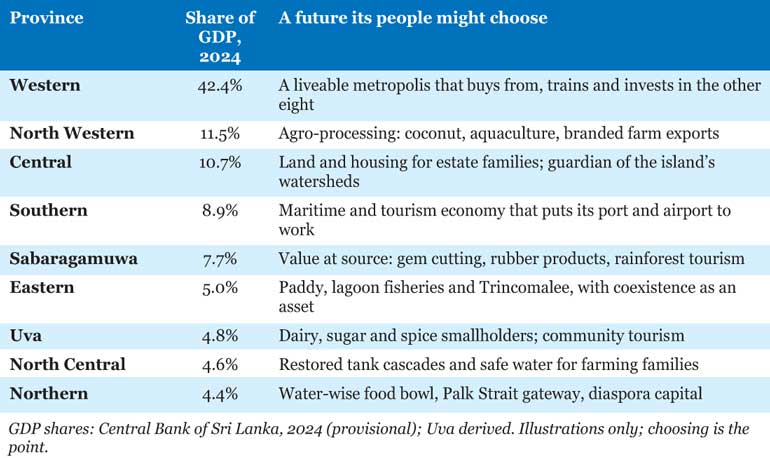
On paper, Sri Lanka has recovered: a primary surplus, rebuilt reserves, restructured debt. Households see otherwise. Poverty is near 17% nationally and 36% on the estates. In 2024 the Western Province produced 42.4% of national output; the North, 4.4%. For most of the country, development has been something done to it, not by it.
After 1987–89, the Presidential Commission on Youth heard young people say they could bear hardship but not deprivation with injustice. Its recommendations were shelved. Every uprising we have had followed one pattern: a voice unheard, a conflict escalated. The street is where unheard arguments go.
Do we give people the opportunity?
The 1986 UN Declaration on the Right to Development calls the human person the central subject of development: its active participant, not merely its beneficiary. That is the test Sri Lanka has failed since independence. In more than seventy-five years, no government has asked the regions what their development priorities are. Colombo has always decided. Decentralised budgets went to MPs, not regions; the District Development Councils of 1981 were stillborn; Provincial Councils have been starved of money and power since 1988. The outcome to date is four uprisings: the JVP insurrections of 1971 and 1987–89, a war in the North and East that consumed a generation, and the Aragalaya of 2022. We ask citizens to bear the cost, yet never let them, or their regions, decide what comes next.
Development is driven by the farmer, the fishing cooperative, the young coder in Vavuniya or Matara. The State’s role is large but supporting: guarantee the floor, share revenue fairly, build what no village can build alone.
The machinery we already have
The 13th Amendment of 1987 gave nine Provincial Councils 37 subjects of their own, among them agriculture, irrigation, health, education and provincial planning, and a Finance Commission to balance development across regions. Its intent was a measure of self-direction. That intent has been honoured mostly in the breach. Councils have gone nearly nine years without elections, most provincial money pays salaries, and subjects have drifted back to ministries.
The Praja Shakthi program shows the bottom-up instinct is alive: community councils in some 14,000 villages now propose local projects. But village councils that answer to a ministry, with no elected provincial tier above them, are a ladder missing its middle rungs. The 13th Amendment supplies those rungs. Using it needs no new constitution, only elections and the will to let elected councils decide.
Nine provinces, nine futures
Ask each province: what do your people want this place to be in ten years? Let the answer be a Provincial Development Charter, built from village assemblies upward, adopted by an elected council, costed, and tested against the minimums every citizen is owed. The State guarantees the floor and a formula-based share of revenue; the province chooses the path.
In the North, a charter might make the province the country’s most water-efficient farming region, owned through a farmer-majority Growers Federation and exporting across 64 kilometres to Tamil Nadu and to diaspora markets abroad. In the hill country, it would begin with dignity: land titles, housing and a route from estate labour to ownership. In the East, shared mills and fish markets could make coexistence pay. Some will fail. A province that tries and misses learns faster than a nation that waits for permission.
Others show it can work. In 1996 Kerala handed 35 to 40% of its development budget to local bodies; today its Kudumbashree women’s groups supply nearly a third of its local councillors.
Plan for the climate we have
Our plans are also written for a climate we no longer have. After floods and Cyclone Ditwah, the Meteorology Department now forecasts drought from January to April 2027 as a strong El Niño plays out. Yet budgets still treat floods, droughts, saline intrusion and coastal erosion as emergencies to answer afterwards, not conditions to design for.
Nor have we set out to harvest our waters. Monsoon rain runs off to the sea while the dry zone thirsts, and ancient tank cascades lie silted. At sea, an exclusive economic zone of 517,000 square kilometres, nearly eight times our land, yields little beyond overfished coastal waters, and about half the tuna caught on multi-day boats spoils before it reaches shore. Every provincial charter should begin with water: capturing and recharging fresh water, farming lagoons and reservoirs, and building cold chains so the sea’s catch becomes income, not waste. Regions know their hazards best. Let them plan for them.
Make the promise bind
Opportunity needs guarantees. The Sri Lanka Resilience and Accountability Framework, published in the Daily FT on 12 June, would turn development promises into obligations. It sets measurable targets in law, such as social protection of at least eight% of the budget and ten doctors per 10,000 people in every district. And it creates an independent commission able to sanction those who miss targets. A promise without a penalty is only a press release. Lenders, who audit our books while no one audits their impact, should meet the same standard. A public district dashboard would let every province see whether it is being heard.
Fairness must also reach within regions, to estate families, female-headed households, oppressed castes, persons with disabilities and informal workers. Equality cannot simply be devolved; it must be guaranteed.
Creators, contributors, custodians
Opportunity is a two-way bargain. Citizens create the jobs and revenue that fund every right, pay their taxes honestly, refuse bribes, and keep watch through the forums that write their province’s charter. The State’s side is to tax fairly, show results, and clear away the gatekeeping that strangles initiative.
The dividend
Will we not all be richer for it? The Western Province holds 28% of the people and produces 42% of output. The other eight provinces hold nearly three-quarters of the people, most of the land and water, and produce less than three-fifths. If they closed even half the gap in output per person with the West, the national economy would be roughly a quarter larger, without a rupee of new debt. That wealth will come not from Colombo but from people given the chance to build where they live.
The 13th Amendment gave the regions a voice in 1987; the 12 June framework would give promises a penalty. Together they turn development from a gift into an opportunity, and opportunity into shared prosperity and trust. The question is whether Parliament will act before the street, and a generation, makes the argument for it.