Thursday Oct 08, 2026
Thursday Oct 08, 2026
Thursday, 8 October 2026 00:19 - - {{hitsCtrl.values.hits}}
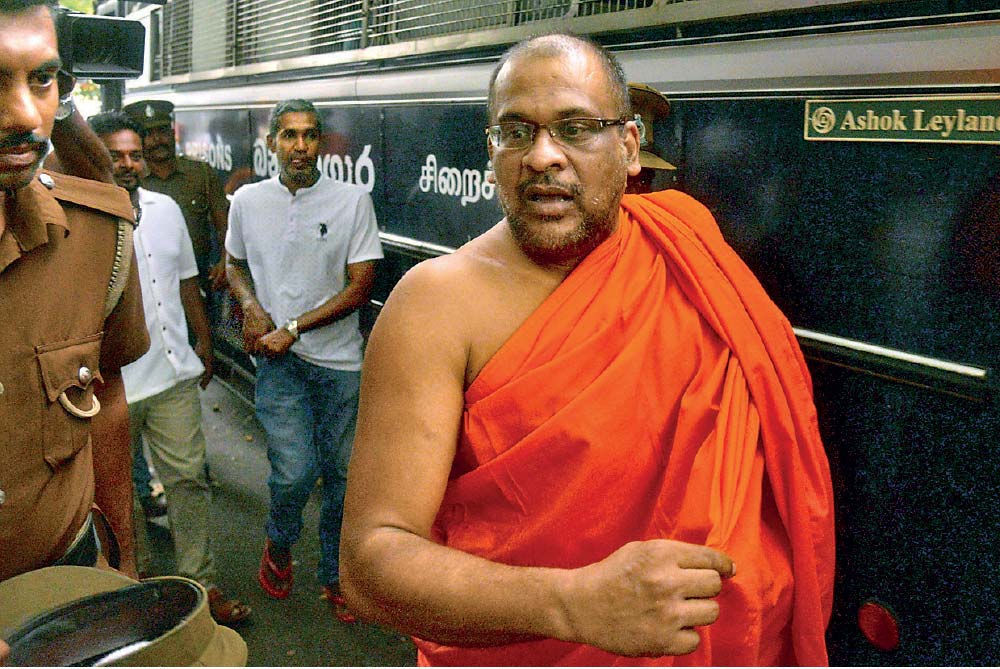
Bodu Bala Sena (BBS) General Secretary Ven. Galagoda Aththe Gnanasara Thera at the Majiatrate Court
- Pic by Jayamal Chandrasiri
 The sight of Galagoda Aththe Gnanasara in a White tunic Shirt being escorted to Court was more than an exceptional visual metaphor.
It pierced the psyche of the Sinhala-Buddhist polity. As I write this, it has been announced that some have planned a peaceful protest for the removal of his robes. That is understandable.
He loomed large in our firmament ever since he launched his Bodhubala Sena movement under the patronage of the then Defense Secretary Gotabaya Rajapakse.
In the volatile ecosystem of Sri Lankan ethnonationalism, the robing, disrobing, and incarceration of a monk are never merely matters of judicial procedure.
They ignite religious and political crises.
As the NPP government of President AKD attempts to steer our nation toward a civic, inclusive republic, it finds itself haunted by the very cosmic myths and institutional structures that have shackled the Sri Lankan state to Sinhala Budhist exceptionalism.
Maha Sangha’s unbroken lineage is a myth
To understand the Sangha panic over Gnanasara’s imprisonment, one must dismantle the historical balderdash that underpins Sinhala-Buddhist ethnonationalism.
The foundational myth of the ‘Maha Sangha ‘constituting a pristine unblemished lineage of blood, soil, and faith stretching back to the Buddha’s mythical visits to Lanka is a highly manufactured construct.
When types like the Buddhist monk and Retired Professor Kotapola Rahula rush to defend Gnanasara, claiming his actions do not amount to Parajika - the defects that demand expulsion from the Sangha, one can only plead that they would revisit Venerable Walpola Rahula’s seminal text,’ What the Buddha Taught’.
That we don’t have such Scholar monks around today is our miserable predicament.
Dhamma preaches detachment from identity. But our contemporary Sangha are obsessed with the preservation of institutional hegemony. They are at times embroiled in Succession litigation which takes years to resolve.
Nowhere is this manufactured nature more evident than in the Siam Nikaya itself. Far from a pristine spiritual lineage, the Siam Nikaya was established in the 18th century under the patronage of the Nayakkar King of Kandy—not as an act of pure spiritual revival, but as a deliberate instrument of feudal statecraft.
By restricting higher ordination (Upasampada) to the aristocratic Govigama caste, the Nikaya effectively institutionalised a system dedicated to perpetuating monastic landlordism.
As Venerable Kotagama Vachissara noted in his seminal critique of that era, the structural transformation of the Sangha under King Kirti Sri Rajasinghe was not merely an eco-systemic shift but calculated political re-engineering. Scholar monk Vachissara thero notes acidly;
“The King found in the new Sangha a powerful instrument of statecraft... By organising the monkhood into a centralised body under a Sangharaja, the Nayakkar dynasty successfully fused religious legitimacy with feudal administration, transforming the monastery into an economic and political extension of the Kandyan Throne.”
This is how this business of a Sangha Raja took shape!
This historic alignment of property, caste, and spiritual authority established a precedent that survived both British occupation and post-independence transitions.
When the British colonial masters arrived, they saw no reason to dismantle this hierarchy. Instead, the colonial administration was perfectly happy to mollycoddle the Sangha.
The formula was simple: protect monastic property rights and prestige, and in return, the monks would keep the populace subdued and loyal to the status quo. That is the sum total of the claim that the British undertook to Protect Buddhism.
They undertook to protect the vast land holdings of the Kandyan Monastic Landlords. Most ‘Radala’ families ordained a male Child to ensure that their land holdings were safe and kept expanding!
The modern political monks you find settled on their Dutch period Ebony Day beds – ‘Kavichchi ‘are not the descendants of ancient ascetics.
They are the products of the chemistry of British colonial ingenuity and Kandyan feudal engineering.
Hyenas of the Opposition
A few hyenas are now exploiting the Fault Line breached with the Gnanasara episode.
For an opposition left reeling by the NPP’s electoral ascent, the Gnanasara crisis is a godsend.
A fractured opposition has found common cause in weaponising the anxieties of the Sinhala-Buddhist majority, each playing a distinct role in confronting the two years old NPP government.
Dilith Jayaweera, the politically sagacious marketing wizard, understands the currency of identity. He recognises that ethnonationalism can be repackaged and branded for a modern audience that feels alienated by the NPP’s secular, technocratic rhetoric.
Jayaweera’s strategy is to position himself as the sophisticated guardian of the traditional heritage, offering a polished, media-savvy alternative to the NPP’s austere civic nationalism.
In contrast stands Patali Champika Ranawaka, the politically ruthless and clever-minded strategist. Ranawaka knows exactly where the structural levers of Sinhala-Buddhist power lie.
He does not rely merely on marketing; he understands the deep-seated fears of the majority. By framing the strict application of the law to a monk as an assault on the Sasana, Ranawaka aims to build a formidable, disciplined pressure group that can paralyse AKD’s reformist agenda.
Then comes Sajith Premadasa, the lackluster leader of the SJB. Lacking the ideological clarity of Ranawaka or the branding genius of Jayaweera, Premadasa has clumsily joined the fray.
His opportunistic commentary on the robing and disrobing of Gnanasara betrays a deeper desperation. Unable to present a coherent economic or social counter-vision to the NPP, the SJB resorts to the oldest trick in the local political playbook: proving they can be just as deferential to the saffron robe as the regime they seek to replace.
The NPP’s Puzzle - Civic Ideals vs Old Strategies
This brings us to the crux of the puzzle, President AKD and his NPP government must resolve.
The NPP campaigned on a brave, revolutionary promise—the establishment of a Civic Inclusive Republic that treats all citizens equally, untangled from the web of crony capitalism and ethnic chauvinism.
Yet, upon ascending to power, the gravity of Sri Lankan political tradition began to pull them back to earth.
To the dismay of purists, the NPP’s initial steps featured a regression into familiar strategies of the very crony elite class they replaced.
The public relations choreography began almost immediately with the mandatory exposition of the Sacred Tooth Relic in Kandy—a time-honored ritual utilised by every incoming administration to legitimise its rule through cosmic endorsement.
Furthermore, President AKD has found his schedule occupied by the need to humor various Maha Nayakas. He has been seen participating in the theatre of monastic politics, watching as hierarchs plan lavish investiture ceremonies to award themselves grand, feudal titles.
For a movement rooted in Left-progressive, egalitarian ideals, witnessing their leadership bow before altars of caste-ridden monastic landlordism is a jarring contradiction. At least to me it appears as such.
Confronting the cosmic myth
The NPP’s defenders argue that these are necessary concessions—tactical retreats to prevent the right-wing opposition from engineering a premature backlash.
They argue that one must speak the language of the old state to transform it.
But the Gnanasara issue has accelerated the timeline. The government can no longer afford to run with the civic hares and hunt with the ethnonationalist hounds.
Gnanasara in prison garb is a direct challenge to the Maha sangha’s myth of cosmic origins. It poses a fundamental question to the state.
Is a monk a citizen subject to the penal code of a modern republic, or is he an untouchable agent of a cosmic destiny?
If AKD and his team capitulate to appease specially the Kotte Chapter of the Siam Nikaya and to neutralise Jayaweera and Ranawaka—they will reveal their Civic Republic to be a mirage.
They will prove that the structural foundations of the Sri Lankan state remain unchanged, and that the NPP is merely the latest management team operating a feudal concession.
To truly succeed, the NPP must find the courage to decouple the state from the cosmic myth of the Sinhala-Buddhist tribe. They must remind the public that true Buddhism, as Walpola Rahula argued, does not require the protection of prisons, caste exclusions, or state-enforced hegemony. The Dhammapada dictates how we should act and behave.
The path forward lies steadfastly defending the rule of law equally, whether the citizen wears a collar, a sarong, or a saffron robe. Only then can Sri Lanka transition from a feudal fiefdom masquerading as a democracy into a genuine, inclusive republic.
Writers Note:
At 84, I lived through the long, complex chapters of Sri Lanka’s post-independence history. This missive was prompted by a WhatsApp exchange this morning between me and two others, both in their fifties.
While one maintained that the prison authorities acted strictly according to the law, the other, while agreeing that punishment was deserved, added the familiar caveat: “But this is a Sinhala Buddhist Country.”
Hearing this phrase repeated by the generations much younger, —men who have themselves witnessed the heavy toll of our island›s identity politics—compelled me to switch on my PC and start writing.
It made me realise how deeply the myths of exceptionalism remain embedded even among the rational. This essay is my attempt, in the twilight of my life, to express my anguish, and challenge the historical assumptions we take for granted, and urge the current generation to look beyond the cosmic myth toward a truly equitable republic.



