Wednesday Sep 16, 2026
Wednesday Sep 16, 2026
Wednesday, 16 September 2026 00:27 - - {{hitsCtrl.values.hits}}
 Congratulations on a well-balanced editorial on Saturday which brilliantly gives a snapshot of the Government healthcare system in Sri Lanka. (See https://www.ft.lk/ft_view__editorial/Holistic-approach-for-healthcare-system/58-797133 ) The choice of title of the editorial (Holistic approach for healthcare system) brings out a very philosophical angle to healthcare.
Our hospital based health system (for right or wrong) is disease and doctors centred. This is so in many global settings particularly in Asia. A holistic health system ought to be health and patient centred.
Data indicates that on average only about 6-7 million admissions are recorded to Government hospitals annually. This is in contrast to 80 million who seek OPD (correct term is Ambulatory Primary Curative Care) in Government hospitals. To this figure one must add another 40-45 million private OPD visits.
In other words in contrast to popular belief healthcare (or in Sri Lanka’s case disease treatment) is not delivered in patient settings in Government hospitals. Rather it is delivered and consumed in Ambulatory Curative Primary Care (ACPC) system.
To further simplify the health seeking behaviour pattern of the Sri Lankan population - every man, woman and child visits an Ambulatory Curative Primary Care system 6 times per year).
This simple fact has been consistently, persistently, deliberately and to a degree negligently ignored by successive technocratic bureaucracy and political authorities in the country with a myriad of health (as opposed to disease consequences) impact to the population and tremendous financial burden to the treasury.
As such a reorientation of healthcare (health maintenance and disease care) to model based on provision of holistic health care (as opposed to disease or organ system based specialist care) is must.
In this context, establishment of Primary Curative Care Centres should be welcome provided the doctors manning these centres and providing care and treatment to those who access these centres are competent.
One cannot and should not accept the Final MBBS qualification as a competency to deliver the expected Primary Ambulatory Curative care at such centres.
Doctors with MBBS qualification before being posted to Ambulatory Primary Curative Care Centres must undergo a structured training program in the Principles and Concepts of General Practice/Family Medicine. At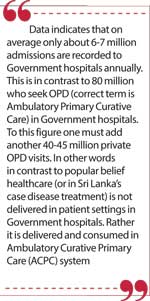 present Medical Officers of Health (MoH) who are posted to MoH officers all over the country to deliver Primary Preventive Care undergo an extensive in-service training program prior to taking up their posts in the Health Ministry. As such merely posting a doctor soon after his/her internship without an in-service training programme in Ambulatory Curative Care will cause more damage to patients and undermine the concept the government is trying to introduce.
In brief the following basic points must be included in a training program for such doctors to be places in Ambulatory Curative Primary Care Centres.
1. Knowledge/Skills/Attitudes to identify risk factors and/or make a diagnosis
2. Knowledge/Skills/ Attitude to control identified risk factors and/or commune treatment (pharmacological and non-pharmacological) of the abnormal parameters in the diagnosis made.
3. Knowledge/Skills/Attitudes to sustain control of the identified risk factors and/or treatment (pharmacological and non-pharmacological)of the abnormal parameters over time
4. Knowledge/Skills/Attitude to actively look for complications of the risk factors and/or diagnosis made.
5. Knowledge/Skills/Attitudes to manage (pharmacologically and non-pharmacologically) complications of the risk factors and/or diagnosis made.
6. Knowledge/Skills/Attitudes to identity emergencies of the risk factors and/or diagnosis made
7. Knowledge/Skills/Attitude to manage the emergencies identifies of the risk factors and/or diagnosis made
8. Knowledge/Skills/Attitude to identity risk factors and diagnosis which require immediate, intermediate and/or long term referral and/or follow up at secondary and/or tertiary and/or Supra specialised centres. (Referral -What, When, Where, and How. In this concept a system of back referral from higher centres to primary care to further manage patients becomes a must)
9.Knowledge/Skills/Attitude to conduct simple research projects based on the clinical and non-clinical data generated at the Ambulatory Curative Primary Care Centres.
The utopian outcome of such a training program for doctors to be stationed at Ambulatory Curative Care Centres is that they become and provide services to the local communities they are stationed in as five star doctors.
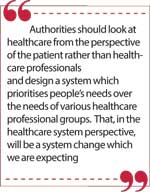
There is no question that we need a reorientation of care provision and service delivery which maintains the concept of free at point of care healthcare service delivery. The question is how best do we do it, and for once may I urge the authorities to look at healthcare from the perspective of the patient rather than healthcare professionals and design a system which prioritises people’s needs over the needs of various health care professional groups. That, in the healthcare system perspective, will be a system change which we are expecting.
(The author is a Specialist Family Physician; Founder Head, Department, Family Medicine Faculty of Medicine, University of Colombo and President Sri Lanka Medical Association 2018)




