Thursday Oct 15, 2026
Thursday Oct 15, 2026
Wednesday, 22 April 2026 00:43 - - {{hitsCtrl.values.hits}}
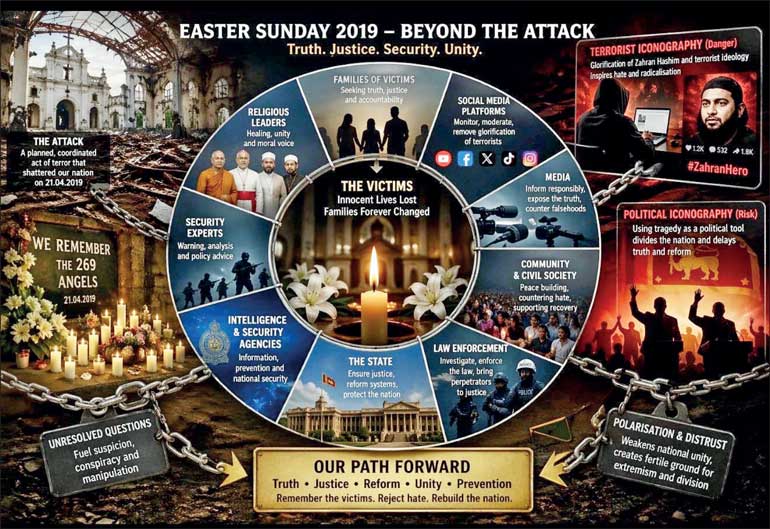
 Seven years after the 2019 Sri Lanka Easter Sunday attacks, Sri Lanka continues to live not only with the grief of that day, but also with the unresolved struggle over how the tragedy is remembered, interpreted, and politically used. Over 260 innocent people were killed, hundreds were injured, and thousands of families were left with pain that time has not erased. Yet each year, as the commemoration returns, so too does a familiar contest over narrative, blame, symbolism, and ownership of memory.
Recent warnings about online comments glorifying Zahran Hashim and references to “terrorist iconography” raise an important concern. Any public praise for a mass murderer must be taken seriously. The glorification of terrorist figures can normalise violence, influence vulnerable minds, and create dangerous pathways toward radicalisation. In an age where digital propaganda moves faster than institutions can respond, dismissing such trends would be irresponsible.
But there is another side to this debate that deserves equal attention. If terrorist iconography refers to the symbolic elevation of killers, then Sri Lanka must also confront what may be called political iconography, the repeated use of national tragedy as a symbolic instrument in political competition.
The Easter attacks have become more than a criminal atrocity requiring truth and justice. They have become a recurring emblem invoked by political actors, commentators, and institutions for different purposes: to discredit rivals, to revive fear, to project strength, to demand loyalty, or to re-enter public relevance during moments of national reflection. In this process, grief is often converted into messaging, and remembrance into rhetoric.
This does not mean that everyone who speaks about Easter Sunday is acting in bad faith. Far from it. Victims’ families continue a legitimate and moral struggle for answers. Religious leaders seek accountability. Security experts warn of continuing threats. Journalists ask necessary questions. Citizens remember the dead. These are valid democratic functions.
Yet the danger arises when selective outrage replaces consistent principle. Why do some voices become loud only during anniversaries? Why are warnings amplified seasonally but forgotten structurally? Why is symbolism emphasised more than systemic reform? Why does the nation still debate narratives when it should have long ago established full institutional accountability?
The real national security challenge is not merely a handful of offensive online comments. It is the persistence of unresolved failures that allow conspiracy, distrust, and manipulation to flourish. When truth is delayed, narratives multiply. When justice is incomplete, symbolism becomes power. When institutions fail to communicate credibly, politics fills the vacuum.
Sri Lanka’s tragedy was not accidental. It was a planned and coordinated act of terror. But what followed also matters: intelligence warnings allegedly missed, failures of coordination, unanswered questions, public distrust, and years of competing claims. That post-attack environment transformed a security catastrophe into a continuing political battlefield.
This is where the concept of political iconography becomes useful. It describes the way certain events are repeatedly displayed in public life as emotional symbols detached from meaningful reform. The attack becomes an image rather than a lesson. The dead become references rather than responsibilities. Security becomes a slogan rather than a professional system.
A mature State must reject both forms of iconography. It must reject the glorification of terrorists and the exploitation of victims. It must challenge extremist narratives online while also refusing to turn mourning into campaign material. It must remember the dead with dignity, not utility.
What would a responsible path forward look like?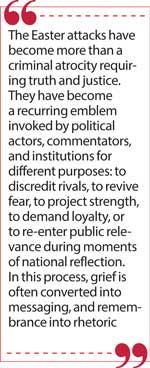
Sri Lanka cannot heal if every April becomes a marketplace of accusation. Nor can it remain safe if genuine warning signs are ignored because the public has grown cynical from years of politicisation.
The country deserves better than annual outrage cycles. It deserves truth, reform, and moral consistency.
The Easter attacks should be remembered as a solemn national wound that demanded institutional change. Instead, too often they remain a symbolic resource to be reactivated when convenient.
The question, then, is not who controls the narrative of Easter Sunday. The real question is whether Sri Lanka is finally prepared to move beyond narratives altogether and choose justice over symbolism, reform over theatre, and memory over manipulation.
“The real danger is not only terrorist iconography, but the repeated conversion of national trauma into political currency.”
(The author is a former senior law enforcement officer and national security analyst, with over four decades of experience in policing and intelligence, including serving as Head of Counter-Intelligence at the State Intelligence Service of Sri Lanka and a graduate of the Asia Pacific Centre for Security Studies in Hawaii, USA)