Thursday Oct 15, 2026
Thursday Oct 15, 2026
Thursday, 15 October 2026 00:13 - - {{hitsCtrl.values.hits}}
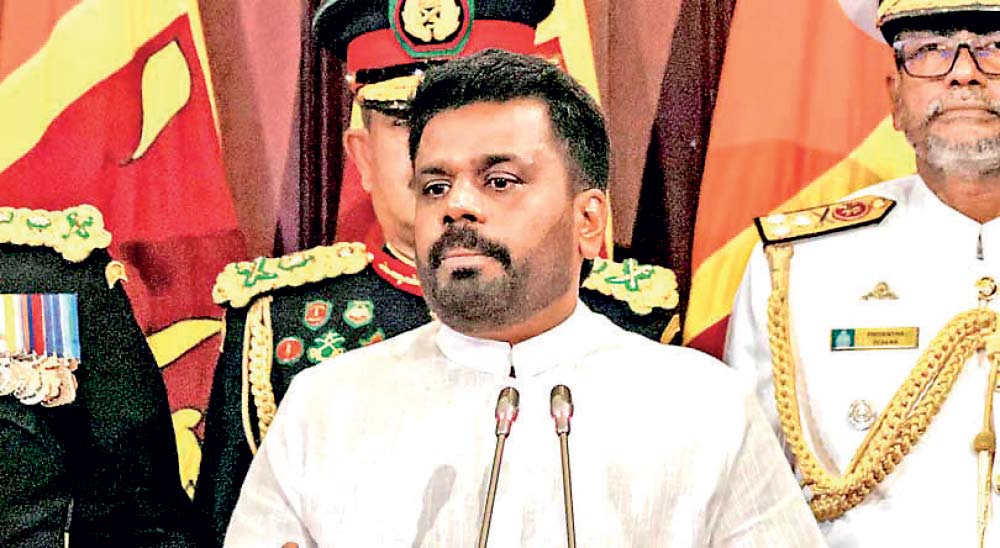
President Anura Kumara Dissanayake
 A small, empowered project-delivery unit reporting to the Cabinet, with authority to resolve inter-agency issues for projects of national importance, would cut timelines dramatically. Pairing it with clear performance indicators for agency heads, linked to approval times and project completion, would embed a culture of delivery across the public service. The Government’s strong focus on efficiency and integrity gives it a natural mandate to lead this change which could be a defining factor of competitive edge
The President’s discussion at Sri Lanka Economic Summit 2026 set out a confident, investment-friendly direction. With a few additions, it can become the blueprint for Sri Lanka’s next growth chapter.
 President Anura Kumara Dissanayake’s discussion at Fireside Chat at the Sri Lanka Economic & Investment Summit 2026 on 12 October sent a clear and welcome message: Sri Lanka is open for private investment, and the Government means business.
The announcements were substantive. Private operating rights for the East Container Terminal. A USD1.4 billion breakwater to unlock West Container Terminal phase II. A fresh tender for a logistics centre inside Colombo Port and a PPP container examination yard at Kerawalapitiya. Relief on the bunkering industry from SSCL and private investment in bunker storage, known as JCT Oil Bank. Four power transmission lines, as part of national power grid to be tendered to private investors, a Singapore-supported AI skills centre and tax relief for rural investment.
Taken together, they mark a pragmatic shift towards partnership with the private sector. This article builds on that direction and suggests complementary steps that can turn a strong agenda into a sustained growth story.
A strong foundation to build on
The Government deserves credit for what has already been achieved. Reserves are being rebuilt, credit ratings have improved and the country is on track to meet its IMF program targets. The President’s insistence that growth must protect these gains reflects sound economic judgement.
The energy record is equally encouraging. About 1,500 MW of solar has been added since the Government took office, with another 1,100 MW contracted. Renewables now supply around 69% of generation, and the country has gone days without diesel-fired power. The move from fixed feed-in tariffs to competitive tenders will lower costs for households and industry alike.
The President also opened the door to a growth-oriented successor arrangement with the IMF. That is the right instinct. Stabilisation has served its part; the natural next step is a deliberate transition to investment-led growth.
The President’s address showed a Government that is confident, pragmatic and ready to partner with the private sector. That is a strong platform.
A pragmatic framework for the growth phase
To move from stability to sustained growth of 5–6% a year, the summit’s announcements can be anchored in a simple, practical framework:
1.Integrate with global supply chains by targeting the sectors Sri Lanka can win.
2.Accelerate strategic infrastructure through private capital.
3.Enact the PPP law to give that capital a secure foundation and attract capital investment through right structure.
4.Build a best-in-region business environment, measured against our competing neighbours.
5.Modernise agriculture using AI and digital tools.
6.Reform the labour market for a productive, inclusive workforce.
Each pillar extends what the Government has already begun. The sections below take them in turn.
1. Joining global supply chains
The port reforms give Sri Lanka a powerful head start. A more efficient Colombo hub, with ECT under an experienced operator and WCT II adding capacity in the future would undoubtedly place Sri Lanka at a greater advantage and lowers logistics costs for exporters.
The next step is to pair this hub with a clear sector strategy. Manufacturers are diversifying their supply chains across Asia, and Sri Lanka’s location on the East–West shipping lane is a natural advantage. A short list of priority sectors, such as electronics assembly, higher-value apparel, processed food, pharmaceuticals, marine services and digital services, each with a dedicated investment package of land, incentives and skills, would turn port capacity into export growth.
2. Strategic infrastructure for a growth push
The port and electricity transmission grid projects show the Government’s appetite for transformative infrastructure. Two further projects would amplify that momentum:
Projects on this scale, alongside storage, transmission and urban transport, call for capital beyond the public budget. The president’s remark emphasising on PPPs shows that Government recognise it as a priority, however, the missing piece is the legal framework.
3. The PPP law: the keystone of the agenda
Nearly every project the President announced, from ECT and Kerawalapitiya to floating solar at Randenigala and new transmission lines, is envisaged as a public-private partnership. A dedicated PPP Act would give all of them a common, secure foundation.
Sri Lanka has used PPPs since the 1990s, and a PPP law has been discussed for nearly two decades. This Government has brought it closer than ever: a draft Bill was published for public comment in 2025, with technical support from the Asian Development Bank, and officials have signalled their intent to introduce it soon.
Enacting it would provide:
Passing the PPP Act, with the refinements proposed by the Ceylon Chamber and other stakeholders, would be the single most powerful way to deliver the President’s pledge of predictable rules and stronger investor protection. Budget 2027 offers the ideal moment to set a firm date.
4. A best-in-region business environment
The President’s pledge of transparency, investor protection and infrastructure support sets the right narrative. The opportunity now is to make Sri Lanka not merely competitive with its competing peers, but the easiest place in South Asia to start, run and grow a global business.
Investors compare destinations on practical questions. How quickly can a company be registered? How long does it take to secure land, a building permit or a power connection? How fast does cargo clear? How reliably are contracts enforced? Sri Lanka can set itself an ambition to match or beat the best in the region, including Vietnam, Malaysia and Thailand, on every one of these measures.
A practical reform package could include:
The most valuable reform may also be the least costly: better coordination across inter-governmental agencies. A single project can need approvals from the BOI, UDA, Central Environmental Authority, local and provincial authorities, line ministries and the Treasury.
A small, empowered project-delivery unit reporting to the Cabinet, with authority to resolve inter-agency issues for projects of national importance, would cut timelines dramatically. Pairing it with clear performance indicators for agency heads, linked to approval times and project completion, would embed a culture of delivery across the public service. The Government’s strong focus on efficiency and integrity gives it a natural mandate to lead this change which could be a defining factor of competitive edge.
5. An AI-driven agricultural revolution
The President’s attention to rural investment opens the door to one of Sri Lanka’s biggest opportunities. Agriculture still employs a large share of the workforce, nearly 23%, yet its productivity lags well behind the rest of the economy. Global advances in artificial intelligence and digital farming can close that gap faster than ever before.
Around the world, farmers are using AI to decide what to plant, when to irrigate and how much fertiliser to apply. Satellite and drone imagery detect crop stress and disease early. Mobile advisory services deliver tailored guidance in local languages. Digital marketplaces connect smallholders directly with buyers and exporters.
Sri Lanka can adopt these tools at scale:
Paired with the new AI skills centre, these steps could turn agriculture from a source of rural vulnerability into an export engine and a driver of rural prosperity.
6. A modern, inclusive labour market
Skilled labour force is the biggest asset in Sri Lanka. Modernising labour laws would enable more conducive environment and will cater for the changing global economy.
Existing labour laws, including laws such as the Shop and Office Employees Act of 1954 and the Termination of Employment of Workmen Act of 1971, was designed for a very different economy. Consolidating labour laws into a single, modern code would bring clarity for workers and employers alike.
Priorities could include:
Reforms designed through dialogue with employers and trade unions would balance fairness with flexibility, and give investors confidence that Sri Lanka’s workforce is ready to grow with them.
The IMF program offered the country a firm footing, long awaited macro stability. With right plans, Sri Lanka can rollout a growth strategy within next two years. Budget 2027 is the ideal place to begin, and the private sector stands ready to play its part
A moment of opportunity
The President’s address showed a Government that is confident, pragmatic and ready to partner with the private sector. That is a strong platform.
With a clear growth framework, deeper integration into global supply chains, strategic infrastructure, an enacted PPP law, a best-in-region business environment, AI-powered agriculture and a modern labour market, Sri Lanka can turn the stability it had earned into lasting prosperity.
The IMF program offered the country a firm footing, long awaited macro stability. With right plans, Sri Lanka can rollout a growth strategy within next two years. Budget 2027 is the ideal place to begin, and the private sector stands ready to play its part.
(The writer is a CFA charterholder and holds the FRM designation, with prior experience at the Central Bank of Sri Lanka and the Ministry of Finance. The views and opinions expressed in this article are those of the writer and do not necessarily reflect the official policy or position of any institution)




