Thursday Oct 22, 2026
Thursday Oct 22, 2026
Wednesday, 7 January 2026 02:19 - - {{hitsCtrl.values.hits}}
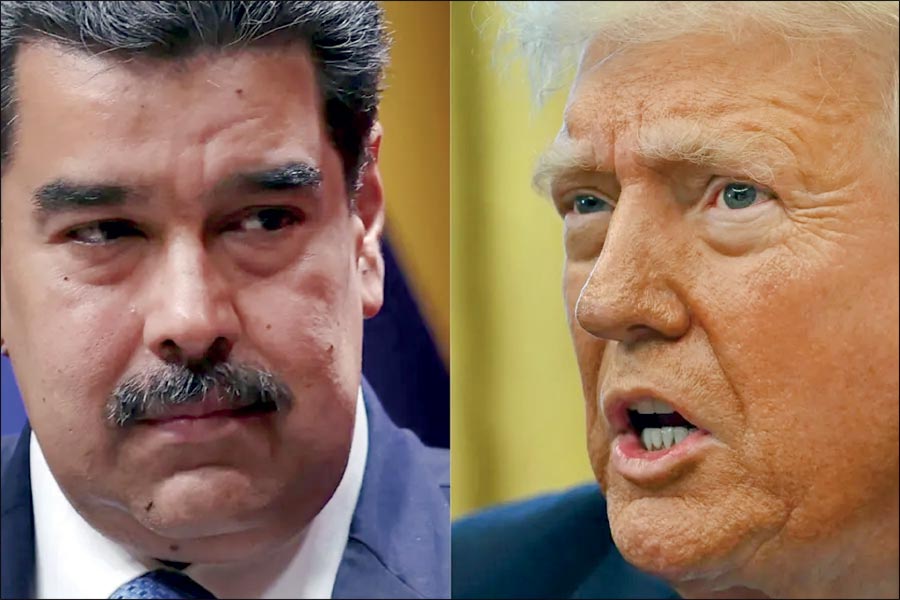
Venezuelan President Nicolás Maduro and US President Donald Trump
 THE reported US operation to seize Venezuelan President Nicolás Maduro, followed by President Donald Trump’s declaration that America would “run” Venezuela, has triggered a global debate that goes far beyond Venezuela itself. The deeper issue is precedent: when great powers choose governments by force without clear legal authority or accountability, the rules based order becomes optional and the world drifts toward rule by power.
1. What happened in Venezuela in simple terms
In the first hours after the news broke, international media reported US strikes in Venezuela and the capture of President Nicolás Maduro, who was subsequently flown out of the country [1]. This framing suggested something more than a counter narcotics or limited security operation. It implied the seizure of a sitting head of state and the deliberate shaping of a successor authority.
The second shock followed quickly. President Donald Trump publicly stated that the United States would “run” Venezuela during the transition [2]. Whether later clarified or softened, the phrase matters. It signals not pressure or diplomacy, but governance — an assertion that the United States intends to exercise administrative authority over another sovereign State.
2. How people reacted and why it matters
Public reaction was immediate and intense. Comment sections, protest actions, and street demonstrations — including rallies in front of US embassies — were dominated by words such as “kidnapping,” “coup,” “illegal invasion,” and “war crime.” This language reflects more than emotional outrage. It reveals a widespread belief that a fundamental international norm has been broken [3].
Three patterns stand out. First, norm collapse anxiety. Many fear that if one superpower openly removes a foreign leader and claims a right to manage the country, others will follow. Sovereignty begins to look conditional.
Second, motive distrust. Many assume oil interests, strategic positioning, or domestic political distraction as the real drivers, not democracy promotion.
Third, domestic spillover. Commentators connect the external action to internal democratic decay within the United States, questioning whether constitutional checks and balances still operate effectively.
Even allowing for exaggerations of online discourse, the moral grammar is revealing. What was once framed as order making is increasingly read as coercion.
3. Has the US President overreached constitutional power?
This is not merely a political question; it is a constitutional one.
Under the US Constitution, Congress holds the authority to declare war and regulate captures, while the president serves as commander in chief. While this division has always produced grey areas, large scale hostilities and regime removal lie at the heart of congressional war powers [4].
Legal analysts cited in early coverage raised immediate questions about the absence of clear congressional authorisation and the scale of the operation [5]. A president may act swiftly in emergencies, but the removal of a foreign head of state and the declaration of intent to administer a country go far beyond limited defensive action.
4. How legal is the strategy under international law?
International law does not prevent all uses of force, but it sets a high bar. The UN Charter prohibits force against the territorial integrity or political independence of states, except in self defence or with explicit Security Council authorisation.
The language of “running” another country undermines the post 1945 taboo against conquest and imposed government. Even where leaders are authoritarian or illegitimate, method matters. Once regime seizure is accepted as a tool of statecraft, legality becomes selective and power decisive.
5. The dangerous precedent: Three hypothetical scenarios
Scenario A: Russia and Ukraine
Russia could argue that the Venezuelan operation legitimises a full takeover of Ukraine under its own security logic. If regime removal by force becomes acceptable for one power, moral resistance weakens for others.
Scenario B: China and Taiwan
China could point to the same precedent to justify decisive action against Taiwan, arguing that sovereignty is subordinate to enforcement capacity.
Scenario C: A tripolar world
The world risks hardening into three informal spheres dominated by the United States, China, and Russia — each enforcing its zone and treating international institutions as decorative rather than binding.
6. What this means for Sri Lanka right now
Sri Lanka observes these developments from a position of vulnerability: strategic location, economic fragility, and heavy external dependence.
In April 2025, Sri Lanka and India deepened defence cooperation during Indian Prime Minister Narendra Modi’s visit [6]. In November 2025, Sri Lanka also signed a defence cooperation MoU with the United States under the State Partnership Program [7].
The issue is not engagement itself. Sri Lanka cannot afford isolation. The concern is process: limited disclosure, weak parliamentary anchoring, and growing public suspicion that security commitments are advancing faster than democratic consent.
7. Practical guidelines: How Sri Lanka avoids bending to one power
Sri Lanka can reduce vulnerability through five disciplines: parliamentary ownership of security commitments; clear national red lines against foreign basing and entanglement; balanced external relations; transparency by default; and regional confidence building focused on non provocative cooperation.
8. The core lesson from Venezuela
The lesson is not about Maduro’s virtues or vices. It is structural. When powerful states demonstrate that they can seize leaders and announce administrative control, the international system shifts from law to precedent.
For Sri Lanka, survival in such a world depends less on slogans of neutrality and more on strong domestic rules. When internal constitutional discipline is firm, external pressure loses force.
(The author is a political economist and independent writer. He has published widely on constitutional governance, political economy, and foreign policy. He can be contacted at [email protected])
Footnotes
[1] Reuters, Trump says U.S. will run Venezuela after U.S. captures Maduro, January 2026.
[2] TIME, “We’re Going to Run the Country”: Trump Signals Long Term Involvement in Venezuela, January 2026.
[3] Reuters, coverage of international reactions and protests following the Venezuela operation, January 2026.
[4] US Constitution, Article I, Section 8; War Powers Resolution of 1973.
[5] Reuters, legal analysis on congressional authorisation and presidential war powers, January 2026.
[6] Indian Ministry of External Affairs / Sri Lankan Government statements on defence cooperation during PM Modi’s April 2025 visit.
[7] US Department of Defense and Sri Lanka Ministry of Defence statements on the State Partnership Program MoU, November 2025.




