Monday Sep 28, 2026
Monday Sep 28, 2026
Monday, 28 September 2026 03:36 - - {{hitsCtrl.values.hits}}
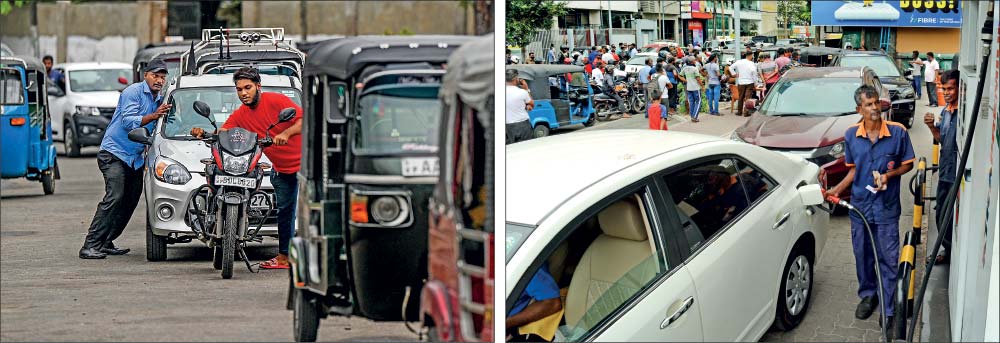
Having queued once for the mistake of over-control, the country should be in no hurry to queue for it again
 Sri Lanka spent six decades finding out what a single, politically insulated fuel monopoly does under pressure. It has spent the last four years finding out, gradually and imperfectly, what something better looks like. The Hormuz shock of 2026 is painful evidence that the job of aligning local prices with international markets is not finished — but it is not evidence that the direction was wrong
 President Anura Kumara Dissanayake has reportedly asked the International Monetary Fund to relax the cost-based fuel pricing formula that has underpinned Sri Lanka›s energy market since the 2022 collapse, seeking room for the Government to subsidise pump prices rather than pass through the full weight of surging global crude costs to consumers. Coming after a year in which fuel has already been revised upward by more than a third, the instinct behind the request is easy enough to understand. It is also, this piece argues, precisely the instinct Sri Lanka can least afford to indulge.
There is a particular image that has come to define Sri Lanka›s 2022 crisis more than almost any other: kilometre-long queues of vehicles outside filling stations, drivers sleeping in their cars overnight, and a nation reduced to rationing petrol by the litre. It is worth remembering that image today, not out of nostalgia for a painful period, but because it is the baseline against which the President›s request — and everything else that has happened since, including the price pressures of 2026 — must be judged. The temptation, when prices rise, is always to reach for control. The lesson of the last four years is that control is precisely what got us into trouble in the first place, and that the gradual, uncomfortable work of opening the market is what has kept us from going back.
A monopoly built for failure
To understand why liberalisation matters, it helps to remember what came before it. Sri Lanka’s fuel trade was nationalised in the 1960s, folding what had been a competitive, multi-company market into a single State entity — the Ceylon Petroleum Corporation.
For the better part of four decades, CPC was not merely the dominant player; it was the only one. It imported, refined, stored, distributed and sold virtually every litre of fuel consumed on the island, answerable not to competitive pressure but to political direction.
That model had a brief crack of light in 2002, when the Government allowed India’s Lanka IOC to enter the market, commencing retail operations here in 2003. But one competitor against an entrenched, politically protected incumbent with the country’s storage infrastructure and legacy distribution network barely dented CPC’s dominance.
For nearly twenty more years, Sri Lanka effectively ran a duopoly in name and a monopoly in practice — and it behaved exactly as monopolies do. Losses were absorbed by the Treasury rather than disciplined by competitors. Borrowing was backed by Government guarantees rather than commercial credit discipline. By early 2022, CPC’s liabilities to State banks alone had swollen past Rs. 700 billion, and cumulative losses would eventually be estimated in excess of Rs. 900 billion. There was no market mechanism forcing efficiency, because there was no market.
The collapse, and what it actually taught us
When Sri Lanka’s foreign exchange reserves ran dry in early 2022, fuel was among the first and most visible casualties — not because fuel was uniquely mismanaged, but because a single, State-funded importer with no alternative source of dollars is a single point of failure by design. When the State could not find hard currency, the country simply could not buy fuel, regardless of what international prices were doing. The queues, the fuel rationing by QR code, the power cuts as diesel-starved plants went offline — all of it traced back to one structural fact: Sri Lanka had built an energy security model with exactly one point of failure, and that point failed.
The reform that followed deserves more credit than it usually gets. In June 2022, at the height of the crisis, the Cabinet approved opening fuel import and retail to companies from oil-producing nations, on one non-negotiable condition: they would have to bring their own foreign exchange. No State bank guarantees, no drawing on Sri Lanka’s own depleted reserves, and — in the early period of operation — no repatriating profits out of the country. It was, in effect, an invitation to absorb Sri Lanka’s currency risk rather than add to it. By March 2023, licenses had been awarded to China’s Sinopec, Australia’s United Petroleum, and America’s RM Parks in partnership with Shell, joining Lanka IOC as the fourth foreign entrant. Sinopec began pumping fuel at its first station in Mattegoda that August, at a discount to CPC’s own pump price. United Petroleum followed. Between them, these new entrants took over roughly 150 CPC-run filling stations and committed to building dozens more.
Competition, it turns out, does not automatically mean cheaper — it means prices set by commercial logic rather than political convenience, which is not the same promise. A sudden, complete removal of price oversight could expose ordinary households to volatility just as severe as anything a subsidy regime produces, only with less warning
What recovery actually looked like
The results, measured honestly, were mixed but real. By 2024, competition was doing something CPC’s monopoly years never managed: it was putting pressure on the State incumbent to behave more like a commercial entity. CPC’s own oil import spending for the first four months of 2024 fell to $648.7 million, down from $828.4 million in the same period of 2023 — a decline driven substantially by private players absorbing a growing share of demand that would otherwise have fallen entirely on CPC’s books, and by extension, on the State’s own scarce dollars. By early 2026, private importers held roughly 43% of the retail fuel market, a genuine and hard-won structural shift from a market that was, for six decades, effectively closed to them.
This is the part of the story that gets lost when the conversation turns, as it inevitably does, back to price. Multi-player distribution was never primarily about lower prices at the pump — it was about spreading foreign exchange risk away from a single State Balance Sheet that had already proven it could collapse under pressure. On that measure, it has worked. Every litre a private importer sells is a litre CPC did not need to find State-guaranteed dollars for.
The test the reform is now facing
That structural gain is precisely why the events of 2026 matter so much — and why they should be read as a stress test of the new model, not a referendum on it. The closure of the Strait of Hormuz in March sent crude above $100 a barrel for the first time in four years. CPC and the private importers together spent $1,281.5 million on fuel in the first quarter alone — about a fifth of the entire national import budget. By May, cumulative year-to-date fuel spending had reached roughly $2.7 billion, two-thirds of what the whole of 2025 had cost. Pump prices rose 21–31% in a single March revision, with transport becoming the single largest driver of non-food inflation. The trade deficit widened to $4.7 billion for the first five months of the year, the rupee lost close to 8% of its value against the dollar, and official reserves eased from over $7 billion in February to around $6.4 billion by July.
It would be easy, faced with numbers like these, to conclude that the liberalisation experiment has failed and that the State should reassert control — freeze prices, subsidise the gap, and worry about the bill later. That instinct should be resisted, because it mistakes the disease for the cure. CPC’s diesel was, by August, being sold at a loss of Rs. 63–70 a litre against its own cost-reflective pricing formula — a formula that exists precisely to prevent the kind of unfunded liability build-up that helped bankrupt the corporation in the first place. Every rupee of that gap is a rupee that either comes out of the Treasury today or compounds into a bigger shock tomorrow. We have been here before, and we know how that story ends.
This is exactly the juncture at which the President’s request to the IMF for relief from cost-reflective pricing needs to be read carefully. The Fund has itself signalled some room for temporary fiscal easing tied to external shocks and post-disaster reconstruction, with a return to stricter targets expected from 2027 — a reasonable, time-bound accommodation for an extraordinary year, not an invitation to abandon the formula outright. The distinction matters enormously. A short, explicitly bounded easing that expires on a known date is a shock absorber. An open-ended subsidy commitment, of the kind now being promised for the next budget, is the same mechanism that ran CPC’s losses past Rs. 900 billion the last time Sri Lanka tried it.
The Government has been careful, so far, to frame its ask as temporary. The test will be whether it stays that way once the immediate crude spike passes.
The weight of the fuel bill in the national forex account
It is worth pausing on just how large a share of Sri Lanka’s total foreign exchange outflow this one commodity represents, because it explains why fuel policy carries macroeconomic weight far beyond the price of a litre of petrol. Sri Lanka’s total merchandise imports came to roughly $20.4 billion in the twelve months to January 2026, against total exports of around $17.2 billion for the year — a country that, even in a calm year, spends more dollars than it earns. Petroleum products alone typically account for close to a fifth of that entire import bill. That is not a marginal line item; it is one of the single largest calls on the country’s foreign exchange, rivalling or exceeding what Sri Lanka spends on machinery, vehicles, and textile inputs combined.
The arithmetic of a price shock follows directly from that weight. Because fuel already sits at roughly 20% of total imports, a 25% jump in Brent crude of the kind seen in March 2026 can add at least a billion dollars to the annual outflow almost overnight, without a single additional litre being consumed — simply because the same volume now costs more in dollar terms. That is precisely what unfolded this year: Q1 2026 fuel imports alone consumed about a fifth of the entire national import budget, and reserves that stood above $7 billion in February had eased to under $6.8 billion within two months. When one commodity can move the reserve needle by that much, on its own, in eight weeks, it stops being a sectoral issue and becomes a whole-of-economy one.
This is the deeper reason liberalisation matters beyond retail competition. Every dollar of fuel demand that a self-funded private importer meets is a dollar that does not have to come from the Central Bank’s own reserves or a State bank credit line — which is exactly the channel that failed in 2022. Conversely, every dollar that flows back through CPC on State-guaranteed credit is a dollar of direct exposure on the sovereign balance sheet. Given that petroleum’s share of the import bill is structural — Sri Lanka has no meaningful domestic crude production and will not for the foreseeable future — the only real lever available to reduce its impact on national forex outflow is to keep shifting more of that dollar-sourcing burden onto import channels that do not draw on the State’s own scarce reserves. That is the practical, balance-of-payments case for continuing — not reversing — the market opening that began in 2022.
The more honest reading of the last four years is that Sri Lanka has already found the right direction — deeper private participation, self-funded imports, a cost-reflective formula for the State incumbent — and simply needs the discipline to keep walking it rather than reversing at the first sign of pain. That means resisting the urge to suspend the pricing formula under political pressure, as happened again this August. It means widening the private import share further rather than freezing it at 43%. It means replacing broad subsidies with narrow, targeted relief for the households and sectors that genuinely need it — funded through a price stabilisation mechanism built up when global prices are kind, rather than through open ended losses when they are not
The case for staying gradual — not for stopping
None of this is an argument against any relief at all, nor is it an argument for switching off price controls overnight and letting the market find its own level in one step. Sri Lanka’s own recent experience argues against that too: when CPC raised prices 24–30% in March, one private competitor raised its own prices by as much as 62% in the same window. Competition, it turns out, does not automatically mean cheaper — it means prices set by commercial logic rather than political convenience, which is not the same promise. A sudden, complete removal of price oversight could expose ordinary households to volatility just as severe as anything a subsidy regime produces, only with less warning.
The more honest reading of the last four years is that Sri Lanka has already found the right direction — deeper private participation, self-funded imports, a cost-reflective formula for the State incumbent — and simply needs the discipline to keep walking it rather than reversing at the first sign of pain. That means resisting the urge to suspend the pricing formula under political pressure, as happened again this August. It means widening the private import share further rather than freezing it at 43%. It means replacing broad subsidies with narrow, targeted relief for the households and sectors that genuinely need it — kerosene users, public transport — funded through a price stabilisation mechanism built up when global prices are kind, rather than through open ended losses when they are not. And it means finally addressing the physical bottleneck that constrains every importer regardless of ownership: barely 25 days of national fuel storage, with Trincomalee’s 99 tanks still sitting largely idle.
Sri Lanka spent six decades finding out what a single, politically insulated fuel monopoly does under pressure. It has spent the last four years finding out, gradually and imperfectly, what something better looks like. The Hormuz shock of 2026 is painful evidence that the job of aligning local prices with international markets is not finished — but it is not evidence that the direction was wrong. If the Government secures its requested relief from the IMF, the responsible use of that room is to cushion households through this specific shock on a clearly sunsetted basis, not to quietly
retire the pricing formula itself. Having queued once for the mistake of over-control, the country should be in no hurry to queue for it again.
(The author is a Chartered Engineer and his analysis draws on Central Bank of Sri Lanka data, CPC procurement disclosures, and public reporting on Sri Lanka’s fuel market liberalisation from 2002 to August 2026)




