Thursday Oct 01, 2026
Thursday Oct 01, 2026
Saturday, 20 June 2026 04:48 - - {{hitsCtrl.values.hits}}
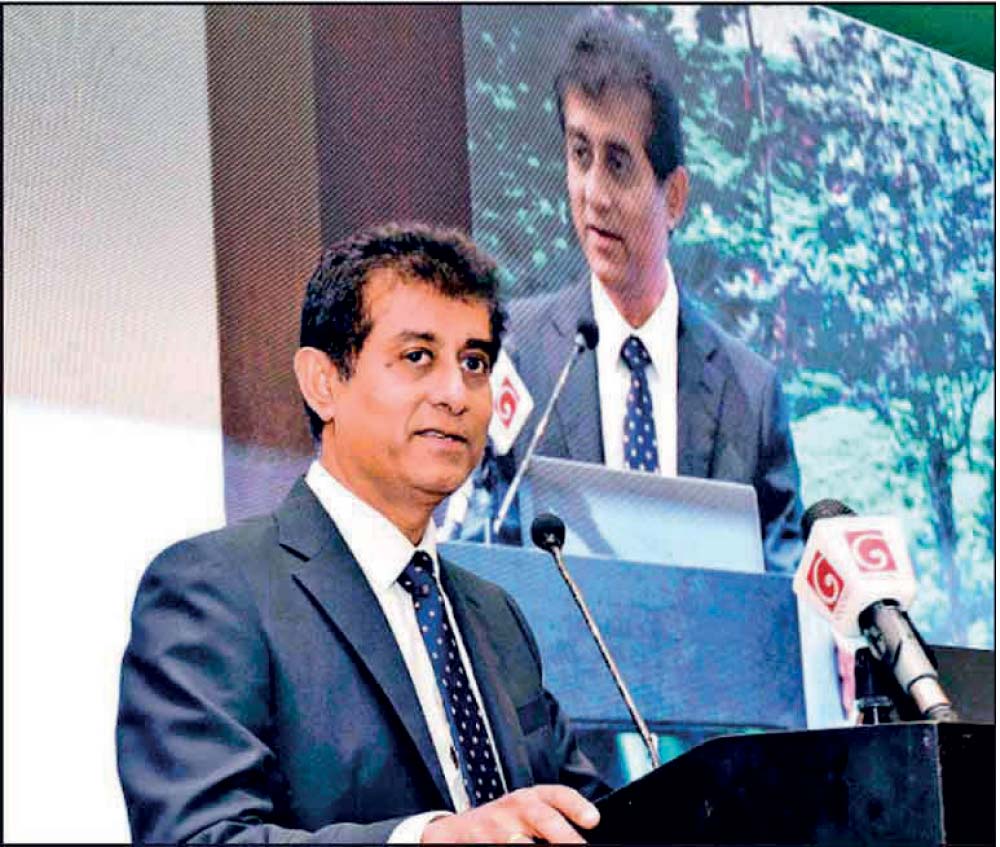
Senior Presidential Adviser on Economic Affairs Duminda Hulangamuwa - Pic by Upul Abayasekara
 Hulangamuwa’s economic message is surprisingly orthodox. Stability first, growth later. Fiscal discipline before redistribution. Private investment before State expansion. Foreign direct investment first before industrial ambition
 In a probing interview on her YouTube channel ‘Conversations with Alanki’, Alanki Kishani Perera recently asked Senior Presidential Adviser on Economic Affairs Duminda Hulangamuwa a series of pertinent and timely questions. To which the answers, while polite and politic, were not always as perspicacious as one would have hoped for at that level.
Yet, the most revealing aspect of the conversation lies not in any single answer. Rather, it is the cumulative impression left behind by the interview as a whole.
For all the ideological battles that preceded the elections of 2024, and despite years of rhetoric positioning itself against the economic orthodoxy of successive administrations, the National People’s Power (NPP) today seems to be governing from a place that is remarkably close to the economic centre.
That may be the most important political story in Sri Lanka’s socioeconomic life today.
The movement that rose to prominence as a vehicle of protest increasingly sounds like a Government of pragmatists. And the revolution, it would seem, has become managerial. Good thing too.
Orthodoxy
Hulangamuwa’s economic message is surprisingly orthodox. Stability first, growth later. Fiscal discipline before redistribution. Private investment before State expansion. Foreign direct investment first before industrial ambition.
One could be forgiven for wondering whether the NPP has inherited not merely the machinery of Government but also much of the economic architecture put in place after the economic collapse of 2022.
The Senior Presidential Adviser’s argument is straightforward. Sri Lanka emerged from economic bankruptcy with shattered public finances, depleted reserves, and diminished credibility. The Government therefore faced a choice: continue the IMF-supported stabilisation program or attempt a radical departure. President Anura Kumara Dissanayake, affirms Hulangamuwa, chose continuity.
In fairness, this is demonstrably the strongest part of the interview.
Whatever one’s political preferences, few serious economists would dispute that macroeconomic stability remains a prerequisite for sustainable growth. Stable inflation, predictable taxation, manageable deficits, and a credible monetary framework are not sufficient conditions for prosperity. But they are certainly necessary ones.
Indeed, by most conventional indicators, the stabilisation effort has produced results.
Inflation, which decimated household purchasing power during and after the crisis, has largely been brought under control. Foreign exchange reserves have recovered significantly from their nadir. The debt restructuring process has provided breathing space. Government revenue performance has improved markedly compared to the pre-crisis years, aided by painful but necessary tax reforms. The economy has returned to positive growth after the deep contraction that followed the sovereign default.
These are not trivial achievements.
Variations on a theme
In the interview, Hulangamuwa returns repeatedly to his theme. Stability, he suggests, accounts for 30% to 40% of the growth journey. The rest must come from investment. Yet it is here that his discourse begins to raise as many questions as it seeks to answer.
The adviser speaks enthusiastically about private-sector participation, public-private partnerships, and the monetisation of under-utilised assets. He cites expressions of interest for Mattala Airport, phosphate deposits, hospitality assets, renewable energy projects, logistics infrastructure, and urban land releases. He points to power-generation projects where private investors are expected to play a larger role.
The underlying proposition is unmistakeable: the State should create the conditions for growth, while the private sector drives it. It’s not rocket science; but coming from an adviser to the ostensibly Marxist/Socialist JVP-led NPP, it is revolutionary, or possibly counter-revolutionary.
Be that as it may, there is much to commend in this view.
Sri Lanka’s experience with many State-owned enterprises scarcely inspires confidence. The island’s SOEs are a cautionary tale for theorists. Any discussion of SriLankan Airlines’ prolonged turbulence and its nosedive is a case in point. Hulangamuwa himself acknowledges the airline’s inherited debt burden, the Government’s assumption of liabilities, and the possibility of inviting strategic investors or management participation.
Pragmatism, rather than ideology, seems to be guiding Government policies at present.
A sea-change?
That, in itself, may be the most revealing aspect of this interview.
During its years in opposition, the NPP frequently presented itself as a challenger to the economic orthodoxy associated with successive administrations. Yet now, ensconced in office, its economic managers increasingly sound like advocates of fiscal restraint, private-sector-led growth, export expansion and foreign investment.
To some supporters, this may appear to be a retreat from principle. To others, however, it may signal the advent of political maturity. After all, governments inherit manifestly messy realities – not nice neat manifestoes.
Yet, there is a tendency throughout the interview to conflate governance reform with economic transformation. This adviser argues repeatedly that corruption-free administration and a level playing field will attract investment. Certainly, they help. Investors prefer predictable institutions to arbitrary ones. And they favour transparency and accountability over patronage.
But good governance, by itself, is not an investment strategy.
Foreign investors also examine labour productivity, logistics efficiency, judicial reliability, contract enforcement, regulatory consistency, land availability, energy costs, and market access. A corruption-free bureaucracy cannot compensate indefinitely for structural weakness.
Pragmatic perspectives
Nor does the interview fully grapple with Sri Lanka’s stubborn competitiveness challenge.
Despite years – decades – of discussion about economic diversification, exports remain heavily concentrated. Apparel, overseas remittances, tea, tourism, et al. continue to dominate foreign exchange earnings. While there have been encouraging developments in information technology and selected services, the economy remains vulnerable to shocks affecting a relatively narrow range of sectors.
To his credit, Hulangamuwa acknowledges many of the country’s limitations.
Unlike some policymakers who promise industrial miracles, he openly admits that Sri Lanka cannot simply become another Vietnam overnight. Ditto India, likewise Thailand. Our country lacks the scale, labour force, supply chain integration, and manufacturing ecosystem enjoyed by larger regional competitors.
No rose-tinted glasses
This realism is refreshing.
His proposed response is to focus on sectors where Sri Lanka possesses genuine comparative advantages: ports and logistics, tourism, apparel, and selected higher-value manufacturing.
The ports-and-logistics strategy is perhaps the most compelling element of the Government’s growth narrative. Sri Lanka’s geographic location remains one of its few enduring strategic advantages. Expanding trans-shipment, logistics parks, bunkering facilities and related infrastructure could indeed generate significant economic value if executed effectively.
Tourism, likewise, offers obvious opportunities. Visitor arrivals have rebounded strongly since the darkest days of the crisis, and earnings have improved. Yet Sri Lanka still struggles to capture the kind of high-spending tourist that destinations such as the Maldives, Dubai (some time ago, for sure, not now or any more) or Singapore have cultivated. Hulangamuwa is right to argue that our tourism product itself requires diversification.
Yet here too the conversation drifts occasionally from strategy into aspiration.
Diversifying tourism products, promoting railway related experiences, developing new destinations, attracting higher-spending visitors, and expanding domestic aviation all sound sensible.
The challenge, however, lies not in identifying these opportunities but in executing them consistently over many years. That challenge is not fully addressed – here, or out there.
Between confidence and conviction
The most significant moment of the interview arrives when Alanki asks the question that continues to haunt many Sri Lankans: could another economic crisis occur?
Hulangamuwa’s answer is unequivocal: No, he says in effect, we will make sure that it does not happen again. The confidence is understandable. Governments cannot govern effectively while forecasting their own failure.
Yet economic realities are rarely so accommodating.
Sri Lanka remains exposed to economic shocks over which no administration could exercise meaningful control. The Middle East conflict while it raged before the ceasefire deal, rising energy costs, global trade disruptions, climate-related events, and fluctuations in tourism demand can all affect outcomes.
Even today, imports significantly exceed imports, leaving the country dependent upon tourism receipts, remittances, and capital inflows to bridge the gap. The country may be vastly safer than it was in 2022. But immunity from future crises is a standard no economy can claim or sensible economist could guarantee.
A more persuasive argument would have been that risks have diminished, not disappeared.
Shocks v. sustainability
Indeed, one of the interview’s recurring themes is external vulnerability.
Hulangamuwa correctly notes that stronger foreign-exchange reserves would improve Sri Lanka’s resilience. He acknowledges that reserve accumulation remains incomplete and the country continues to operate within constraints imposed by its recent sovereign debt repayment default and subsequent bankruptcy.
This is perhaps where the conversation comes closest to confronting economic reality.
Curiously, though, the interview has little to say about the reality that most citizens experience on a daily basis. There is certainly much discussion about GDP ratios, fiscal balances, investment pipelines, logistics hubs, and export sectors. There is considerably less discussion about household finances.
To wit: what has happened to real wages? Can ordinary families afford food more comfortably than, say, a year or two ago? Have salaries recovered relative to inflation? Are young people finding meaningful employment – after, hopefully, meaningful education? Has education itself, as well as housing, healthcare, and transport, become more accessible and affordable?
The average citizen does not experience recovery through primary surpluses or reserve accumulation. Their recovery – if any as such – is experience through improved living standards.
This is especially important because one of the recurring paradoxes of post-crisis Sri Lanka is that macroeconomic indicators have improved more visibly and dramatically than public sentiment.
Fiscal numbers may be healthier; but many households still feel poorer. Foreign reserves may be stronger; but many families continue to struggle with increased costs of living. Economic stabilisation and social recovery are not quite the same thing in the real world.
Pardon me, your slip is showing
A lacuna in the discussion is the presentation of numbers without bolstering evidence. He references many statistics: growth rates, primary balances, investment pipelines, revenue to GDP ratios. Yet, many figures are asserted rather than contextualised. For example, a pipeline of “$ 800 million to 1 billion” sounds encouraging. But Sri Lanka has historically announced much larger investment pipelines than it has actually realised. And this interview, too, never distinguishes between approved projects, committed to projects, and actually implemented projects.
Then again, the discussion of recent cyber attacks on State and non-State financial institutions is arguably the least persuasive part of the interview. The interviewee largely characterises these incidents as ordinary crimes. This understates their significance and in fact gravity. The repeated failures across banks and Government payment portals raises broader questions regarding Sri Lanka’s cyber resilience, governance standards, State institutional controls, public sector digital security, which demand more convincing responses.
The human impulse
To be fair, Hulangamuwa comes across as measured, informed, pragmatic, and considerably more market-oriented than many may expect from a mandarin advising a Marxist Government.
He also realises the imperatives of the human dimension towards the interview’s end, recounting President Dissanayake’s insistence that economic statistics are ultimately meaningless unless people’s lives improve. It is the most human moment of the conversation, and perhaps the most important.
For all the debate about IMF targets, debt sustainability, and foreign investment, the political fate of the NPP Government will not ultimately be decided by the state of its balance sheets. It will be determined by whether citizens feel that their lives are becoming better or not.
In that sense the interview provides an illuminating glimpse into the Government’s economic soul.
The revolutionary rhetoric of opposition has largely given way to the pragmatism of administration. The language is now one of stability, investment, competitiveness, and gradual reform.
Whether that pragmatism delivers prosperity remains to be seen. But one conclusion already seems difficult to avoid.
The NPP is governing far closer to the economic centre than either its admirers or detractors anticipated.
For a movement born in dissent, that represents a remarkable transformation. It may yet prove to be its greatest strength.
Or its most lamentable vulnerability.
(The writer is the Editor-at-large of LMD and is a senior journalist with a Post-graduate Diploma in Politics and Governance)



