Monday Sep 14, 2026
Monday Sep 14, 2026
Wednesday, 3 December 2025 01:12 - - {{hitsCtrl.values.hits}}
 Summary
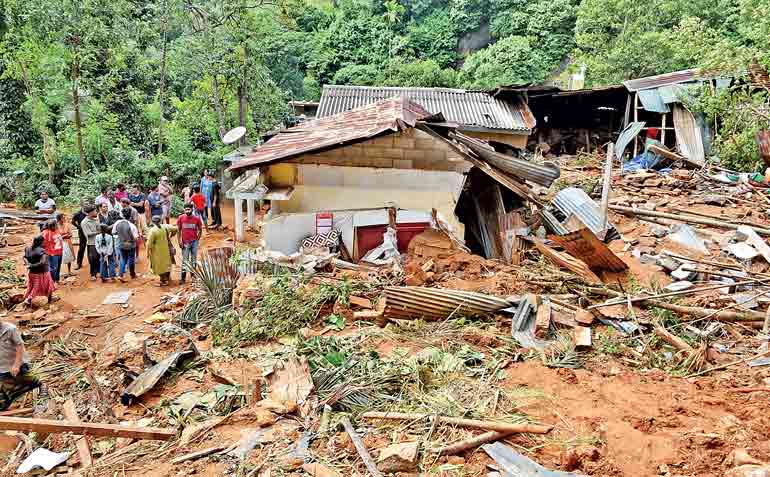
Cyclone Ditwah wreaked major national devastation in November 2025, not just because of the storm’s power, but due to the State’s profound systemic failures. Timely warnings were issued, yet the Government’s response was slow, uncoordinated, and fragmented. This critical gap between comprehensive policy and actual execution left citizens exposed and vulnerable when the State’s protective apparatus was most urgently neededA broad coalition—including Government agencies, academia, INGOs, NGOs, the private sector, and development partners—contributed to major policy and planning instruments such as the Road Map for Disaster Risk Management (2006–2016), the National Disaster Management Plans (2013–2017) and (2023-2030), UNDAC recommendations (2011), the Sri Lanka Comprehensive DRM Programme (2014–2018), and the National Emergency Operations Plan (2017) etc. Despite their strong technical foundations, these plans were only partially implemented. Recurrent emergencies repeatedly diverted institutional priorities toward short-term, reactive operations, limiting progress toward long-term risk reduction.Cyclone Ditwah wreaked major national devastation in November 2025, not just because of the storm’s power, but due to the State’s profound systemic failures. Timely warnings were issued, yet the Government’s response was slow, uncoordinated, and fragmented. This critical gap between comprehensive policy and actual execution left citizens exposed and vulnerable when the State’s protective apparatus was most urgently needed.This article critically examines Sri Lanka’s disaster management legislation, institutional mechanisms, and recent ground realities to assess how systemic governance failures contributed to the scale of destruction during Cyclone Ditwah. By situating the event within two decades of post-tsunami reforms and global DRR/CCA commitments, the attempt highlights the enduring gap between policy ambition and implementation performance, underscoring the need for a renewed governance approach grounded in accountability, integration, and anticipatory risk management.2. Sri Lanka’s post-Tsunami disaster management framework2.1. A legislative framework aligned with global standardsThe Disaster Management Act No. 13 of 2005 established a comprehensive, robust institutional architecture intended to reflect global best practices:
- National Council for Disaster Management (NCDM) chaired by the President, with the Prime Minister, Opposition leader, relevant Cabinet Ministers, Provincial Chief Ministers, District Secretaries, and relevant Technical Agency Heads as members.
- Mandates included policymaking, resource allocation, and strategic oversight.
- Disaster Management Centre (DMC) is designated as the special-purpose operational arm responsible for preparedness planning, early warning dissemination, inter-agency coordination, and district to local-level activation.
In structure and intent, the system mirrors global models of effective disaster governance.2.2. Commitment to the Sendai FrameworkSri Lanka’s ratification of the Sendai Framework placed the country under four core priorities:1.Understanding disaster risk2.Strengthening disaster risk governance3.Investing in DRR for resilience4.Enhancing preparedness and building back betterThe national disaster management system was well-positioned to implement these principles — provided political leadership and institutional direction remained consistent.2.3. An underutilised CouncilDespite its central role, the NCDM convened infrequently, with only a handful of meetings over a decade. Key shortcomings included:
- Irregular policy direction
- Stalled long-term DRR planning initiatives
- Weak oversight of disaster preparedness mechanisms
These systemic weaknesses directly challenge the integrity of the structure established by the 2005 Act. Derogatory remarks made during the last Council meeting, branding the DMC a “white elephant,” highlight the authorities’ deep misunderstanding of the agency’s vital national mandate.NCDM convened infrequently, with only a handful of meetings over a decade. Key shortcomings included: Irregular policy direction; Stalled long-term DRR planning initiatives and Weak oversight of disaster preparedness mechanisms, etc. These systemic weaknesses directly challenge the integrity of the structure established by the 2005 Act. Derogatory remarks made during the last Council meeting, branding the DMC a “white elephant,” highlight the authorities’ deep misunderstanding of the agency’s vital national mandate3. The November 2025 Disaster: A failure of governance, not prediction3.1. Early warnings were clear and timelyBefore the torrential rains reached peak intensity:
- The Department of Meteorology issued warnings from 12 November onward, two weeks ahead of the event,
- The National Building Research Organisation (NBRO) released landslide warnings for multiple districts, and
- The Department of Irrigation alerted authorities to possible reservoir spillovers and downstream flood risks accordingly.
These alerts offered a critical window for proactive protection of at-risk communities. However, instead of implementing proactive pre-disaster risk reduction measures, the authorities adopted a post-disaster ‘firefighting’ management approach.3.2. A system that did not respondDespite these alerts:
- National preparedness mechanisms were not visibly activated.
- There was no widespread and effective public awareness campaign or pre-emptive evacuation program.
- District Disaster Management Units lacked central guidance.
- The NCDM did not issue timely risk-level directives.
As rainfall intensified, Sri Lanka was forced into a reactive, rescue-heavy mode instead of a coordinated, pre-disaster risk reduction intervention.3.3. Failure to declare a national disasterThus far, a ‘National Disaster Declaration’ has not been made, which would have unlocked international humanitarian and technical assistance. Instead, a Public Emergency was declared only on 28 November, well after peak impacts. Moreover, the Former President Chandrika Bandaranaike Kumaratunga publicly appealed for a National Disaster Declaration a day earlier, signalling the seriousness of the governance vacuum.4. Cyclone Ditwah: National impact overview4.1. Human toll and displacement
- Confirmed deaths: 410,
- Missing persons: 336,
- People affected: 1,466,615 (from 407,594 families), and
- Displaced: 233,015 persons housed in 1,441 shelters (as at 10.00 a.m. 2 December 2025) according to the Disaster Management Centre
These numbers continue to be revised as assessments expand.4.2. Landslides and severe floodingThe extreme weather event has had a nationwide impact, with extensive flooding affecting all parts of the country. The impact has been especially severe along the east coast, in the districts of Ampara, Batticaloa, and Trincomalee, as well as the Central Province and the Uva Province district of Badulla.Catastrophic landslides struck several districts, including Badulla, Nuwara Eliya, Kandy, Matale, and Kegalle. Concurrently, major river basins such as the Mahaweli, Kelani, Kalu, Daduru, Malwathu etc., experienced extensive flooding, with the City of Colombo being significantly impacted. This widespread damage was exacerbated by flash floods resulting in inundation from the overflow of Tanks within the major irrigation and the Mahaweli Reservoir systems.Several remote communities were entirely cut off, prompting helicopter evacuations and specialised search-and-rescue operations.4.3. Damage to housing and infrastructure
- Homes destroyed: Over 15,000 (DMC); over 20,000 (BBC, 29 Nov.).
- Homes damaged: Tens of thousands.
- Infrastructure: Collapsed bridges, blocked roads, halted rail transport, severe power and communication failures.
- Urban flooding: Particularly severe in Colombo, Gampaha, Kandy, and major lowland basins, including towns of Anuradhapura, Polonnaruwa, Kurunegala, Trincomalee, etc.
4.4. Preliminary economic impactWhile official estimates are pending, early indicators point to:
- Extensive crop damage (paddy, tea, vegetables).
- Heavy losses to small businesses and rural livelihoods.
- Billions of rupees in infrastructure repair and reconstruction.
According to unconfirmed estimates, the economic loss is expected to be more than SLRs. Rs. 40 billion, equivalent to around$ 130.3 million.Sri Lanka must leverage the lessons of Cyclone Ditwah to fundamentally reform its disaster management best practices. While the nation’s legislative and institutional frameworks appear robust on paper, their effectiveness is compromised by critical operational gaps. The current system will inevitably fail during future crises without dedicated action5. Aid response and international support5.1. Government mobilisationThe Armed Forces executed search-and-rescue missions, provided medical aid, and delivered emergency relief supplies. The invocation of emergency powers on 29 November streamlined the deployment of essential resources. A key point of contention was the establishment of a National Operational Room at the SL Army headquarters, a move which bypassed the legally stipulated disaster management framework.5.2. International support
- India launched a rapid Humanitarian Assistance and Disaster Relief (HADR) mission, deploying NDRF teams, helicopters, and emergency supplies.
- UN agencies initiated coordinated humanitarian assessments.
- International NGOs activated emergency response programmes.
5.3. Domestic humanitarian actionCivil society organisations, religious institutions, media networks, and volunteer groups became crucial first responders — filling operational gaps through food distribution, temporary shelters, and local rescue assistance.6. Why this disaster was mitigatableThe November 2025 tragedy was not the result of a failure in forecasting. It was the result of a failure of governance.Key breakdowns included:
- Early warnings were issued but not acted upon.
- The National Council did not lead.
- The DMC lacked authoritative direction.
- District-level preparedness mechanisms were not fully activated.
- Communities received inadequate pre-disaster guidance.
- Evacuations were delayed or not organised in time.
These shortcomings represent a direct contradiction of both the Disaster Management Act and the National Disaster Management Plan (2023-2030) and simultaneously ignore Sri Lanka’s mandatory obligations under international protocols on Disaster Risk Reduction (DRR).7. Conclusion and the way forwardSri Lanka must leverage the lessons of Cyclone Ditwah to fundamentally reform its disaster management best practices. While the nation’s legislative and institutional frameworks appear robust on paper, their effectiveness is compromised by critical operational gaps. The current system will inevitably fail during future crises without dedicated action on the following fronts:
- Active leadership: The National Council for Disaster Management (NCDM) requires regular and active leadership to provide strategic directions, based on informed decision-making.
- Continuous governance: Strong and continuous disaster governance structures must be maintained, not just ‘ad hocly’ activated during emergencies.
- Transparent funding: Dedicated funding, accountability mechanisms, and full financial visibility are essential for preparedness and response efforts.
- Reliable early warning: Early-warning systems need to be reliable and fully accountable for the dissemination of timely information.
- Local preparedness: Comprehensive preparedness systems must be established and maintained at the community level.
Sri Lanka must prioritise the immediate restoration of the risk-reduction principles outlined in its latest National Disaster Management Plan (2023–2025) and align all actions with international Disaster Risk Reduction (DRR) frameworks. Urgent and decisive reforms in governance and accountability are essential, as ongoing vulnerabilities mean that both natural and human-induced hazards continue to result in preventable suffering for communities
Sri Lanka must prioritise the immediate restoration of the risk-reduction principles outlined in its latest National Disaster Management Plan (2023–2025) and align all actions with international Disaster Risk Reduction (DRR) frameworks. Urgent and decisive reforms in governance and accountability are essential, as ongoing vulnerabilities mean that both natural and human-induced hazards continue to result in preventable suffering for communities.The core argument remains that recent catastrophes were not inevitable natural tragedies; they were preventable failures of management and governance that escalated a contained event into a national disaster.(The author is attached to Department of Geography, University of Sri Jayewardenepura, Sri Lanka)Recent columns
COMMENTS




