Thursday Oct 15, 2026
Thursday Oct 15, 2026
Saturday, 9 May 2026 03:24 - - {{hitsCtrl.values.hits}}
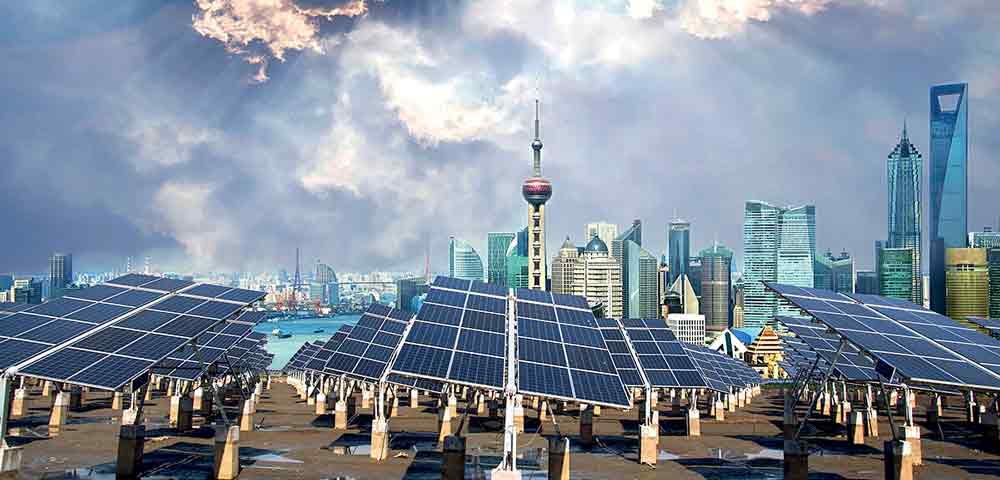
The Shanghai Bund skyline landmark and Ecological energy renewable solar panel plant
 The Middle East crisis has put global economies to the test, raising critical questions about its resilience in the face of energy shocks. Amid these tensions, China appears to be better positioned to navigate the turbulence, owing to its far-sighted policy decisions on investing in the green transition. Over the past few decades, China has made remarkable strides in achieving its sustainability goals.
China is the world’s largest energy importer and consumer, with over 70% of its crude oil consumption dependent on imports, of which approximately 50% flows through Middle East. Chinese authorities have long recognised this vulnerability, and an energy security strategy had been prepared well before any crisis, by diversifying supply routes and reducing dependence on foreign fossil fuels through a shift to domestic renewable energy such as wind, solar and including the widespread adoption of Electric vehicles.
 The Middle East conflict and recurring geopolitical shocks continue to highlight the vulnerability of oil and gas dependent economies to supply disruptions, transit chokepoints, and price spikes, further highlighting energy security as a key driver of global energy choices
In 2024, China’s energy mix reached a pivotal turning point, with non-fossil fuel sources surpassing crude oil in primary energy consumption for the first time, with renewables and nuclear share increasing to approximately 20% in 2024 from about 9% in 2020. In terms of power generation, although coal-fired plants continued to dominate, accounting for roughly 54% of total electricity output in 2025, renewable energy sources have witnessed substantial growth. This structural transition away from fossil fuels has been supported by the unprecedented pace and scale of China’s renewable energy expansion in recent years. These developments have propelled China’s power system toward a renewables-first model, particularly in terms of installed capacity.
The development of the world’s largest and fastest growing renewable energy system has provided a strong foundation for the electrification of China’s economy. The country’s power demand is mainly driven by its industrial sector, underpinned by energy intensive manufacturing and export-oriented production, with industrial users accounting for approximately two thirds of total electricity demand, while the remaining portion is being shared by the household consumption and services, transport and public infrastructure. China’s transport sector is also significantly reshaping energy demand, as both passenger and freight activity increasingly shift away from oil intensive modes of transport toward electricity based alternatives. Furthermore, China’s extensive rail network has served as a substitute for short-haul flights and long-distance bus travel, substantially reducing reliance on aviation fuel and diesel.
The Middle East conflict and recurring geopolitical shocks continue to highlight the vulnerability of oil and gas dependent economies to supply disruptions, transit chokepoints, and price spikes, further highlighting energy security as a key driver of global energy choices. A prolonged conflict would likely accelerate the global green transition, positioning China as the world’s leading green technology powerhouse to benefit significantly, while simultaneously supporting its economic growth through exports. Research reports indicate that global demand for China’s green technology products such as electric vehicles, batteries, solar modules, and wind equipment has been steadily increasing.
To support its ongoing energy transition, China’s recently published 15th five year plan signals that the country’s long-standing commitment to energy transition will continue through 2026–2030, elevating green energy to a more prominent and active role. The plan also places a clear emphasis on power sector investment and the integration of diverse energy supply sources and technological innovations. Furthermore, continuing industry reforms are expected to reduce government intervention in market pricing, a development that is particularly favorable to the growth of renewable energy.
(The author works as a researcher in private investment research firm. His primary focus is researching broader economic issues, including geopolitical developments, and sustainability matters, and their implications across various sectors. He holds a Master’s degree in Applied Finance from the University of Sri Jayewardenepura and a Bachelor’s degree in Business Economics with a first-class division from the same university. He has over 4 years of professional experience in the investment banking and financial services industry, serving clients across the US and Europe)




