Thursday Oct 22, 2026
Thursday Oct 22, 2026
Wednesday, 31 December 2025 00:26 - - {{hitsCtrl.values.hits}}
 Background
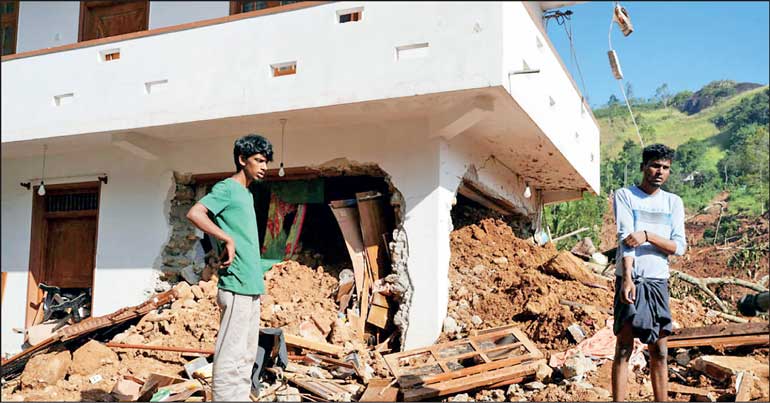
Cyclone Ditwah, which formed on 26 November 2025, and lasted until 3 December 2025, was perhaps the deadliest natural disaster Sri Lanka has faced since the 2004 Indian Ocean tsunami. Most of the cyclone’s impact was concentrated in Sri Lanka, causing landslides and heavy flooding, killing over 600 people and causing extensive damage, including to housing. Flooding and landslides are not new to Sri Lanka. Each time cyclones and heavy rains strike the country, the same disastrous images recur. Many people’s livelihoods are affected. Many children take shelter in schools, and homes are reduced to rubble. As usual, the Government responds quickly and appropriately with emergency relief and promises to engage in post-reconstruction of housing and to restore livelihoods as promptly as possible. However, many of these families return to the same area, and some of the rebuilt houses again stand in flood-prone areas, waiting for another disaster. As climate change makes extreme weather more frequent, Sri Lanka must move beyond short-term flood relief and begin investing in flood resilience strategies. Given this moment, the purpose of this writing is to propose a strategic rethink of how we support affected families who lose everything to disasters—not merely restoring what was lost, but rebuilding a sustainable housing scheme that is safer, smarter, and more sustainable.
Why do we need sustainable housing for disaster-affected families?
Although the writer lacks data on the economic conditions of the affected families, most are likely low-income, with few outliers who could afford to secure safe land and enough funds to build resilient housing. Some of those families were settled in vulnerable places by politicians for their own political gain. Therefore, the damage is not purely caused by nature but also by humans who do not care about the overall well-being of citizens or sustainability. The Government is seriously considering reconstruction. It has to spend a considerable amount of funds on rebuilding houses, using taxpayers’ money, domestic loans and grants, support from Sri Lankan expatriates, and external bilateral and multilateral loans and grants. Given these circumstances, it is the Government’s responsibility to effectively use the limited available funds to help affected people by moving from merely providing flood relief to a well-designed flood-resilience housing scheme with a reasonable grace period for paying for the housing and transferring ownership after paying an agreed amount. It should be noted that this proposal is complementary, not a complete replacement, for ground-level housing.
What kind of housing do we need?
 Considering factors such as climate resilience, efficient land use, long-term cost efficiency and sustainability, Government scarce funds, and dignified housing with ownership for low-income families, the writer recommends that the Government take the initiative to build high or medium-rise apartment housing for disaster-affected households. This can also be done through a public-private partnership if properly designed and implemented. The following are essential factors planners should consider in the planning process. Identifying the proper location is one of the most critical factors. Some affected areas are beyond use, and therefore, relocation may be compulsory. Location identification also needs to consider the affected people’s livelihoods, service availability, financial viability, and social acceptability.
Possible challenges and way forward: Role of Community Development Councils (CDCs)
In Sri Lankan culture, particularly outside major cities, people prefer to live in individual houses. Therefore, it may be challenging to convince affected people to remain in their apartments. The proposed project can thus begin with voluntary participation. A survey can be conducted to identify volunteers to be housed in apartments. The housing design can include community development programs to address livelihood disruptions and social sensitivity by constructing houses near their original locations, if feasible.
 The Government has proposed very promising Community Development Councils (CDCs) or Praja Shakhi to address poverty and other issues facing the country. The writer argues that CDCs can be used effectively for post-Cyclone Ditwah reconstruction activities, including housing. Identifying beneficiaries fairly and transparently is challenging because of favouritism and exclusion. The CDCs can verify losses at the village level, identify the most vulnerable families, and maintain a transparent list of beneficiaries, generating trust and enhancing participatory democracy. As mentioned earlier, resistance to apartments may not be socially acceptable to many affected people. The CDCs, being the most closely related to the local community, can organise community-level consultations on site selection, long-term payment plans, ownership issues, safety, and maintenance procedures. Once people are convinced that they are heard and respected, they may willingly move to apartments. Housing that reflects daily life is better maintained, and more liveable. One-size-fits-all housing sometimes fails socially. Housing relocation may disrupt income sources, affecting long-term repayment plans. The CDCs can provide more detailed input in designing housing units, taking into account the affected people’s socio-economic and environmental needs. The CDCs can prioritise livelihood-enhancing activities among their other activities by providing required skills, microcredit, and market access near apartment complexes, with appropriate coordination with the Divisional Secretariat and Pradeshiya Sabha, which, in turn, can coordinate activities with district, provincial, and central Government line ministries and departments.
Who should be coordinating the post-reconstruction activities?
Currently, the Disaster Management Centre is handling most disaster-related activities in collaboration with many related authorities in Sri Lanka. However, post-reconstruction in Sri Lanka should be centrally coordinated by the Prime Minister’s Office (PMO) for better coordination. If coordination is fragmented, it may lead to duplication, uneven standards and resource allocation, undue delays, and political interference. The PMO has the political authority, without prejudice, to set national priorities and standards and to coordinate with the international community and across ministries, provincial and local Governments, and CDCs. The Government should consider either changing the existing disaster management centre or establishing a new entity, “A Dedicated National Reconstruction and Resilience Authority (NRRA) enabling the PM’s office to get technical and operational support, prepare an action plan or framework on national reconstruction, taking climate resilience, land use pattern, and social inclusion into consideration. The authority can also monitor progress and outcomes.
The overall coordination involves different levels and sectors. At the national level, the PMO and NRRA can set appropriate policies and programmes, criteria and standards, project financing, and coordination with domestic and international Sri Lankan expatriates and bilateral and multilateral donors. Sector-level coordination with line ministries is necessary. The PMO also needs coordination with local-level or sub-national Governments, including the nine Provincial Councils, 341 Divisional Secretaries, and 341 local Governments (276 Pradeshiya Sabhas, 29 Municipal Councils, and 36 Urban Councils). The CDCs do not coordinate at the national level, but they are essential for ground-level coordination in identifying beneficiary validation, participation, and monitoring. Community-level coordination or involvement enhances participatory democracy.
One can ask why the PMO, not the President’s Office. This may be a legitimate question; however, the writer proposes a PMO for valid reasons. Post-reconstruction is not an emergency task. It is a multi-year, multi-sector, and long-term development project involving many stakeholders. Reconstruction involves day-to-day technical coordination, comprehensive monitoring, and continuous stakeholder involvement. The PO has to deal with so many issues and should not be overloaded with post-reconstruction activities.
Concluding remarks
 Cyclone Ditwah has caused significant damage to the country, and it needs to engage in post-disaster reconstruction innovatively. Constructing housing for displaced families is a priority. The Prime Minister’s Office (PMO), as the central authority, should coordinate overall post-disaster reconstruction activities, including housing construction. As with many previous disasters, instead of rebuilding vulnerable individual houses, the country should invest in climate-resilient, subsidised apartment ownership to enable disaster-affected families to rebuild their lives with dignity, safety, and long-term security and sustainability. A couple of pilot projects can be launched in selected districts. Sri Lanka has goodwill and support from around the world following disasters, but coordination remains fragmented. The construction of a housing scheme and the rebuilding of the country need a centrally coordinated body, such as the PMO, to ensure better coordination and effective use of scarce resources.
(The writer is a professor at the International University of Japan and the President of the Association of Sri Lanka Academics in Japan. The writer wishes to acknowledge valuable comments from the audience during the recent presentations at the University of Colombo and the Ranaviru Sevana Army Rehabilitation Centre)




