Monday Sep 28, 2026
Monday Sep 28, 2026
Monday, 28 September 2026 03:21 - - {{hitsCtrl.values.hits}}
 Ultimately, the Design Hub should be judged by one question, does it connect capable Sri Lankan SMEs with buyers who would otherwise not find them? If it does, the gains can extend beyond individual factories. New orders can support export earnings, regional employment, household incomes and stronger local economies. That is where the real value of the SLCGE Design Hub lies
 Sri Lanka’s apparel industry has built a strong global reputation over several decades. Yet access to international buyers remains uneven.
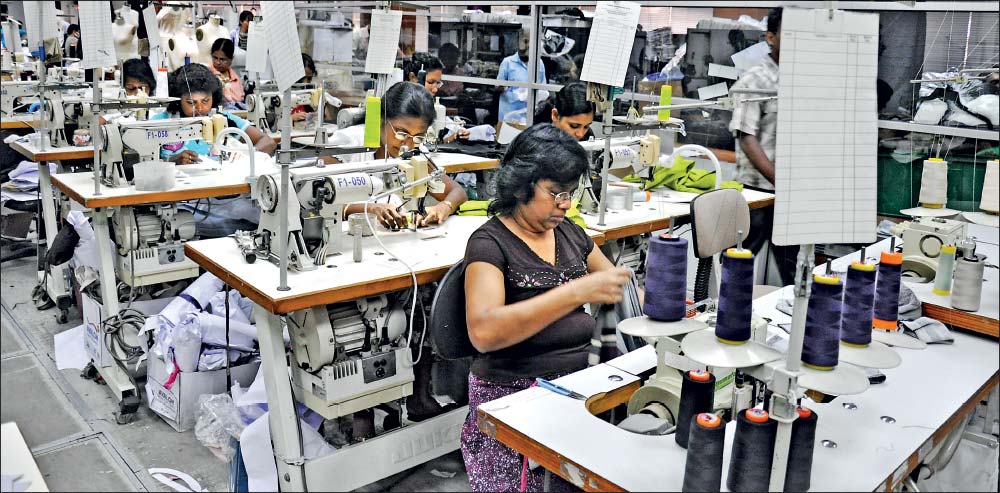
Large manufacturers have dedicated merchandising teams, design capabilities, established buyer relationships and the resources to participate in international trade fairs. Many small and medium-sized manufacturers do not have the same reach. They may have skilled workers, specialised machinery, quality systems and spare production capacity, but still remain largely invisible to overseas buyers.
The proposed SLCGE Design Hub seeks to address this gap.
On 28 May 2026, the Sri Lanka Chamber of Garment Exporters presented the proposal to Deputy Minister of Industry and Entrepreneurship Development Chathuranga Abeysinghe. The concept is to transform the existing SLCGE office from an administrative space into a central platform where member companies can display products, present their capabilities and meet international buyers. SLCGE could also work with the Export Development Board to direct visiting buyer delegations to the Hub.
The real problem is market access
The main constraint facing many apparel SMEs is not production capability. It is access to buyers.
Before placing an order, an international buyer needs to assess production capacity, minimum order quantities, compliance, certifications, lead times, sampling capability and financial reliability. Searching for this information across many individual SMEs takes time and increases transaction costs.
A Chamber-backed platform could make that process easier. Instead of searching for suppliers separately, buyers could compare several manufacturers through one trusted channel.
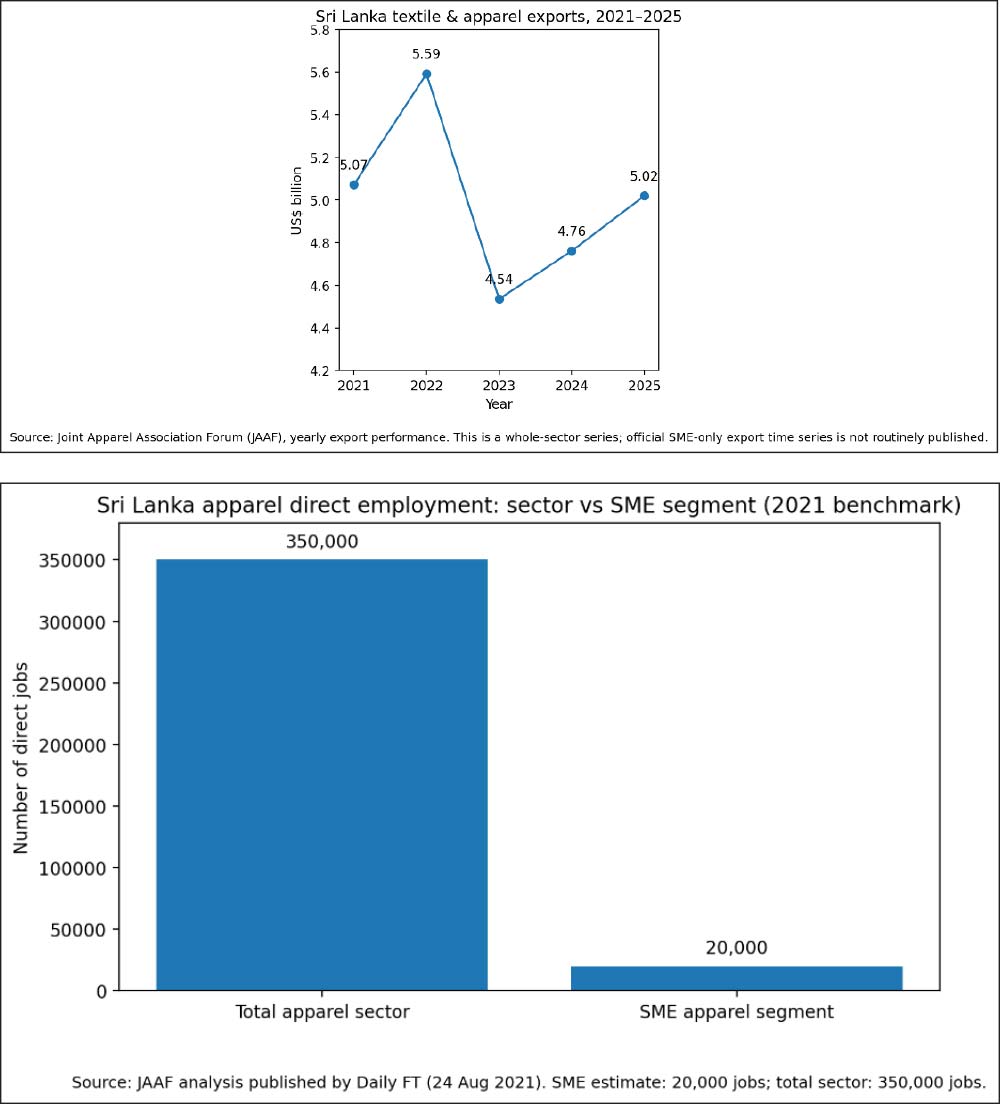
A JAAF analysis published in 2021 estimated that the SME apparel segment accounted for around 20,000 direct jobs. It also found that about 80% of apparel SMEs at the time obtained business through larger exporters rather than directly from overseas buyers. These figures are a historical benchmark rather than a 2026 estimate, but they highlight the structural market-access challenge.
The wider export trend reinforces the case for finding new buyers. Sri Lanka’s textile and apparel exports were approximately $5.07 billion in 2021 and $5.59 billion in 2022. They fell to $4.54 billion in 2023 before recovering to $4.76 billion in 2024 and $5.02 billion in 2025.
For an SME, even a few additional orders can make a difference. Higher volumes improve factory utilisation and spread fixed costs over a larger production base. This can support worker retention, new investment and product development.
However, the national benefit depends on whether the Hub creates additional exports. Moving an existing order from one Sri Lankan factory to another does not increase national export earnings. The stronger economic case is to attract new buyers, generate new orders and expand total production. Furthermore, if small and medium-scale apparel manufacturers are able to directly access smaller-volume orders placed by international buyers, they would be better positioned to maintain higher profit margins. These additional returns could then be reinvested in innovation, upgrading technological capabilities, maintaining international standards, and adopting more efficient production practices. In turn, this would also help SMEs in the apparel sector expand their production capacity and strengthen their competitiveness.
From exports to regional employment
Sri Lanka’s apparel industry directly employs around 350,000 people. SME factories matter because they can operate beyond the country’s main industrial centres and create employment closer to regional communities.
This creates a possible link between apparel exports, regional incomes and poverty reduction. But the connection should not be overstated.
A Design Hub by itself will not reduce poverty. The economic chain must be clear: buyer introductions should generate new orders; new orders should increase production; higher production should support sustainable jobs and incomes.
The geographic dimension is important. Sri Lanka’s first official National Multidimensional Poverty Index, based on the 2019 Household Income and Expenditure Survey, found that 16% of the population was multidimensionally poor. The rate was 16.6% in rural areas, 4.4% in urban areas and 51.3% in estate areas. More than 80% of people identified as multidimensionally poor lived in rural areas. These are 2019 figures, not current 2026 poverty rates, but they show why the location of new economic opportunities matters.
Employment quality matters as much as numbers. Sustainable gains require decent wages, safe working conditions, skills development and opportunities for progression.
The Hub should therefore track not only export orders, but also jobs created or retained, the location of production, participation by women and young people, training provided and incremental export revenue.
More than a showroom
The Design Hub should not become simply a room displaying garments.
Its physical showroom should be supported by a verified digital platform. A buyer examining a product should be able to see the manufacturer’s production capacity, certifications, machinery, minimum order size, lead time and product-development capability.
Products could also be organised by category — such as sportswear, children’s wear, uniforms, intimates, workwear and specialised products — rather than only by company. This would allow buyers to identify suitable suppliers quickly.
A digital version would extend the Hub beyond Colombo and allow overseas buyers to explore Sri Lankan SMEs without travelling to the country.
In economic terms, this reduces information gaps between buyer and supplier. In commercial terms, it makes SMEs easier to discover and easier to buy from.
The unanswered question: who pays?
The proposal explains what the Hub should do, but it still needs a sustainable financing model.
The 2027 Budget process provides a useful policy opportunity. Budget 2026 already established precedents for public support to improve export market access, including Rs. 250 million for the EDB’s National Export Brand Promotion Plan and a further Rs. 250 million for trade fairs, certification, digital marketing and support for export-oriented SMEs to meet international buyer requirements.
A blended financing model would be more practical than relying on a single source.
Time-bound Government or EDB support could finance the initial fit-out, digital platform, sample library and buyer-promotion infrastructure. Recurring costs could gradually shift towards SLCGE member contributions and income from product displays, training, buyer programmes and market-information services.
Industry partnerships could also support equipment, technology and buyer events. Development-partner programmes could help with export readiness, sustainability, digitalisation and skills development. Closer coordination with EDB buyer missions could also reduce duplication in export promotion.
The principle should be simple: public support, where available, should help establish the platform, but the Hub should progressively build its own operating income.
Measure it from day one
The Hub should have clear performance indicators from the beginning.
It should report the number of international buyers introduced, SMEs connected with them, samples requested, quotations issued, orders confirmed, incremental export revenue generated and jobs supported outside the Western Province.
SLCGE could also create a confidential baseline covering member employment, export turnover, production capacity and geographic distribution. This would make it possible to measure the Hub’s contribution over time.
Ultimately, the Design Hub should be judged by one question, does it connect capable Sri Lankan SMEs with buyers who would otherwise not find them?
If it does, the gains can extend beyond individual factories. New orders can support export earnings, regional employment, household incomes and stronger local economies.
That is where the real value of the SLCGE Design Hub lies.
(The author is the President – Sri Lanka Chamber of Garment Exporters)




