Tuesday Oct 06, 2026
Tuesday Oct 06, 2026
Tuesday, 6 October 2026 06:00 - - {{hitsCtrl.values.hits}}
 Sri Lanka’s unemployment challenge is not merely an education problem. It is an economic, institutional and human-capital challenge and the teacher must be at the center of the solution.
For decades, a university degree in Sri Lanka was regarded as a passport to both domestic employment and to the global labour markets. Sri Lanka has produced generations of distinguished professionals whose brilliant contributions have extended far beyond their disciplines to delight the body of knowledge with human friendly inventions, origination and development of institutions via leadership, and setting examples for education as the way to transform lives to the next level of living. Nevertheless, the recent IMF article on “Graduating into Uncertainty” by Harry Jacques (2026) discusses the unemployment trends among most educated young people in Asian region, alarming Sri Lanka to rethink about not only economic perspectives but also the educational reforms to connect qualifications to global labour market capabilities in parallel to contemporary technological advancements.
Accordingly, unemployment among Sri Lankans aged 15–24 with post-secondary education stands at approximately 43%, the highest reported rate among the South Asian countries covered in the comparison. (See graphic)
The situation inevitably raises several fundamental and critical questions. Why do most educated youngsters remain unemployed despite investing years in higher education process? Is the problem fundamentally the mismatch between demand and supply expectations of the labour market? Are qualifications offer in Sri Lanka adequately aligned with evolving structural changes due to technological advancements, or are we witnessing the growing gap between the expectations and aspirations of Generation Z and expectations of employers at the labour market?
However, the integrated multiple dimensions require to be overviewed to discuss underlying causes and consequences of graduate employment, skills mismatch, technological readiness and adaptation and upcoming generational dynamics.
Education a long term investment
From an economic perspective; education should not only be regarded as a responsible social service but as a long-term investment by the entire nation. It contains extensive public expenditure financed via taxation as well as private investment by households in the form of tuition fee, accommodation, time and foregone wage income, indicating significant opportunity cost to the entire nation. Therefore, the return on investment should extend beyond the individual and generate significant economic as well as social externalities to the whole nation. Similarly, persistent unemployment among most educated people indicates the utilised resources have not generated the intended returns for scarifications as a nation.
The educational investment associated with the 43% who remain unemployed must ultimately translate into productive participation in the active labour force rather than prolonged job seeking. The prevailing employment–unemployment ratio among the highly educated should serve as an important signal to regulators and policymakers to commission systematic, evidence-based research and identify the educational and labour-market interventions required to address this gap
Graduate unemployment
On the other hand, graduate unemployment should also be examined from demand and supply side of labour markets. Labour demand is a derived demand, determined largely by the demand for final goods and services. Hence, the economy should be able to ensure the creation of sufficient number of productive, diverse and sustainably engageable employment opportunities to attract candidates at the graduate caliber. Accordingly, the expansion and diversification of economic activities in modern and emerging domains are essential. This requires transformation towards technologically revolutionised industries linked to global value chains, technology driven knowledge-based services and modernised agricultural establishments. In response to these demands, appropriate supply-side attributes are also essential to mitigate graduate unemployability. Education is therefore must move beyond the mere acquisition of academic or professional qualification and greater GPA but greater emphasis on satisfying industry relevance competencies, adaptability and professional values. It is not doubted that graduates should theoretically sound but more importantly enriched through practical exposure and real-world work-place applications. In addition, the provisions in curricula to incorporate soft skills such as communication, critical thinking, creativity, problem solving, team collabouration, emotional intelligence and adaptability may be less readily substitutable with artificial intelligence.
Labour market shifts
Nevertheless, the demand and supply perspectives of the labour market shift the focus towards the prevailing education system. The qualifications and certificates acquired by young graduates do not necessarily translate into capabilities relevant to contemporary economic requirements. Conventional teacher-centered education has placed considerable emphasis on subject knowledge and examination performance, validated through formal qualifications. While sound theoretical knowledge remains fundamental, industry readiness, practical competence and adaptability are increasingly critical to securing and sustaining employment.
Employability
The question, therefore, is how most highly educated young people can strengthen their employability. This may reflect either disparities in the educational processes experienced by students or variations in teaching and learning practices despite a common formal education structure. Two observations consequently emerge: while more than half have secured employment, 43% remain unemployed. The attention of education stakeholders should therefore be directed towards identifying and strengthening the educational practices and competencies associated with successful transition from education to employment.
Accordingly, the employment–unemployment ratio among the highly educated raises a fundamental question about the effectiveness of the education-to-employment transition and warrants closer examination. A systematic audit should examine the nature of educational processes, qualifications offered, industry relevance of those qualifications, teaching and learning practices, resources available throughout the educational process, assessment methods, and the extent to which soft skills and other employability competencies are developed. Due attention should also be given to investment in education, whether borne by the government through national universities or by individuals through private education.
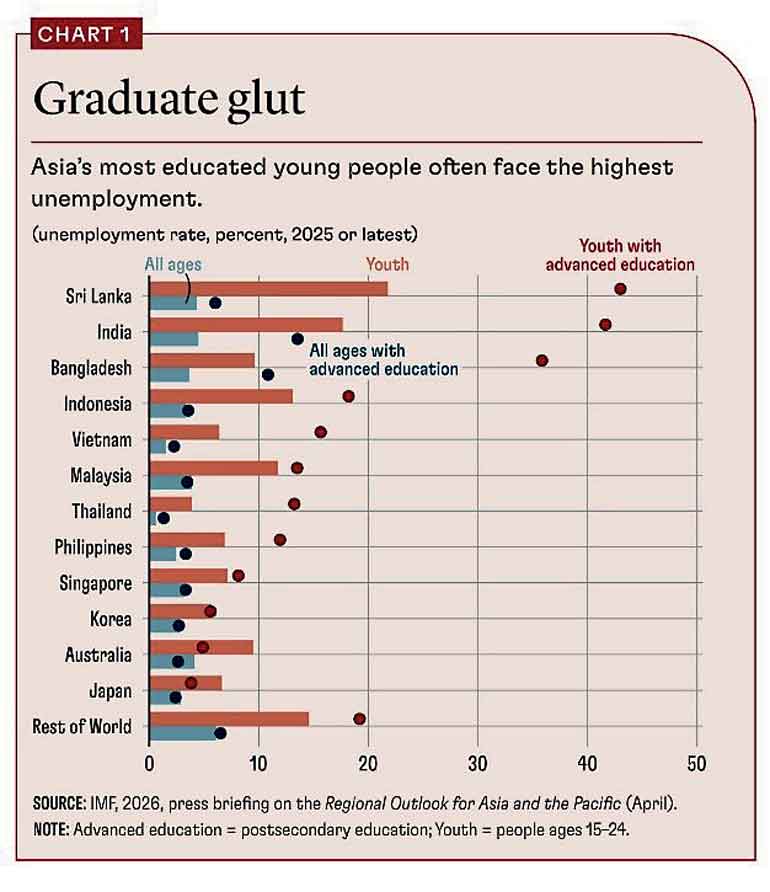
The educational investment associated with the 43% who remain unemployed must ultimately translate into productive participation in the active labour force rather than prolonged job seeking. The prevailing employment–unemployment ratio among the highly educated should therefore serve as an important signal to regulators and policymakers to commission systematic, evidence-based research and identify the educational and labour-market interventions required to address this gap.
Redesigning education
Redesigning educational processes is therefore imperative. However, this transformation must be accompanied by a redefinition of the role of the teacher and the necessary institutional support to enable teachers to deliver the expected change. The teacher, as the essential human element or liveware within the education system, has the capacity to brighten life through influence, inspiration and lasting impact. The incubation of free thinkers is equally important, not merely to prepare graduates to participate in the labour market as employees, but also to empower them to become employers through an entrepreneurial spirit. Ultimately, the educational journey of every learner should be facilitated to experience the true wonder of education from remembering and understanding to applying, analysing, creating and transforming knowledge into meaningful contributions to society.
(The author is Head, School of Business, National Institute of Business Management)



