Wednesday Oct 07, 2026
Wednesday Oct 07, 2026
Wednesday, 7 October 2026 03:48 - - {{hitsCtrl.values.hits}}
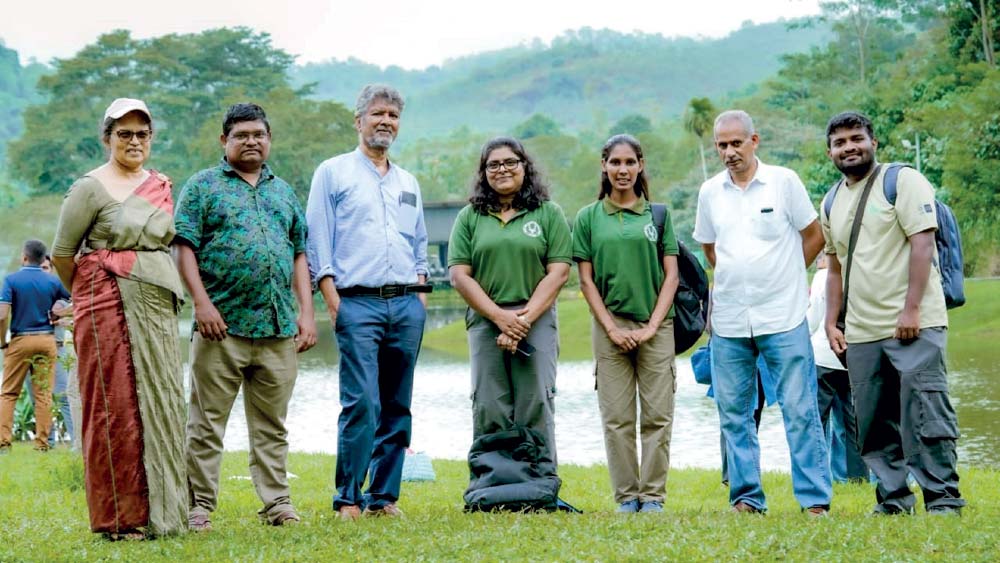
Conservation partners come together at the Kayea stylosa and Stemonoporus moonii restoration program at Seethawaka botanical gardens
 More than two decades ago, I wrote about the importance of conserving Sri Lanka’s remarkable biological diversity and the need to protect not only individual species but also their habitats, genetic variation and ecological relationships. The urgency was already apparent then. Today, it has increased considerably.
Habitat destruction, fragmentation, invasive alien species, pollution and climate change have intensified the pressures on our native plants and animals. Species once regarded as vulnerable have moved closer to extinction, while others survive only as small, isolated populations in increasingly fragile habitats.
Yet there is reason for hope. Advances in research, conservation techniques and institutional partnerships are creating opportunities to prevent species loss. The Wildlife and Nature Protection Society’s ENDEMICS Project translates them into action for some of Sri Lanka’s most threatened endemic species.
An island of extraordinary biological wealth
Sri Lanka possesses a natural heritage far richer than its geographical size might suggest. Its rainforests, cloud forests, montane grasslands, dry-zone forests, wetlands, rivers and coastal ecosystems support an exceptional variety of life. Many species found in these environments occur nowhere else on Earth, having evolved through long periods of isolation under the island’s varied climate, topography and ecological conditions. For such species, extinction in Sri Lanka means extinction everywhere.
The significance of biodiversity cannot be measured simply by counting species. It also includes genetic variation within species and the diversity of habitats they occupy. Genetic diversity enables species to respond to disease and environmental change. Species diversity supports pollination, seed dispersal and nutrient cycling, while ecosystem diversity provides the environments upon which life depends.
These dimensions are inseparable. A rare tree cannot be conserved effectively without considering the soil, water, associated organisms and surrounding vegetation essential to its survival. Similarly, a threatened amphibian, fish or insect cannot be protected merely by preserving a few individuals while its habitat continues to deteriorate. Conservation must address species within the wider living systems to which they belong.
 The growing threat of extinction
Although Sri Lanka has long been recognised for its exceptional biodiversity, recognition has not prevented the decline of many endemic species. Forests have been cleared or fragmented for agriculture, settlements, infrastructure and other development. Wetlands have been drained or degraded, watercourses polluted or altered, and invasive alien species have displaced native vegetation. Uncontrolled fires and unsustainable land use have further weakened vulnerable ecosystems.
Climate change adds another layer of uncertainty. Shifting rainfall, prolonged drought, extreme weather and rising temperatures can transform habitats faster than many species can adapt. Organisms restricted to isolated mountains, small forest fragments or specialised wetlands are particularly vulnerable.
The danger is greatest for species with very limited distributions. Some are known from only one locality or survive in tiny populations. A single landslide, drought, pollution incident or land-use change could eliminate them. Their disappearance would erase unique evolutionary histories, ecological relationships and potential resources, diminishing the natural inheritance we must pass to future generations.
Moving beyond traditional conservation
Protecting natural habitats remains the foundation of biodiversity conservation. Species are best maintained within functioning ecosystems, where they can reproduce, adapt and interact with other organisms. This in-situ approach depends on the effective management of forests, wetlands, grasslands and other habitats, with government institutions such as the Department of Wildlife Conservation and Forest Department playing central roles.
Habitat protection alone, however, may not be sufficient when a species has declined to a critically low level or survives outside protected areas. Active recovery measures may then be necessary, including field surveys, population monitoring, ecological research, habitat restoration, invasive-species control, seed collection, propagation, tissue culture and the establishment of additional populations.
Ex-situ conservation also becomes important. Botanic gardens, arboreta, research institutions and conservation nurseries can maintain threatened species outside their original habitats as safeguards against sudden loss in the wild. Nevertheless, this should not replace the protection of natural ecosystems. A plant in a garden does not retain all the ecological relationships, genetic variation or evolutionary processes of a healthy wild population.
The principal value of ex-situ conservation lies in supporting recovery: maintaining genetically representative collections, developing propagation techniques, producing planting material and supplying individuals for carefully planned reinforcement or reintroduction. Effective conservation therefore integrates in-situ and ex-situ approaches, supported by sound science and long-term monitoring.
The WNPS ENDEMICS Project: Turning concern into action
The WNPS ENDEMICS Project is an important response to these contemporary challenges. Rather than limiting its contribution to awareness, it supports practical interventions intended to improve the survival prospects of threatened endemic species.
The project brings together researchers, universities, government agencies, conservation organisations, botanic gardens, local communities and other partners. Such collaboration is essential because the knowledge and resources needed to prevent extinction rarely exist within one institution. Researchers provide taxonomic knowledge, ecological information and propagation techniques. Government agencies provide access, regulation and conservation management. Botanic gardens and arboreta maintain living collections and suitable sites, while communities contribute local knowledge, stewardship and long-term protection.
Coordinated in this way, conservation becomes a practical program with identified species, defined interventions and measurable outcomes. It also supports organisms that might otherwise be overlooked. Public interest often favours large or striking animals, although threatened plants, amphibians, freshwater fishes and insects are equally important to ecosystems.
A little-known endemic tree may support specialised insects, stabilise soil, influence water conditions and form part of a distinct plant community. Its loss can therefore affect many organisms and processes. By supporting threatened endemic species across different groups, the ENDEMICS Project broadens our understanding of conservation success.
Bringing critically endangered plants back from the brink
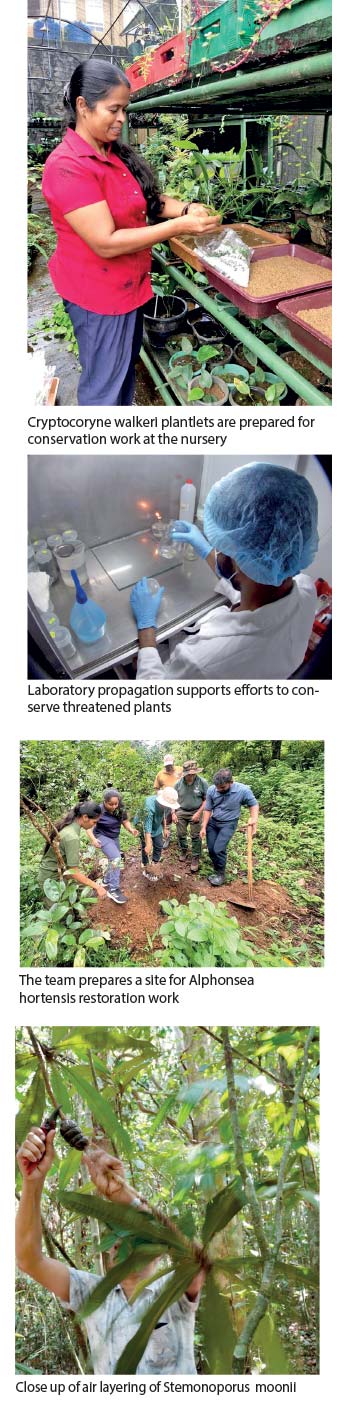
The conservation of Stemonoporus moonii provides a compelling example of the value of targeted intervention. Known locally as horawel, this Critically Endangered endemic tree survives in the highly restricted wetland-associated habitat of Walawwatte, Wathurana, near Bulathsinghala. Its small population and limited distribution leave it extremely vulnerable to disturbance and habitat degradation.
Documentation alone cannot secure such a species. Its survival requires an understanding of its ecological needs, effective propagation methods and the establishment of additional plants at suitable conservation sites. Through research and propagation at the National Institute of Fundamental Studies, new individuals of Stemonoporus moonii have been produced, reducing the risks associated with dependence on a single vulnerable population.
Introducing propagated plants at Mirishena and Seethawaka Wet Zone Botanic Gardens helps establish protected ex-situ populations. Combined with habitat protection, restoration and monitoring, such work can support long-term recovery.
Comparable attention has been given to Kayea stylosa, locally known as suwanda, another highly threatened endemic tree. Each established plant preserves genetic material, increases propagation potential and contributes to recovery. These cases illustrate partnership: research institutions, practitioners, botanic gardens and supporting organisations provide essential parts of the process, while the ENDEMICS Project connects their efforts.
Restoring habitats, not simply planting trees
Threatened-species recovery must not be confused with indiscriminate tree planting. Ecological restoration requires knowledge of a site’s original vegetation, soils, hydrology, associated species and natural regenerative processes. A rare wetland tree cannot be protected simply by planting it wherever space is available; it needs appropriate moisture, compatible vegetation and protection from disturbance. Montane species, dry-zone trees and rainforest plants likewise have distinct requirements.
Conservation planting must therefore use careful site selection, suitable genetic material and long-term monitoring. Restoration may also require controlling invasive species, protecting water sources, rehabilitating degraded habitat and reconnecting isolated forest patches. Wherever possible, naturally regenerating vegetation should be encouraged. Assisted natural regeneration can rebuild native ecosystems while retaining local ecological characteristics.
These principles are increasingly important under climate change. Restored habitats must be managed for present survival and future resilience. The ENDEMICS Project can advance this broader vision by linking recovery of individual species with protection and restoration of the habitats on which they depend.
Communities as partners
Protected areas alone cannot secure every threatened species. Many endemic plants and animals occur in village wetlands, agricultural lands, home gardens, privately owned forests, estates, temple lands and other human-used landscapes. Their survival therefore depends partly on the choices of landowners, farmers and local communities.
Conservation must recognise people as partners. Communities can identify threatened species, safeguard habitats, monitor populations, restore land and maintain water sources. Schools and local organisations can strengthen stewardship. Conservation can also support livelihoods through responsible ecotourism, native-plant nurseries, restoration work and nature education, provided ecological integrity remains central.
More than two decades ago, I suggested that farming communities should help protect mountain grasslands, cloud forests and wet-zone forest fragments as part of their relationship with the surrounding landscape. That aspiration remains relevant. Conservation becomes more durable when communities regard nature not as an obstacle to development but as an asset supporting water security, productive soils, climate resilience and cultural identity.
Science, policy and long-term commitment
Preventing extinction requires more than short projects or isolated planting events. It demands reliable taxonomy, updated conservation assessments, field surveys, population studies and knowledge of the biological needs of threatened species. For many endemic plants, reproductive biology, seed behaviour, pollination, dispersal and responses to environmental change remain poorly understood. Without this information, well-intentioned interventions may be ineffective or harmful.
Research must therefore be linked with national biodiversity policies, Red List assessments, protected-area management, environmental impact assessments and restoration programmes. Sustained funding is equally important. Species recovery can take many years, especially for slow-growing trees and ecologically specialised plants. Propagation or planting is only the beginning; monitoring, maintenance and adaptive management must follow.
Donors, businesses and philanthropic supporters can enable research, fieldwork, propagation, restoration, community participation and the training of young conservation scientists. The ENDEMICS Project provides a means of directing such support towards scientifically established priorities. These investments must remain transparent and accountable. Success should be measured through indicators such as population stability, habitat protection, effective propagation, improved genetic representation and viable new populations where appropriate.
A responsibility we cannot postpone
Sri Lanka’s endemic species are irreplaceable. Once lost, they cannot be recreated, imported or recovered. Their protection is both a scientific necessity and a moral responsibility.
The WNPS ENDEMICS Project shows what can be achieved when scientific knowledge, institutional cooperation and public commitment are brought together. Its significance lies not only in the species it supports today but also in the model it offers for the future: conservation that is collaborative, scientifically grounded, practical and responsive to a changing environment.
Scientists must continue to investigate threatened species; institutions must coordinate their efforts; policymakers must provide effective protection; donors must invest in long-term recovery; and communities must be recognised as essential partners. The future of Sri Lanka’s biodiversity depends on our willingness to move beyond admiration and act decisively.
Every endemic species we save preserves a unique chapter of Sri Lanka’s natural history. Through initiatives such as the WNPS ENDEMICS Project, those chapters need not end in extinction. They can become stories of recovery, shared responsibility and renewed hope for the living heritage of our island.



