Saturday Oct 24, 2026
Saturday Oct 24, 2026
Tuesday, 8 September 2026 04:27 - - {{hitsCtrl.values.hits}}
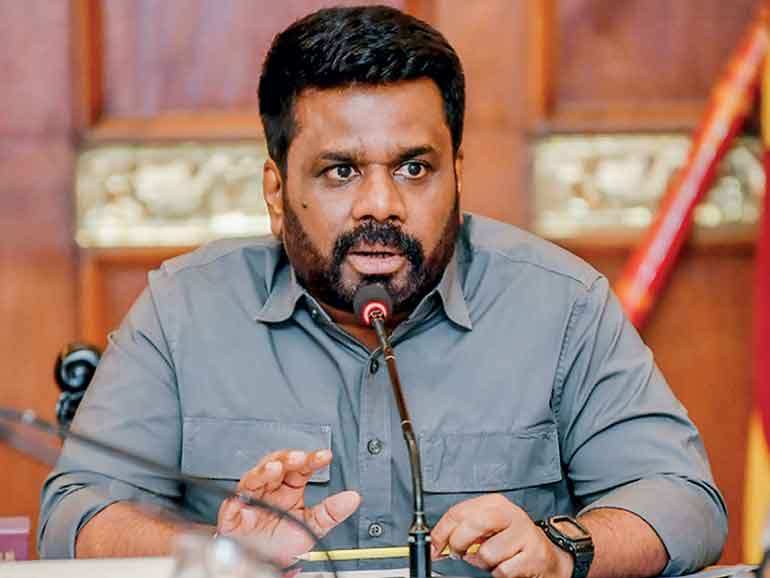
President and Finance Minister Anura Kumara Dissanayake
 The new National Business Facilitation Centre (NBFC) will remove the obstacles that slow our businesses. It can do something far larger. It can become the one place in Sri Lanka where a new concept for earning foreign exchange, one that belongs to no ministry, is received, evaluated, coordinated and launched.
Purpose behind decision
On 24 August the Cabinet approved a proposal from the President to establish a National Business Facilitation Centre under the Presidential Secretariat. Its stated task is to coordinate the many State agencies a business must deal with, to have enough authority to remove administrative barriers, and to improve policymaking for industry.
The decision does not say why it is needed. It does not need to. The purpose behind it is plain to anyone who lived through 2022, and it is the first responsibility of any President: a stronger and more resilient economy, one that earns what it needs rather than borrowing it. From 2028 Sri Lanka must begin repaying its restructured debt in dollars, year after year. Those dollars cannot come from taxes, which are paid in rupees. They can come only from what Sri Lankan enterprises earn abroad or save the country from importing.
Seen that way, the Centre has two responsibilities, and the second is much bigger than the first.
First responsibility:
Remove bottlenecks in the system for everyone
A business in Sri Lanka today needs land, an environmental clearance, a water connection, a local authority permit and a ministry decision to do almost anything new. Each office has its own queue, and no one owns the whole journey.
The Centre can change that, and it should. But its real value here lies not in walking one file through the offices, which helps one business, but in treating each case as evidence. When the same problem arrives twenty times, the task is not to solve it twenty times. The task is to find the rule or procedure that keeps causing it and remove it once, for every business in the country. Singapore has done this since 2000 through a panel chaired by its Head of Civil Service, which has turned more than 1,100 business suggestions into changed rules. That is facilitation working as reform.
The returns from this first responsibility are real. They are also limited. They reach only the businesses that already exist and are already in the queue. A stronger economy needs more than that. It needs new income.
Second responsibility: Facilitate building of stronger and more resilient economy
Given the NBFC's purpose of supporting a stronger and more resilient economy, the need to facilitate more foreign exchange (FX) inflow pathways is clear. Every large source of foreign exchange Sri Lanka has today began as an idea that nobody had asked for. Tea, apparel, tourism and the remittances of Sri Lankans abroad were all once new FX inflow pathways that somebody facilitated. They are now the pillars of the economy. The next pillars will begin the same way.
Such concepts or ideas have a particular character. They are not complaints. They are not a demand of any industry or sector. They do not solve anyone's problem, and they trouble nobody. They come from people who look at what the country already has and see a way to earn from it that the traditional sources of income have never used. And they have one fatal weakness: they belong to no ministry. So they are admired, passed along, and forgotten.
Sri Lanka may have lost countless ideas of this kind over the years. A good idea here rarely dies because somebody said no. It dies because nobody was ever responsible for picking it up and implementing it, a job that lies entirely outside the scope of any officer at any level.
Yet the returns from a new pathway of this kind are unlike anything else Government can do. Opening a new FX inflow pathway creates businesses that do not yet exist, hundreds and then thousands of them, and each one earns. Because the market for such a pathway is the world and not the home market, its growth is not capped by the size of Sri Lanka. It keeps growing for as long as the country stays competitive, and a pathway that starts small can in time stand beside, or surpass, the sectors we depend on today.
The Cabinet has given the country something it has never had: a place with the standing and the authority to receive an idea that belongs to no one and make it belong to the nation. Used only for facilitation, the Centre will make business easier, and that is worth having. Used for both of its responsibilities, it will keep adding new sources of income to an economy that has depended on the same few for too long
Consider three typical pathways waiting for an owner. In each, the capacity is already here, several agencies each hold a piece, and no institution has the duty to put the pieces together.
a) The first is international trade through our export zones. The enterprises in them already hold Customs controlled premises, warehousing, banking relationships and overseas customers. Allowing them to trade regional goods through Sri Lanka, as Singapore and Hong Kong do on a vast scale, and as Vietnam permitted its own zone enterprises to do by decree in 2018, would open a new trading income at almost no Government cost, and trading leads in time to sorting, assembly and manufacturing. Yet no institution has the single mandate to open up re-export to zone enterprises in addition to their usual operations. Customs controls the goods, the Board of Investment governs the zones, the Treasury sets the fiscal rules, and each can answer only for its own part.
b) The second is surgery for foreign patients. Our accredited private hospitals already perform, at internationally competitive cost, the cardiac, orthopaedic and many other procedures that foreign patients travel abroad for. What is missing is one coordinated pathway of hospital recognition, medical visa, insurance, facilitation and recovery that lets Sri Lanka function as a surgical destination. Yet no institution has the mandate to build it. Health regulates hospitals, Immigration issues visas, Tourism promotes the country, and none of them is charged with making the three work as one.
c) The third is offering a level playing field for local industry. Our export industries import billions of dollars of inputs every year that Sri Lankan industry could supply, if one principle were established: that buying from a local supplier carries no greater tax or financial burden than importing. Yet no institution has the mandate to establish that principle. Inland Revenue administers the tax, Customs the border, the Board of Investment the exporter, and the local supplier belongs to none of them. Local industries are left with few orders, because the system makes the foreign supplier's offer the more attractive one to our BOI exporters.
That is why immensely beneficial concepts of this kind have waited endlessly. Not because anyone opposed them, but because no one was responsible for them. And each, once launched, grows on its own, benefiting thousands of businesses and industries and strengthening the country's foreign exchange reserves from its first year.
Why only this Centre can do it
The Board of Investment serves investors. The Export Development Board serves exporters. Each ministry serves its own sector. None of them is wrong to do so, and none is placed to carry a concept that spans them all. Until 24 August, no institution in Sri Lanka had the mandate to receive such a concept, let alone the authority to evaluate and launch it.
The Centre is different in three ways. It sits at the Presidential Secretariat, so its standing is national rather than sectoral. It has been given authority across agencies, so it can bring many of them to one table. And its mandate speaks of improving policy, not only applying it. The Centre is the only place where such a concept can be received, coordinated and launched. The ideas will not lack for authors. What they have lacked is an address to send them to.
What we hope it will be given
The Cabinet decision already speaks of the authority the Centre needs, and we can take that at its word. As a gentle reminder in case anything has been missed, this second responsibility requires a door for concepts as well as cases, open to anyone in the country or its diaspora with a credible way to earn Sri Lanka a dollar; evaluation on the foreign exchange a pathway would earn or keep, net of what it costs in imports; ownership of each pathway at the level of the Centre; a decision, yes or a reasoned no, within a fixed time; and published results. A Centre that publishes its own scorecard will never need anyone else to judge it.
One test would keep everything in proportion: does this make the economy stronger and more resilient? Between a change that helps a few enterprises and one that opens a new sector for many, the second deserves to come first.
What the rest of us can bring
The Centre should not be flooded. If every delayed licence and private grievance is pushed through its door, it will become an overwhelmed complaints counter. Individual matters belong with the relevant agency, and the Centre will be right to send them there.
What it needs from us is clarity. If you bring a pathway, state what the country already has that makes it possible, which agencies must act together, what each must change, and what it would earn once it runs. Written that way, a submission is not a wish. It is a launch plan.
And the people who hold such pathways are not only in business. The engineer who knows a process nobody in the region offers. The surgeon who sees the patients who could come. The Sri Lankan overseas who knows a market from the inside. The public officer who watches a rule block productive work every day and has never had anyone to tell. Each of them now has somewhere to go.
A door is only the beginning
The Cabinet has given the country something it has never had: a place with the standing and the authority to receive an idea that belongs to no one and make it belong to the nation. Used only for facilitation, the Centre will make business easier, and that is worth having. Used for both of its responsibilities, it will keep adding new sources of income to an economy that has depended on the same few for too long. A stronger and more resilient Sri Lanka will not be built by managing the foreign exchange we have. It will be built by opening new pathways that earn what we do not yet have. The Centre is where that can now begin, and what it becomes depends on what all of us bring through its door.
(The author is Founder/Chairman of the KIK Group of Companies, an export-oriented engineering and switchgear manufacturer and a Presidential Export Award winner, and serves on the Executive Committee of the Free Trade Zone Manufacturers' Association of Sri Lanka. The views expressed are his own. He can be reached at [email protected].)




