Sunday Sep 13, 2026
Sunday Sep 13, 2026
Saturday, 6 June 2026 01:49 - - {{hitsCtrl.values.hits}}
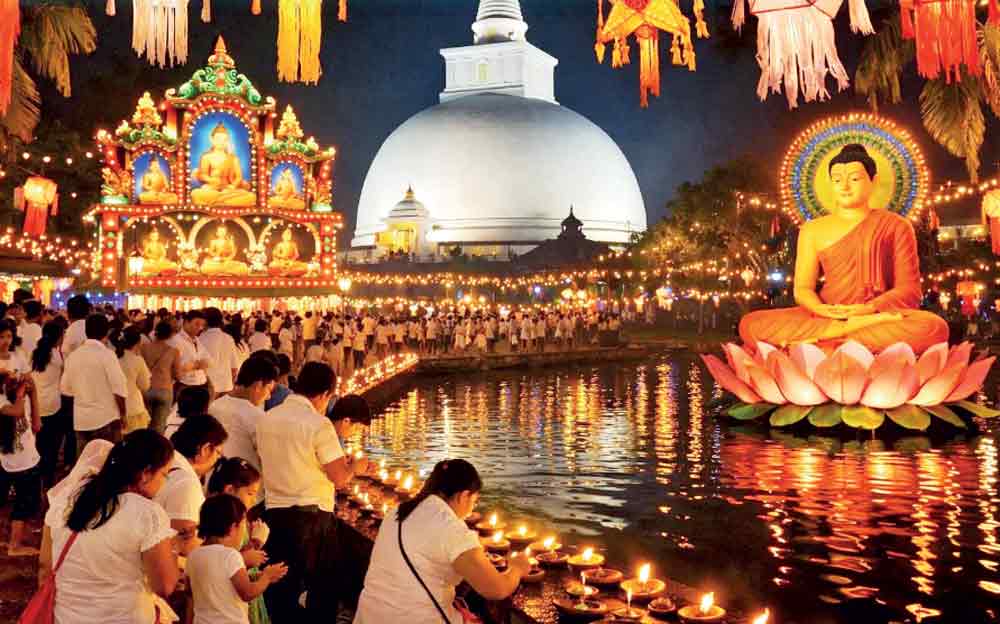
 Can our blessed island nation monetise meditation and mindfulness? Sri Lanka has spent decades selling itself as sun, sea, sand and safari. This is a splendid way to promote a tropical paradise such as ours... until one notices that other Indian Ocean nations have swathes of beach.
Also observe that elephants and leopards are no longer unique selling propositions, and every second touristy country now promises ‘authentic wellness experiences’ with suspiciously expensive herbal tea to boot!
Meanwhile, right under our saffron-robed noses lies perhaps our island’s most under-leveraged tourism asset of all: religious and cultural tourism. Or to put it less piously and more economically, Buddhism – over and above its salvific praxis – may yet help to balance our balance of payments.
Twin luminous lights
Every May and June, Sri Lanka undergoes a transformation that no tourism campaign has properly captured to date. Vesak and Poson turn our blessed isle into a luminous theatre of devotion. Lanterns flicker across villages and towns, temples glow through the night atop high mountains, and dansal-based generosity erupts spontaneously while pandals dazzle and instruct.
More importantly perhaps, millions travel internally in what may be one of South Asia’s largest movements of peaceful pilgrimage.
 Sri Lanka’s tourism problem is not a lack of product or potential. It is a lack of packaging and persuasiveness
Yet, remarkably, the State – to say nothing of tourism authorities and hoteliering operations – treat travel in these months as ‘off-season’ tourism! That, I’m sorry to say, is not a failure of government or geography or even our culture... it is a failure of the Sri Lankan imagination.
Traditional lags and lapses
Tourism statistics over the past 25 years show May and June traditionally lagging behind the December to February ‘peak-season’ highs. Even in record-breaking 2025, May recorded the lowest monthly tourism footfall of the year despite an all-time-high for the month itself. Sri Lanka welcomed 132,919 visitors in May 2025, while tourism earnings for the month stood at $ 164 million – the weakest monthly revenue figure of the year.
Which raises a rather obvious question. Why are we failing miserably to monetise a globally significant religious-cultural season that already exists organically and authentically?
Technology, too, is embarrassingly underused by Sri Lanka’s tourism promoters. Visitors should be able to scan a QR code at Mihintale, say, and instantly access multilingual storytelling, augmented reality recreations, meditation audio guides and historical interpretation helps. A Japan or South Korea and Singapore would have already done this... yesterday
In fact, in a milieu in which Sri Lanka’s name is taken reverently on the lips of literally billions of devotees around the world, thanks to the UN’s official recognition of Vesak as an international event!
(Thank you once again to the late great Sri Lankbhimanya Lakshman Kadirgamar, who put Sri Lanka on the map in this regard – refer my column last week at https://www.ft.lk/columns/Our-Vesak-gift-or-how-to-rebuild-a-civilised-nation/4-792632).
Treasury of riches
This is especially ironic at a time when global travellers increasingly seek precisely the things Sri Lanka already possesses: mindfulness, spirituality, slow travel, community immersion, heritage experiences and emotional authenticity.
Thailand understood this years ago. Vietnam is learning this vital national lesson quite well... and rapidly, too. And Japan monetised Zen so successfully that tourists now pay handsomely to sweep temple gardens in utter silence.
Sri Lanka, meanwhile, still markets itself internationally with the subtle sophistication of a faded airline poster from 1994.
Thousands upon thousands
This is curious. Because Buddhism is not a niche market. Some 500 million adherents of this sublime philosophy worldwide live primarily across East and South-East Asia. Add the wider wellness, spiritual retreat and slow-travel segments, and the potential audience becomes enormous – easily in the early billions.
Even more importantly, Buddhist travellers tend to spend steadily, travel respectfully, and stay longer. They are certainly not chasing Instagram sunsets and cocktail happy hours. They seek experience, connection, and meaning. Even enlightenment.
Tourism circuit par excellence
Sri Lanka already possesses the building blocks of a world-class Buddhism tourism circuit. Anuradhapura and environs at all times. Mihintale under a Poson poya moon. Kandy’s superlative Temple of the Tooth relic. Dambulla’s intriguing cave monasteries. Kelaniya temple and its hallowed precincts in Vesak season.
The reclusive Ritigala for contemplative trekking. Arankele for forest monasticism. Nagadeepa for a one-of-a-kind pilgrimage. Kataragama for interfaith spirituality and the spectacle of magical rituals.
And even Colombo’s splendid pandals – frequently shared virally by astonished foreigners – possess untapped touristic value.
Tourism overall generated roughly $ 3.25 billion in 2025 from 2.36 million arrivals. But the island could realistically aim to capture a specialised Buddhist-cultural tourism segment worth several hundred million dollars annually in five, six, seven, years if it is marketed strategically and sustainably. Not through mass-tourism-vulgarity. But through premiumised authenticity. And with quiet class rather than querulous crassness.
Yet, what does the average visitor encounter?
Abysmal transport. Absent, misleading or indecipherable signage. Minimal multilingual interpretation. Poor digital integration. Inconsistent sanitation. Limited curated itineraries.
And worst of all, indifferent coordination between State authorities, municipalities, temples, and accommodation and transport networks.
Don’t forget – in fact, dispense with or drastically improve – marketing campaigns that too often confuse ‘promotion’ with merely printing another smiling peacock logo.
Sri Lanka’s tourism problem is not a lack of product or potential. It is a lack of packaging and persuasiveness.
Two months of enlightenment
Consider what could be done.
A properly curated ‘Island of Enlightenment’ campaign could market the sublime Vesak-Poson season as a two-month-long immersive cultural pilgrimage.
Airlines could bundle pilgrimage circuits. Railways could run heritage pilgrim trains. Hotels could offer meditation retreats tied to temple festivals. Provincial councils could create lantern trails, heritage walks and temple food festivals. Local artisans could monetise handicrafts sustainably instead of relying on seasonal charity.
The irony is that authentic experience – the hardest commodity to manufacture artificially – is something Sri Lanka possesses naturally (and in abundance at that) during Vesak and Poson. And many discerning tourists have already noticed it
Technology, too, is embarrassingly underused by Sri Lanka’s tourism promoters. Visitors should be able to scan a QR code at Mihintale, say, and instantly access multilingual storytelling, augmented reality recreations, meditation audio guides and historical interpretation helps.
A Japan or South Korea and Singapore would have already done this... yesterday.
Instead, Sri Lanka often acts as if tourism promotion still means attending trade fairs with glossy brochures and stale cashew nut packets.
The irony is that authentic experience – the hardest commodity to manufacture artificially – is something Sri Lanka possesses naturally (and in abundance at that) during Vesak and Poson. And many discerning tourists have already noticed it.
Online travel forums increasingly feature foreigners asking specifically where best to experience Vesak in Sri Lanka. Travellers speak of wandering through lantern-lit streets, receiving free meals from strangers, and discovering a form of communal spirituality absent in much of the modern world.
That emotional memory of some touristic experiences has economic value.
Tourism revenue blind spots
At present, Sri Lanka does not separately quantify religious and cultural tourism revenue comprehensively – and this in itself reveals an institutional blind spot.
Tourism overall generated roughly $ 3.25 billion in 2025 from 2.36 million arrivals. But the island could realistically aim to capture a specialised Buddhist-cultural tourism segment worth several hundred million dollars annually in five, six, seven, years if it is marketed strategically and sustainably.
Not through mass-tourism-vulgarity. But through premiumised authenticity. And with quiet class rather than querulous crassness.
That means fewer casino fantasies and more heritage conservation. Fewer random beautification projects and more functioning public conveniences. And less slogans about ‘so...’, ‘like no other’, ‘the wonder of Asia’, etc., and more actual visitor facilitation.
Above all, sustainability matters.
Tourist dollars trap
Sri Lanka cannot afford to destroy sacred spaces in the pursuit of tourist dollars. Thailand’s over-commercialised temples offer cautionary lessons. Religious tourism succeeds only when spirituality remains genuine and communities benefit directly.
Done intelligently, however, Vesak and Poson could become not merely local festivals, but national economic seasons.
A country such as Sri Lanka, once bankrupt in terms of finances but rich in civilisation, ought to know how to monetise spirituality – and the attendant wisdom of the ages – without selling its soul.
And if Sri Lanka truly wishes to stand apart from regional competitors, perhaps the answer is not to become another Bangkok or Bali. But to become more fully itself.
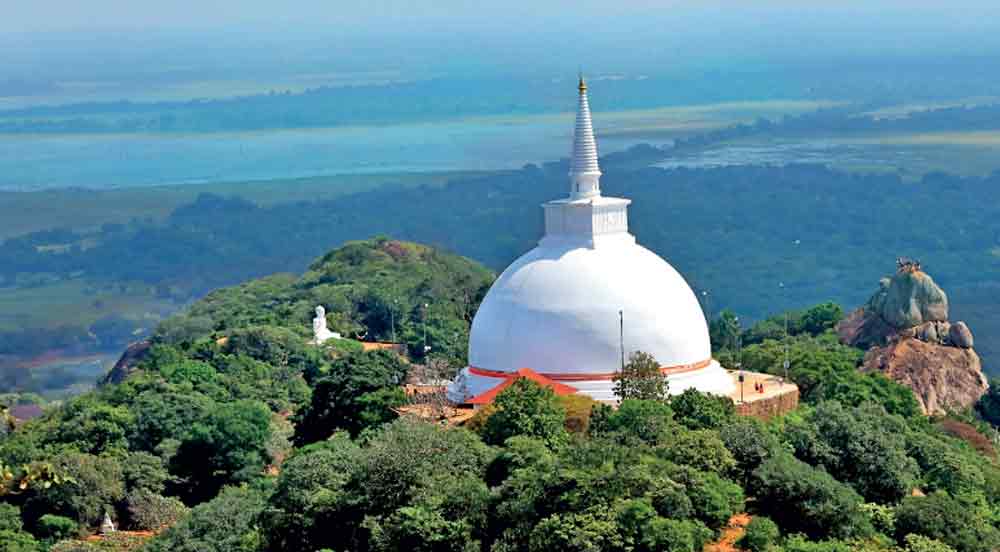
Over the past quarter-century, May and June have barely been blockbuster months for tourist arrivals compared to the European winter season (officially, 1 November to 30 April).
Yet, recent Sri Lanka Tourism Development Authority (SLTDA) data reveals a quiet but important shift.
May 2025 recorded 132,919 arrivals – an 18.5% increase, year-on-year – while June rose to 138, 241 visitors, up 21.8% over 2024.
Tourism earnings in May 2025 reached $ 164.1 million, the highest ever recorded for a May since 2019 even though it remained the weakest monthly inflow of the year.
In other words ... the floor is rising – even if the ceiling has not been lifted.
More significantly, Sri Lanka earned approximately $ 3.2 billion dollars from tourism in 2025 from 3.26 million arrivals – still below the roughly $ 4.4 billion generated in 2018 despite similar visitor numbers.
That disparity matters enormously. It suggests the country is attracting more volume without sufficiently increasing value. Or, translated from Economics into English: we are hosting more tourists, but extracting fewer dollars per traveller.
This is precisely where religious and cultural tourism could become transformative.
A well-designed Vesak-Poson tourism strategy should not aim merely for higher footfall. The smarter target would be higher-spending, longer-staying, culturally motivated travellers.
If Sri Lanka successfully positions itself as South Asia’s premier Buddhist experiential destination, attracting even an additional 150,000 to 200,000 high-value spiritual and cultural visitors annually over the next five years, the country could conservatively generate an extra $ 300-400 million in yearly foreign exchange earnings.
Push that ecosystem further. Integrate wellness retreats, meditation residencies, heritage railway circuits, eco-pilgrimages and boutique cultural hospitality. And then the medium-term potential edges closer to a billion-dollar niche segment within the broader tourism economy.
That is not fantasy. Thailand already earns billions annually from faith-linked tourism ecosystems connected to Buddhist heritage, wellness and spiritual travel, while Japan monetises Zen aesthetics with respectful but ruthless sophistication.
Sri Lanka by comparison remains oddly shy about commercialising what it already possesses organically: authenticity, a panoply of experiences amidst a naturally hospitable people, and the native blessing of sacred geography.
(The writer is the Editor-at-large of LMD and is a senior journalist with a Post-graduate Diploma in Politics and Governance)




