Tuesday Oct 20, 2026
Tuesday Oct 20, 2026
Saturday, 5 September 2026 00:23 - - {{hitsCtrl.values.hits}}
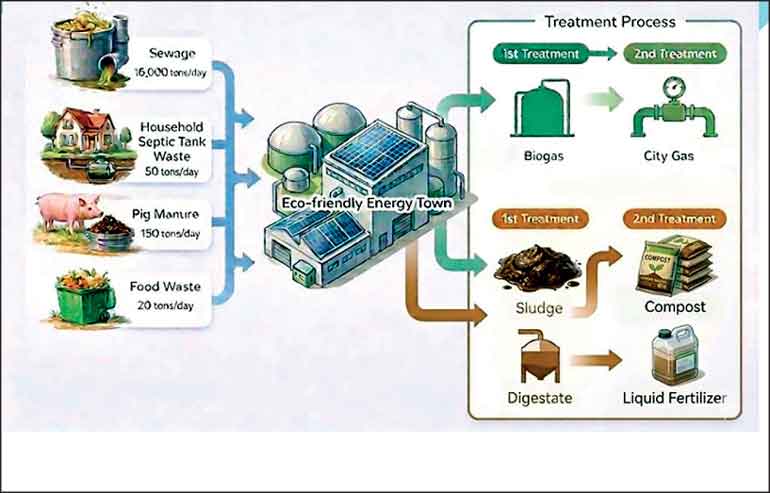
“Trash to Treasure” Concept in Hongcheon Eco-friendly Energy Town
(Source - 22nd ITCEEP training program)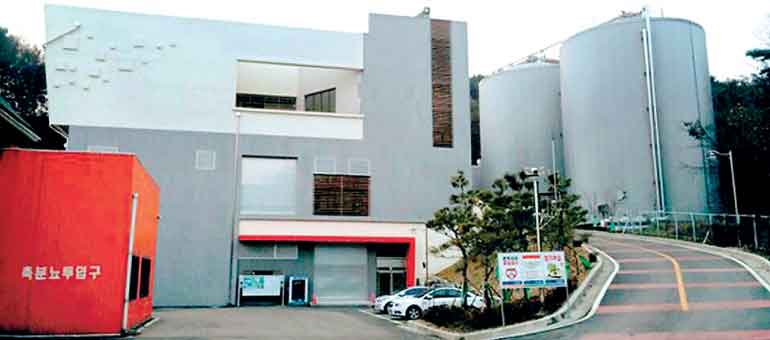
Livestock and food waste resource facilities at the Eco-friendly
Energy Town in Hongcheon
(Source - https://koreajoongangdaily.joins.com/2016/06/15/socialAffairs/Ecofriendly-towns-are-profitable-for-residents/3020061.html)
 Climate change has emerged as one of the most serious environmental challenges facing humanity. Rising global temperatures, melting glaciers, sea-level rise, heat waves, wildfires and increasingly frequent extreme weather events demonstrate the profound impacts of human activities on the environment. The continued dependence on fossil fuels, deforestation and unsustainable consumption of natural resources has increased greenhouse gas emissions and contributed to the interconnected crises of climate change, biodiversity loss and pollution, commonly referred to as the “triple planetary crisis.” Addressing these challenges requires urgent and coordinated climate action supported by technological innovation, effective policies, institutional capacity and meaningful public participation.
As a country, South Korea provides valuable lessons on how innovative policies and community-based approaches can contribute to climate change mitigation. One important strategy is the transition from fossil fuels towards renewable energy. Solar, wind and hydrogen energy are being promoted to reduce dependence on coal and natural gas and to support the decarbonisation of different economic sectors. The expansion of renewable electricity can also facilitate the electrification of transportation and heating systems. Such measures not only contribute to reduce the emission of greenhouse gas but also improve air quality and provide significant public-health benefits.
A particularly noteworthy example of South Korea’s integrated approach is the Hongcheon Eco-friendly Energy Town. This initiative demonstrates how environmental challenges can be transformed into economic and social opportunities for local communities. The project utilises food waste and animal manure to produce biogas, while solar panels and small-scale hydropower facilities provide additional renewable energy. The facility processes approximately 100 tons of organic waste each day, converting waste into useful energy resources for the local community.
The Hongcheon model also demonstrates the practical application of the “Waste-to-Wealth” or “Trash to Treasure” concept and circular-economy principles. During the biogas production process, useful materials such as liquid fertiliser and organic compost are generated as secondary products. These materials can be utilised by agricultural and recreational facilities, reducing the need for conventional chemical inputs. At the same time, the sale of biogas, fertiliser and compost creates additional economic benefits for residents while contributing to lower energy and heating costs. Consequently, waste that was previously regarded as an environmental burden has been transformed into an economic and community resource.
One of the most interesting aspects of this initiative is its contribution to transforming the traditional NIMBY (Not In My Back Yard) attitude into a PIMFY (Please In My Front Yard) approach. NIMBY generally describes opposition from local communities to facilities that are perceived as undesirable, potentially hazardous or environmentally problematic, such as waste-treatment plants or landfills. Such opposition can make the development of essential environmental infrastructure difficult.
In contrast, PIMFY describes a situation in which communities actively seek facilities or projects that are expected to provide economic, social or developmental benefits to their areas. In South Korea, the term is commonly associated with competition among Local Governments and communities to attract beneficial infrastructure, including transportation facilities, public institutions, research centers, parks and other development projects. The motivation is often linked to improved services, employment opportunities, regional development and increased property values.
The Hongcheon Eco-friendly Energy Town provides an important environmental application of this concept. Rather than viewing waste-treatment facilities solely as undesirable infrastructure, the community benefits from projects through generation of the renewable energy, reduced energy costs, income from resource recovery and improved local facilities. These benefits can encourage residents to support environmental infrastructure and participate actively in its operation. Thus, the project illustrates how appropriate economic incentives and community participation can change perceptions from “Not In My Back Yard” to “Please In My Front Yard.”
This experience highlights an important principle for climate change mitigation; environmental projects are more likely to succeed when local communities can recognise and share their benefits. Climate action should therefore not be limited to emission reduction targets or technological interventions. It should also consider the social and economic dimensions of sustainability. Projects that create employments, generate local income, reduce household costs and improve community infrastructure can strengthen public acceptance and long-term sustainability.
The South Korean experience provides valuable lessons for other countries, Waste-to-energy systems, renewable energy generation, resource recovery and community-based environmental projects could be adapted to local conditions including Sri Lanka. However, successful implementation would require appropriate policies, technical expertise, stakeholder participation and transparent benefit-sharing mechanisms as well.
Overall, the Hongcheon Eco-friendly Energy Town demonstrates that climate change mitigation can be approached as an opportunity for sustainable development rather than merely as an environmental obligation. Similar “Waste-to-Energy” initiatives have been implemented in several other areas of South Korea, including Asan, Cheongju, Eumseong, Gunwi, Gyeongju, Inje, Jeju, Tongyeong and Yangsan. These initiatives have successfully promoted waste conversion into renewable energy and valuable resources while generating economic and environmental benefits. Notably, active community participation has played an important role in supporting the successful implementation of these initiatives, demonstrating the importance of community engagement in achieving sustainable climate solutions.
By transforming waste into resources and community resistance into participation, South Korea illustrates how innovative, inclusive and economically beneficial solutions can contribute to climate resilience and sustainable development. The transition from NIMBY to PIMFY provides an important lesson: when communities receive meaningful environmental, social and economic benefits, they can become active partners in achieving climate solutions.
(The author is an Assistant Director, Environmental Promotion Unit at Central Environmental Authority, with academic qualifications including a BSc Special Degree in Zoology, Postgraduate Diploma and MSc in Environmental Science, and PhD in Public Health. She also holds qualifications in Palaeobiodiversity and Wildlife Conservation and Management. Dr. Radhika is also a freelance lecturer, writer, poet, and environmentalist, with a strong interest in environmental education, conservation, and public awareness)
End Notes:




