Wednesday Oct 21, 2026
Wednesday Oct 21, 2026
Thursday, 2 April 2026 02:11 - - {{hitsCtrl.values.hits}}
 Sri Lanka’s economy—still in the early stages of recovery from its recent crisis—remains heavily reliant on migrant remittances, which totaled $8.1 billion in 2025, as well as tourism inflows. Continuing tensions in the Middle East are drawing renewed attention from global markets, policymakers, and investors. Beyond headlines of military strikes and political rhetoric lie deeper implications for energy markets, trade flows, tourism, financial stability, and investor confidence. For emerging economies like Sri Lanka, closely connected to global financial flows and commodity markets, these developments are far from abstract. The Middle East remains central to global energy supply, with countries such as Saudi Arabia, Iran, and Qatar accounting for a significant share of the world’s oil and natural gas exports. The instability along the key route - Strait of Hormuz,
through which a substantial portion of global oil passes—has already driven energy prices higher. This surge directly impacts Sri Lanka by raising fuel and transportation costs, which in turn increases import bills and the cost of tourism services, affecting both households and businesses across the country.
Energy prices and inflation
Rising energy costs quickly translate into global inflationary pressures. For oil-importing countries like Sri Lanka, higher fuel prices increase the cost of transport and manufacturing, widen trade deficits, and strain foreign exchange reserves. Financial markets respond swiftly. Higher energy prices influence interest rates, currency movements, and equity valuations. Investor sentiment is also affected: periods of instability trigger a “flight to safety,” with capital moving toward safe-haven assets such as the US dollar, gold, and US Treasury securities. For countries undergoing fiscal adjustment, such shifts can complicate recovery.
|
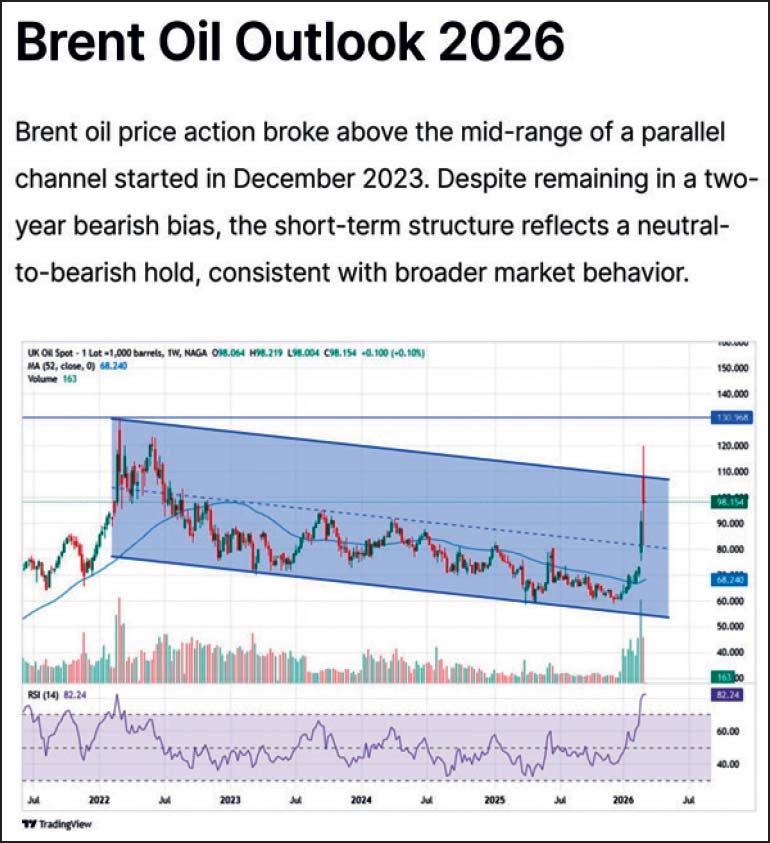
Brent crude oil prices surged from roughly $70 per barrel in late February to above $100 per barrel by late March 2026, underscoring the impact of escalating Middle East tensions on global energy markets
|
Sri Lanka’s exposure to energy shocks
For Sri Lanka, the impact of rising energy prices is particularly acute. The country imports nearly all of its crude oil and refined fuel, making it highly sensitive to fluctuations in global oil markets. Even modest price spikes can widen the trade deficit, strain foreign reserves, and push up transportation and production costs across the economy. For households and businesses alike, energy inflation quickly translates into higher living costs and operational expenses. Policymakers face a delicate balancing act: mitigating the impact on citizens while maintaining macroeconomic stability and investor confidence in a still-recovering economy.
Trade and supply chains
Global trade is another casualty of Middle East instability. The region sits at the crossroads of major maritime trade corridors linking Asia, Europe, and Africa. Disruptions to shipping routes or spikes in insurance costs raise freight rates and delay supply chains. For export-dependent economies, these disruptions undermine competitiveness and slow growth. Financial institutions feel these pressures through multiple channels. Banks face higher risks in trade financing and foreign exchange management. Capital markets experience volatility, with portfolio outflows and declining valuations in sectors sensitive to geopolitical risk, including aviation, tourism, and logistics. Insurance and shipping firms may face elevated premiums. Against this backdrop, diversification of energy sources, prudent foreign reserve management, and strong financial regulation are critical to mitigating external shocks. Central bank will play a key role in maintaining market confidence and liquidity during turbulent periods.
Geopolitics and prospects for prolonged conflict
The trajectory of the conflict may be heavily influenced by the level of international support for US military action. Donald Trump has recently urged European allies to provide stronger backing against Iran, including access to military bases, potential relocation of missile defense systems, and broader strategic cooperation. Yet many allies have been lukewarm, offering limited defensive support while repeatedly calling for de-escalation. Without broad international backing, coordinated action becomes more difficult, raising the prospect that the war could be prolonged. Across Europe and Asia, US allies have already been drawn further into a conflict that has disrupted the Gulf region and sent shockwaves through global markets. Ongoing strikes against Iran heighten the risk of escalation beyond the Middle East. Should the theatre of conflict expand, already strained supply chains and fragile economies could face further disruption, exacerbating global instability.
Conclusion
Understanding the drivers of the Middle East crisis—energy markets, trade flows, investor behavior, and geopolitics—is critical for policymakers, businesses, and financial institutions. Emerging economies like Sri Lanka are particularly vulnerable to these external shocks. Wars in today’s interconnected world are no longer regional events; they are global economic shocks. Rising energy costs, disrupted trade routes, and volatile financial markets underscore the importance of resilience, prudent risk management, and strategic foresight. For economies reliant on trade, remittances, and foreign investment, the Middle East conflict is more than a distant headline for Sri Lanka —it is a test of financial stability, livelihoods, and long-term economic sustainability. As Kofi Annan pointed out many years ago: “Nothing could be more important than a stable, peaceful world. For violence and conflict are the enemies of development and the friends of poverty.”
References
https://edition.cnn.com/2026/03/31/world/live-news/iran-war-us-trump-oil
https://edition.cnn.com/2026/03/31/europe/trump-lashes-out-europe-iran-war-latam-intl
https://www.youtube.com/watch?v=R5J3q8wlEIw
Ziad Daoud (@ZiadMDaoud) on X/Twitter (March 30, 2026) – Daoud highlighted that oil has surged from $61 to $116 due to the conflict, marking the “biggest disruption in history”.