Thursday Oct 22, 2026
Thursday Oct 22, 2026
Saturday, 24 January 2026 05:39 - - {{hitsCtrl.values.hits}}
 As Australia Day approaches on 26 January, it is timely to reflect on the deep and evolving relationship between Sri Lanka and Australia. From historical links shaped by shared Commonwealth ties to contemporary cooperation across trade, tourism, investment, migration, remittances and development, the partnership between Sri Lanka and Australia has strengthened steadily over time. Both countries have navigated global economic challenges and today there is a renewed opportunity to deepen collaboration for mutual prosperity.
Bilateral trade: Resilient and growing
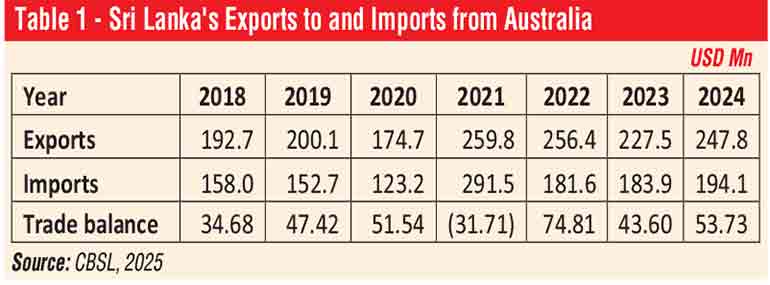
As illustrated in the Table 01, trade between Sri Lanka and Australia has continued to show positive momentum over the past in recent years. The total bilateral trade value rose from $ 350.8 million in 2018 to $ 442 million in 2024. Sri Lanka’s exports to Australia increased from $ 192 million in 2018 to $ 247 million in 2024 while imports from Australia also grew from $ 158 million in 2018 to $ 194 million in 2024.
Sri Lanka recorded a positive trade balance with Australia in most years, including $ 53.7 million in 2024. Major Sri Lankan exports to Australia include garments, tea, tyres, rubber gloves, fish, and coconut products, while Sri Lanka’s key imports from Australia comprise lentils, cereals and paper products.
The Sri Lankan migrant community in Australia can play a vital role in strengthening bilateral trade. By creating demand for Sri Lankan products, identifying market opportunities and connecting businesses on both sides, the diaspora helps deepen market linkages and supports export diversification.
Tourism: A top source market for Sri Lanka
Tourism remains one of the most significant areas of economic cooperation between Sri Lanka and Australia. Australia has consistently ranked among Sri Lanka’s top 10 tourism source markets, reflecting strong people-to-people connections and growing interest in Sri Lanka’s natural beauty, cultural heritage and hospitality.
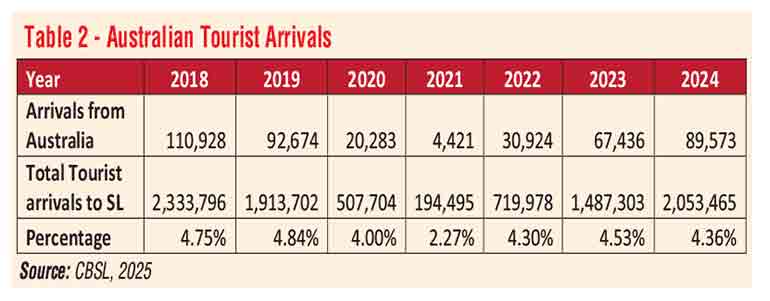
Australian tourist arrivals to Sri Lanka have shown a strong rebound following the pandemic as illustrated in the Table 02. Australian tourist arrivals totaled 92,674 in 2019 and despite a sharp decline during 2020 and 2021, arrivals recovered to 89,573 in 2024 nearly returning to pre-pandemic levels. Overall, Australia’s share of total tourist arrivals has remained strong at around 4% during recent years, reaching 4.36% in 2024.
A significant portion of Australian tourism to Sri Lanka is driven by visiting friends and relatives (VFR), reflecting the close migration ties.
According to SLTDA data, VFR accounted for 19% of Australian arrivals in 2024, underscoring the strong family and community links that sustain travel flows. Similarly, Australia remains a popular destination for Sri Lankan residents visiting family members, reinforcing the deep people-to-people connections that underpin bilateral relations.
Migration and remittances: An enduring pillar of bilateral ties
The Sri Lankan community in Australia is a vibrant diaspora that contributes to both economies through skills, knowledge transfer, and strong people-to-people links. Many Sri Lankans travel to Australia for higher education, gaining international exposure; while some remain abroad, others return with global experience and professional networks that support Sri Lanka’s development.
Remittances from Sri Lankans in Australia remain an important economic pillar, supporting household incomes and local development. According to CBSL data, remittance inflows increased from $ 108.6 million in 2023 to $ 144.8 million in 2024, strengthening economic resilience during a period of adjustment. Beyond financial flows, the diaspora also facilitates trade and tourism linkages, reinforcing the broader Sri Lanka–Australia economic partnership.
Investment: A growing opportunity for deeper engagement
Australian investment into Sri Lanka is gradually strengthening, reflecting growing confidence in Sri Lanka’s long-term economic prospects. While current annual inflows remain modest, the overall stock of Australian foreign direct investment in Sri Lanka has reached $ 231 million by the end of 2024 as per CBSL data. This indicates a solid foundation for deeper engagement.
Sri Lanka’s strategic location, improving regulatory environment, and expanding sectors such as renewable energy, tourism, infrastructure, and agribusiness offer attractive opportunities for Australian investors. By strengthening public–private partnerships, improving market access, and promoting sustainable projects, both countries can unlock higher investment flows that support job creation, innovation, and shared growth.
Development cooperation: Supporting resilience and shared progress
Australia has maintained a longstanding development partnership with Sri Lanka, supporting a wide range of economic and governance reforms, civil society strengthening, and skills development. During Sri Lanka’s 2022 economic crisis, Australia provided significant humanitarian support to address urgent food security and health needs. More recently, Australia also assisted Sri Lanka in the aftermath of Cyclone Ditwah helping affected communities with relief and recovery efforts.
As Sri Lanka continues its recovery, Australia’s development program remains focused on promoting inclusive, sustainable, and resilient growth. Australia continues to work in close partnership with Sri Lanka, aligning development support with local priorities to strengthen resilience and regional stability.
As Australia Day approaches, the Sri Lanka–Australia partnership stands out as a relationship grounded in shared values and mutual interests. From trade and investment to tourism, migration, remittances, and development cooperation, the two countries have built a multifaceted economic bond that supports growth and resilience on both sides. With continued dialogue, strengthened business linkages, and deeper collaboration in key sectors, there is strong potential to expand this partnership further. Looking ahead, Sri Lanka and Australia can continue to work together to build a more prosperous, stable, and interconnected future in the Indo-Pacific.
(The author is a researcher with over a decade of experience in the private and non-profit sectors. He holds an MPhil and a Master’s degree from the University of Colombo and has undertaken extensive consultancy work with international development organisations. He can be contacted via [email protected])




