Monday Sep 14, 2026
Monday Sep 14, 2026
Tuesday, 14 July 2026 05:00 - - {{hitsCtrl.values.hits}}
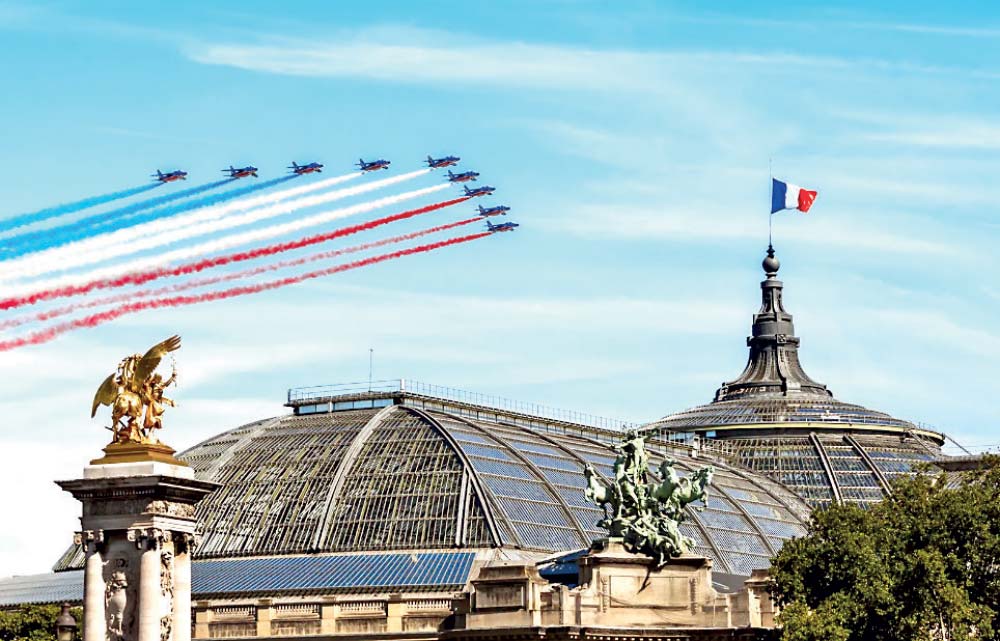
 The French Revolution’s promise was never perfection. It was possibility. Victor Hugo once observed that “nothing is more powerful than an idea whose time has come”
 The French could hardly have asked for a better prelude to Bastille Day. A composed 2-0 victory over Morocco in the FIFA World Cup 2026 quarterfinals has propelled ‘Les Bleus’ into another semifinal, reaffirming what football lovers have come to expect over the past three decades: France rarely exits the world’s biggest tournament quietly.
As supporters begin counting the hours to the next match versus Spain on 15 July, another date looms larger still. On 14 July, the French Republic celebrates its 237th anniversary of the storming of the Bastille – an event whose symbolism has long eclipsed the military significance of the prison itself.
The coincidence is irresistible. France enters the decisive stages of the World Cup at precisely the moment it commemorates the birth of its modern political identity.
But here lies a fascinating dilemma. Is France merely a great nation sustained by the glory of its past, or does it remain one of the indispensable architects of the world’s future?
That question matters far beyond the furor and fandom of football.
The ideal trio
Every World Cup eventually reaches the knockout stages where history counts for little and performance counts for everything. Nations cannot rely forever upon previous trophies. They must continue to deserve their place among the elite.
The same is true of republics.
The French Revolution unleashed three concepts that have echoed around the globe for more than two centuries: Liberté, Égalité, Fraternité. Liberty, Equality, Brotherhood. (And football fans may add, Mbappé – no translation needed!)
But seriously, those three ideals emerged from extraordinary violence.
The French Revolution produced both the visionary Marquis de Lafayette and the implacable Maximilien Robespierre. It inspired the Declaration of the Rights of Man and of the Citizen, while also descending into the Reign of Terror.
Out of the upheaval strode Corsican general Napoleon Bonaparte, military genius and subsequently imperial conqueror, whose ambitions redrew Europe even as they contradicted the republican ideals from which he emerged.
History, however, has a curious habit of correcting itself.
If Napoleon embodied French power, Charles-Maurice de Talleyrand espoused French diplomacy. The statesman who survived monarchy, revolution, empire and restoration demonstrated that nations endure not merely through military victories but through political adaptability.
Talleyrand understood something modern geopolitics repeatedly confirms: today’s enemy may become tomorrow’s indispensable partner.
France has often lived by that lesson.
The force of republican principles
Modern France remains one of only a handful of countries possessing permanent membership of the United Nations Security Council, an independent nuclear deterrent, advanced aerospace capabilities, global diplomatic reach and a seat within the G7.
Together with Germany, it continues to provide much of the political engine driving the European Union through successive crises – from sovereign debt and Brexit to the COVID-19 pandemic and Russia’s invasion of Ukraine.
Indeed, if Europe has increasingly spoken with one strategic voice, French has often supplied its accent.
That influence extends to security.
France occupies a distinctive place within NATO. General Charles de Gaulle famously withdrew France from the North Atlantic Treaty Organisation’s integrated military command in 1966, in defence of strategic autonomy – only for President Nicolas Sarkozy to fully reintegrate French forces in 2009.
Yet even while insisting upon independent decision-making, France has consistently remained one of the western alliance’s strongest military contributors. It has participated in operations from the Balkans to Afghanistan, from counterterrorism campaigns across the Sahel to the reinforcement of NATO’s eastern flank following Russia’s invasion of Ukraine.
There is no contradiction here. Republican principles do not require pacifism. Rather, they require that force serve law rather than replace it.
The enduring strength of the French Republic lies precisely in its willingness to revisit its founding ideals without abandoning them. Liberty, equality, and fraternity remain aspirations rather than completed achievements. This is true not only for France but for every democracy
The horns of a dilemma
That distinction has become increasingly important as the international rules-based order faces perhaps its greatest challenge since the Cold War.
Russia’s assault upon Ukraine challenged the prohibition against territorial conquest. Conflict in the Middle East continues to test international humanitarian law. Strategic rivalry between the United States and China increasingly threatens to fragment global governance into competing spheres of influence.
Economic coercion, cyber warfare, disinformation and artificial intelligence have created entirely new arenas where power is exercised without formal declarations of war.
For a middle-ranking great power such as France, these developments present both danger and opportunity. Danger because empires once flourished through spheres of influence; today’s France flourishes through multilateral institutions instead. Opportunity because whenever rules are questioned, diplomacy becomes indispensable.
La vie en rose
And France has long excelled at diplomacy.
Its influence frequently exceeds the size of its population. French remains one of the principal languages of diplomacy. The country maintains one of the world’s largest diplomatic networks. Paris continues to host negotiations on climate, culture and international governance. The Paris Agreement on climate change remains one of the defining diplomatic achievements of the twenty-first century.
Yet influence today cannot rest upon diplomacy alone. It must also rest upon culture.
We will always have Paris
Here France continues to perform with astonishing consistency.
Victor Hugo and Alexandre Dumas remain among the world’s most translated novelists. Molière continues to define comic theatre. Jean Racine and Pierre Corneille shaped classical drama. Charles Baudelaire transformed modern poetry. Marcel Proust reinvented memory itself through literature. Albert Camus and Jean-Paul Sartre asked uncomfortable questions about existence, freedom and responsibility that remain strikingly contemporary. French philosophy still informs debates on identity through Michel Foucault, Jacques Derrida and Simone de Beauvoir.
The arts of France tell an equally remarkable story. Claude Monet, Pierre-Auguste Renoir, Edgar Degas, Paul Cézanne, Henri Matisse and Georges Seurat altered forever how humanity sees colour, light and movement. Auguste Rodin gave sculpture emotional intensity. Claude Debussy and Maurice Ravel reimagined musical harmony. Georges Bizet composed Carmen, among opera’s most enduring masterpieces. Édith Piaf’s La Vie en Rose still chills and thrills.
Cinema has produced Jean Renoir and François Truffaut, while Gérard Depardieu, Juliette Binoche, Marion Cotillard, Mélanie Laurent and Timothée Chalamet have carried French acting onto the global silver screen.
The groves of academe
Science perhaps reveals France at its most quietly influential.
René Descartes transformed philosophy and mathematics. Blaise Pascal advanced probability theory. Antoine Lavoisier became the father of modern chemistry. Louis Pasteur revolutionised medicine. Pierre and Marie Curie changed physics forever through the study of radioactivity. Henri Poincaré laid foundations for modern mathematics and cosmology.
Even today, French universities, laboratories, aerospace industries and technology firms remain central participants in European innovation.
France enters its 238th year not as an empire seeking to reclaim vanished grandeur, but as an experienced midfielder still reading the game, linking defence with attack, setting the rhythm for others, and reminding the world that vision can matter as much as velocity
Allons enfans de la patrie
Nor has France retreated from sport.
Football may dominate headlines, but France continues producing Olympic champions, Tour de France winners, world-class judoka, rugby players, fencers, swimmers and tennis players. Kylian Mbappé may represent one generation; but before him came Zinedine Zidane, Michel Platini and Thierry Henry. The production line seems remarkably resilient.
No more the Marseillaise?
Yet to celebrate France honestly also requires acknowledging its challenges.
Economic growth has often lagged behind those of faster-growing economies. Public debt remains substantial. Social cohesion has been tested by immigration debates, secularism, pension reforms and periodic urban unrest. The rise of political movements on both the left and right reflects anxieties shared across much of Europe.
Nor is French influence quite what it once was.
The decolonisation of Africa has transformed relationships that Paris once regarded as permanent. Military withdrawals from parts of the Sahel symbolise changing realities. English increasingly rivals French even within institutions where French once predominated.
Economic dynamism has shifted towards Asia. India’s rise, China’s manufacturing scale and America’s technological leadership inevitably alter global hierarchies.
Measured purely by relative power, France no longer occupies the commanding heights it once did.
Cherchez la femme!
But relative decline should not be confused with irrelevance.
Indeed, the twenty-first century increasingly rewards precisely those countries capable of building coalitions rather than dominating continents.
France understands coalition-building. Its republican tradition equips it well for an age where persuasion often proves more valuable than coercion.
The French Revolution’s promise was never perfection. It was possibility. Victor Hugo once observed that “nothing is more powerful than an idea whose time has come”.
The enduring strength of the French Republic lies precisely in its willingness to revisit its founding ideals without abandoning them. Liberty, equality, and fraternity remain aspirations rather than completed achievements. This is true not only for France but for every democracy.
Allons, enfans, de la patrie
Perhaps that explains why Bastille Day continues to resonate far beyond French borders.
It commemorates less the fall of a prison than the refusal to accept that any prison (political, intellectual or social) must remain permanent.
As the World Cup advances towards its final on 20 July, football again offers an apt metaphor.
Championships are not won in the opening fixture, nor secured by memories of former triumphs. Every tournament demands fresh resolve, tactical adaptation and collective discipline. Great teams survive because they continue learning long after lifting previous trophies. The same may be said of great republics.
France enters its 238th year not as an empire seeking to reclaim vanished grandeur, but as an experienced midfielder still reading the game, linking defence with attack, setting the rhythm for others, and reminding the world that vision can matter as much as velocity.
Whether ‘Les Bleus’ ultimately lift another World Cup is a question that only the remaining matches can answer. Whether the French Republic still has a decisive role to play in shaping the modern world is a different matter altogether.
That match is far from over. And if history is the geopolitical power tournament in which nations seek lasting glory, France has shown time and again that it remains a player no serious observer can afford to mark loosely before the final whistle has been blown.
(The writer is the Editor-at-large of LMD and is a senior journalist with a Post-graduate Diploma in Politics and Governance)




