Thursday Oct 22, 2026
Thursday Oct 22, 2026
Wednesday, 21 January 2026 00:24 - - {{hitsCtrl.values.hits}}
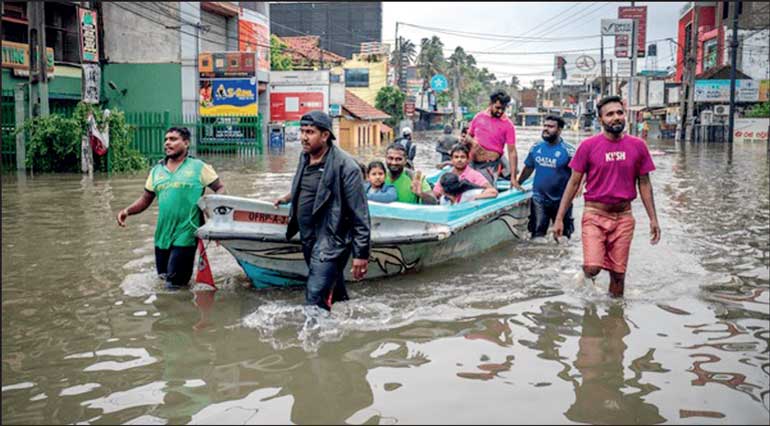
Floods in Colombo
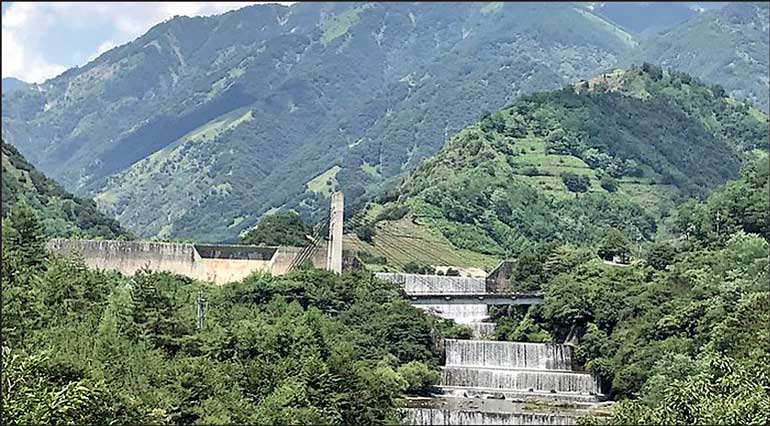
Japanese type SABO dams
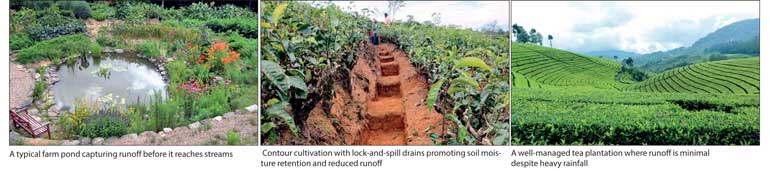
 Floods in Sri Lanka are often treated as downstream problems, to be managed at river mouths, river basins, embankments, or reservoirs. Yet floods do not originate in floodplains. They begin where rain first falls, on rooftops, home gardens, plantations, forests, and steep hillsides in the upper catchments.
While priority must be given to upstream watershed management, the role of floodplains as downstream sinks cannot be overlooked. In lowland areas, ecosystem-based approaches are essential, particularly the restoration of wetlands as sinks to absorb excess floodwater and the rehabilitation of natural drainage pathways to convey water safely without causing damage.
Harnessing floods before they become disasters
Sri Lanka’s 103 rivers discharge an estimated 39 billion cubic metres of water to the sea each year, nearly one-third of the country’s annual rainfall. This volume is equivalent to filling the Victoria Reservoir about 54 times. More than 90 per cent of this runoff comes from just three river basins, the Mahaweli, Kalu, and Kelani, with the Mahaweli alone contributing nearly 9 billion cubic metres annually. Much of this water reaches the sea as destructive runoff, remaining largely unutilised while causing severe land degradation in upper catchments.
During cyclone Ditwah. peak releases reportedly reached about 2,700 m³ per second from Victoria Reservoir and 250 m³ per second from Rajanganaya reservoir, reflecting the limits of reservoir-based flood moderation.
Poor land use and land use planning
The flash flood problem was mainly due to inappropriate land use planning, poor land use and watershed management practices in mid and hill country. The country’s first line of natural water storage, the soil, the sponge and the sink of water, failed in wider area, due to poor infiltration. At the time of Ditwah, reservoirs were already close to full or spilling, leaving no buffering capacity. Consequently, intense surface runoff, carrying eroded soil and debris, surged from the uplands to the coastal plains, destroying homes, roads, railways, and other infrastructure. Crucially, the floods were driven not only by reservoir releases, but by runoff volumes far exceeding both soil and storage capacities.
 Flood control must move upstream
Effective flood control must begin at the source by reducing rapid surface runoff, slowing, storing, spreading, soaking, and safely releasing rainwater as much as possible to where it falls. Although the specific measures differ across homesteads, plantations, and landslide-prone areas, the underlying principle is universal: every landscape unit must function as a temporary water buffer rather than a rapid run-off surface.
Practical flood control at field level
Flood control must begin where rain falls. Regardless of land use, the objective is the same: intercept runoff early, slow down, store, improve infiltration, and release excess water safely.
Along small streams, low-cost anicuts can be constructed using locally available materials such as stone, timber, or earth. These simple structures trap soil, slow down runoff, store water, and reduce downstream flood peaks.
In larger streams, Japanese-style SABO dams offer an effective solution. Designed to trap sediment while allowing controlled flow, these small check dams stabilise stream beds, reduce erosion, and temporarily store floodwater and trap sediments. Individually their impact may seem modest, but when constructed in series across a catchment, hundreds of such structures can collectively retain substantial volumes of water and silt. This distributed approach strengthens watershed resilience at a fraction of the cost of large downstream engineering works.
Across homesteads and commercial cultivations, simple, proven measures can sharply reduce flood peaks. Small ponds and retention pits can capture rooftop and field runoff, while contour bunds, lock-and-spill drains, and interceptor drains prevent water from accelerating downslope. Maintaining permanent vegetation cover, such as trees, shrubs, grasses, or hedgerows such as vetiver improves infiltration, traps sediment, and stabilises soil. Well-managed plantations using these practices can reduce surface runoff by 30–50 per cent.
 In landslide-prone upper catchments, flood control and slope stability are inseparable. Surface runoff must be intercepted at regular intervals and safely disposed of, while subsurface drainage reduces groundwater pressure. Long-term protection depends on bio-engineering solutions, including deep-rooted native trees, vetiver grass, and forest restoration, which simultaneously reduce landslide risk and moderate flood flows at their source.
A powerful combined benefit
There are approximately one million households in Sri Lanka’s hill country, each owning about 0.25 hectares.
Together, these measures provide 226 million m³ of storage. Even after accounting for existing storage, the net gain is about 168 million m³ which is nearly equal to the full capacity of the Kotmale Reservoir (172 million m³).
The cost of ignoring the source
The combined damage from floods and landslides triggered by Cyclone Ditwah is estimated at nearly $ 7 billion (Rs. 2,100 billion), caused by a single extreme rainfall event. Unless the root causes are addressed, similar disasters will recur, imposing enormous social and economic costs. What the country urgently needs is not temporary relief, but a sustainable, preventive solution.
Sri Lanka’s flood and landslide crises are not due to a lack of laws, but to weak enforcement and poor institutional coordination. In fact, there are too many laws, with overlapping responsibilities and unclear accountability.
The Soil Conservation Act, Land Development Ordinance, and Town & Country Planning Ordinance already provide adequate legal authority to regulate land use in upper catchments-f they are properly applied. In addition, the Irrigation Ordinance No. 32, Soil Conservation Act No. 25, Mahaweli Authority Act No. 23, and Disaster Management Act No. 13 collectively empower state agencies to control erosion, manage land use, and protect watersheds.
The real challenge, therefore, is not a lack of laws or technical knowledge. Proven soil and water conservation measures are well known. However, despite having sufficient legal powers, most responsible agencies remain inadequate at ground level (mostly due to lack of trained staff, budget, mobility and overlapping responsibility).
What is missing is effective enforcement, coordination among institutions, and political commitment to manage land and water responsibly at the source, where floods and landslides truly begin.Top of Form Unless action shifts upstream, Sri Lanka will continue to treat the symptoms of floods rather than their causes.
Policy recommendation
With climate change, more floods like Ditwah are likely. Flood management policy must prioritise reducing runoff where rain falls. National policy should mandate rainwater retention at homesteads (rain water harvesting), enforce soil and water conservation in commercial cultivations, and integrate flood control with landslide mitigation in upper catchments.
Existing legal tools combined with fiscal incentives and community-based implementation, can make this shift possible. Thousands of small, decentralised interventions can prevent catastrophic floods downstream.
(The author holds a B.Sc. in Agricultural Engineering from Tokyo University and an M.Sc. in Soil and Water Management from the University of Wageningen. He is a specialist in watershed management and soil conservation, and a former Director of the Natural Resources Management Centre, Department of Agriculture, Sri Lanka. He has also worked with FAO in Sri Lanka and Bangladesh)




