Friday Nov 27, 2026
Friday, 27 November 2026 00:21 - - {{hitsCtrl.values.hits}}

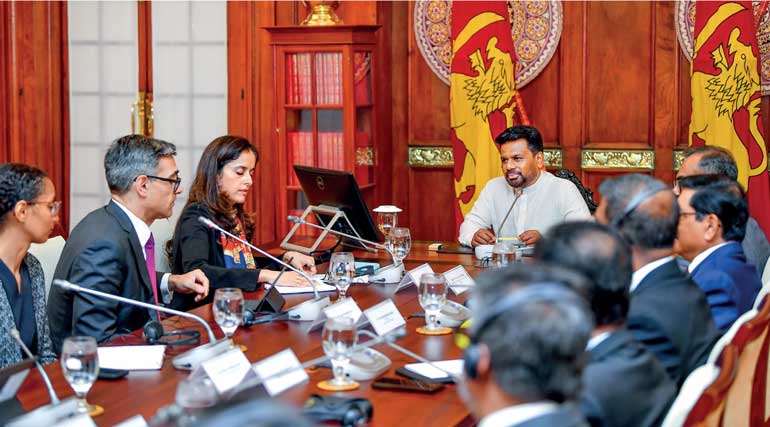
President Anura Kumara Dissanayake chairs a meeting with an IMF delegation during its visit to Colombo in July 2026

Sri Lanka’s economic recovery in terms of macroeconomic indicators has been a remarkable story of success and resilience. From a nation posting negative growth of around 7%, inflation at nearly 70% and market interest rates at over 30%, Sri Lanka has largely stabilised thanks to its fiscal policies and the IMF. But currently Sri Lanka is facing external shocks such as the Mideast war, Russia-Ukraine war, rising global interest rates, El Nino and trade pattern changes globally. The most devastating impact has been the Mideast war, which is leading to a high fuel import bill, severely hampering Sri Lanka’s ability to build gross reserves.
But as Sri Lanka’s reserves are not meeting projections, global interest rates are high, the IMF program is coming to an end and debt repayment levels are increasing from 2028, a critical question is, “Should Sri Lanka go for another IMF program”? Let me give the case for it.
Low gross reserves
Sri Lanka has lagged behind in terms of getting to the IMF’s projected (not target) figures in terms of gross official reserves. Currently as of October 2026, we are at $7.1 billion in reserves. Fitch projects gross reserves to be at $7.7 billion by the end of this year. The IMF report of May 2026 projected gross reserves to be at $8.6 billion by the end of this year. Sri Lanka is still going to fall back by almost $1 billion from the reserves projected by the IMF just 6 months ago, if we get to $7.7 billion by the end of this year (as Fitch projects). But when looking at the March 2023 IMF report which the program was signed with, that report projected that Sri Lanka would have reserves of $10.9 billion by the end of 2026. We will be short of the end-of-2026 projection made by the IMF in March 2023, by close to $3.2 billion, even if we are to have reserves of $7.7 billion by the end of this year. March 2023 IMF projections were not targets and were always subject to change, but I am raising the point to show how far we have fallen back. An IMF program will be a strong safeguard for Sri Lanka, when gross reserves are not doing as well as projected.
IMF brings confidence
Many people in Sri Lanka dismiss the IMF as saying it’s just $3 billion and if we can get an investment of such a figure, we would not need the IMF. I have explained this many times before, the IMF is much more than the $3 billion. The IMF is like a verification for the Sri Lankan economy. It is like an auditor where investors, international bond markets, bilaterals and other multilaterals trust the IMF to move forward with a country in most cases. At this juncture especially when Sri Lanka is facing turbulence due to external shocks, having the IMF on board is much better.
IMF is cheaper to borrow from than ISBs
As US 10 year Treasury yields hit 5.35% in October this year, borrowing costs are currently high due to high debt levels in developed countries, increasing inflation and financing being diverted to AI related spending. This will also mean that IMF borrowing costs also get higher but borrowing from the IMF is cheaper than issuing international sovereign bonds. Rather than issue a sovereign bond next year, 2027 (as projected by the IMF), Sri Lanka could borrow from the IMF. The other benefit is that borrowing from the IMF comes with technical assistance and IMF reviews of the economy at least twice a year.
Sovereign rating not enough
The current rating of B- by Fitch may not be enough to access international capital markets in 2027 at decent borrowing costs. The IMF has projected Sri Lanka issuing a Eurobond of $1.5 billion in 2027 but a further rating upgrade would give us better access to international capital markets. Another rating upgrade is not guaranteed in 2027 so it is best for Sri Lanka to grab what is within reach in March 2027 to safeguard itself from potential shocks. As gross reserves are not where they were projected to be even by the IMF in May 2026, Sri Lanka has little time.
Borrow from the IMF to pay the IMF back
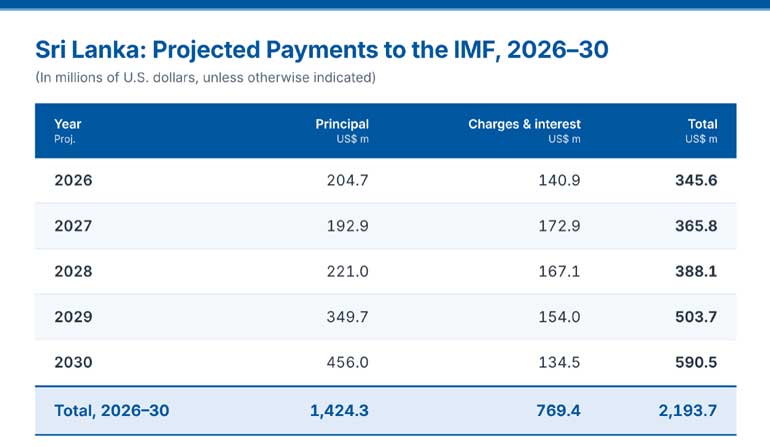
Table 1 shows how much we have to pay back the IMF each year from 2026-2030.
As seen in Table 1, Sri Lanka will be paying $2.194 billion back to the IMF from 2026 to 2030. There is a saying which goes as “Borrowing from Peter to pay Paul”. I am saying, “Let us borrow from Peter to pay back Peter”. In the next 4 years (2027-2030), Sri Lanka is expected to pay back the IMF a sum of $1.848 billion. Another program can help neutralise this to some extent. This is not something new. Sri Lanka keeps borrowing from the World Bank and at the same time, Sri Lanka is paying back the World Bank for past loans. We can do a similar process with the IMF.
(The author is a Sri Lankan Economist. The views expressed in this article are strictly the author’s own personal opinions)