Thursday Nov 12, 2026
Thursday Nov 12, 2026
Thursday, 12 November 2026 00:20 - - {{hitsCtrl.values.hits}}

Introduction
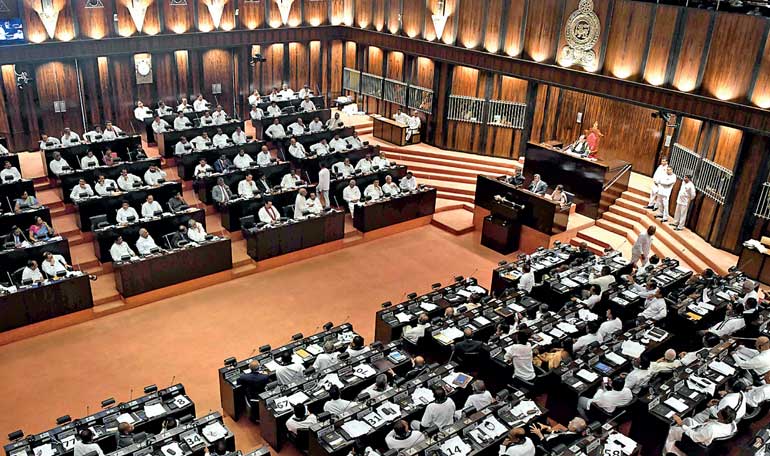
The current NPP Government will present its third Budget to Parliament on 12 November 2026. Among citizens’ many expectations, the Government also aims to deliver on its election manifesto commitments in this Budget. It will allocate the necessary funds to continue initiatives already underway since 2024. In my view, five national initiatives share overlapping sustainable development objectives, including building a prosperous, inclusive, and sustainable nation. These are: (1) A Thriving Nation – A Beautiful Life (the NPP Government’s election manifesto), (2) Digital Economy, (3) Prajashakthi, (4) Clean Sri Lanka, and (5) the work of the Sustainable Development Council (SDC). The last is not a national-level initiative; however, it measures the country’s overall performance in development activities. These initiatives have distinct mandates and implementation mechanisms. However, they share a common aspiration from NPP’s Election Manifesto: to enhance people’s quality of life and well-being through economic progress, social inclusion, environmental sustainability, and good governance.
One might ask whether the new Budget brings new development projects. Whatever the outcome of the Budget proposals, the central question one should ask is not whether Sri Lanka needs more development initiatives, but how existing initiatives can be integrated into a coherent national development framework that delivers measurable benefits to communities, as the market and the state have not addressed the salient problems facing the community-the third pillar. Rajan, Raghuram G. (2019), in his book titled “The Third Pillar: How Markets and the State Leave the Community Behind”, argues that the state and markets have left communities behind.. The best option for aligning these three pillars is inclusive localism. This article shows how existing initiatives can be integrated into a coherent national development framework that delivers measurable community benefits.
Shared national goals, fragmented implementation
The NPP election manifesto, A Thriving Nation, sets out the overarching vision for economic and social transformation, or renaissance. The Digital Economy initiative promotes productivity, economic growth and development through technological innovation, digital infrastructure, and efficient public services. Prajashakthi focuses on reducing poverty, empowering communities, and supporting local economic development through Community Development Councils (CDCs) nationwide. Clean Sri Lanka emphasises environmental sustainability, ethical behaviour, civic responsibility, and social transformation. Meanwhile, the Sustainable Development Council, established under the Sustainable Development Act of 2017, promotes policy coherence and progress towards the United Nations Sustainable Development Goals (SDGs). The SDGs have 17 goals, 169 targets and 234 unique global indicators. The Government initiatives mentioned above complement rather than compete with one another. However, without effective coordination, overlapping objectives may lead to duplicated activities, fragmented resource allocation, and missed opportunities for collaboration. The question then is how to integrate goals, funding allocation, monitoring and evaluation across all initiatives into a single framework while respecting original mandates. The next section will answer this question.
Eight capitals: The seeds of sustainable economic growth
Sri Lanka’s economy has grown at an annual rate of 4.5% since independence. This is the long-term growth rate, or structural rate of growth. Last year’s economic growth was 5%, slightly above the historical growth rate. The country has achieved many remarkable achievements in many areas except economic growth. To build a thriving nation and improve lives, higher per capita income is vital because Sri Lanka’s standard of living and well-being depend on the country’s ability to produce goods and services and increase income. However, according to SDC, the weakest area among all the 17 SDGs is decent economic growth. Economic growth and sustainable development do not occur in isolation. They depend on a nation’s capacity to develop, mobilise, and use its resources productively. Conventional economic analysis has emphasised investment in labour, human capital, physical capital, natural capital, and technological progress as major drivers of growth. 
Jean Tirole, a winner of the 2014 Nobel Prize in Economic Sciences, argues in his 2017 book, “Economics for the Common Good: Delve into Economics With A Nobel Prize Winner”, that economists have too much to learn from the social sciences and humanities. Andrew Leight, in his book How Economics Explains the World, beautifully explains how economic change has shaped the course of history. Economics helps us trace humanity’s progress from hunter-gatherer societies to the modern global economy. The Agricultural Revolution allowed for food surpluses and specialisation, and the Age of Sail, which facilitated global trade and colonisation, shaped the course of history. The Industrial Revolution marked a turning point, dramatically improving living standards through technological innovations. The World Wars and subsequent economic theories shaped 20th-century policies, leading to periods of prosperity but also inequality. Throughout, geography, culture, technology, and institutions played crucial roles in determining economic success.
Many scholars argue that investing in conventional capital formation alone will not enrich community-level sustainability because the vulnerabilities and poverty communities face are multifaceted. Institutional economists such as Acemoglu, Robinson, and North stress that institutions shape economic development and material well-being. Adam Smith introduced the original economic conception of capital in 1777. Later, as the concept of capital broadened beyond its conventional economic meaning, sociologists also examined different forms of capital to enhance communities’ social well-being. These include cultural, economic, and social capital, as introduced by Pierre Bourdieu. James Coleman introduced social capital theory, while Lyda Judson Hanifan was among the earliest scholars to use the term. They used the notion of social capital in the context of community relationships and collective action. Amartya Sen’s foundational contributions include welfare economics, the capability approach to human development, social choice theory, and poverty analysis. Elinor Ostrom’s work on collective action and common-pool resource governance, as well as Robert David Putnam’s work on civic participation and social capital, are also particularly relevant to community development.
Political Economy uses three pillars—state, market, and community—to describe any country’s economic system. The market is an effective way to organise economic activity and drives innovation. Economics and politics are closely intertwined. The market has market failures, and the Government has Government failures, and both need each other to function properly. This does not mean the community should be ignored; the three pillars must be delicately balanced. In these circumstances, growth and sustainable development require a comprehensive understanding of the resource allocation and capabilities that underpin a nation’s long-term prosperity. Evaluating all perspectives mentioned above, the writer proposes the Integrated Eight-Capital Framework (IECF), which identifies eight interconnected foundations of growth and sustainable development: human, physical, natural, economic, social, cultural, institutional, and technological capitals. For details on the IECF, see the article published on 8 June, 2026[1].
These capitals are not unrelated or independent resources; they reinforce one another and collectively shape a nation’s ability to produce goods and services, build resilience, and support well-being. The IECF can be understood as the seeds of economic growth and sustainable development. Just as seeds require suitable conditions to grow, Government and the private sector should invest continuously in the formation of these capitals. Effective institutions, scientific knowledge, and community participation are needed to deliver lasting economic and social benefits. In fact, institutional capital can serve as a catalyst for capital.
For example, environmental conservation protects natural capital, and effective public institutions create the conditions for productive investment. Social trust, cultural values, and community cooperation facilitate collective action and enhance the effectiveness of development programmes. Investment in education and health strengthens human capital, while digital infrastructure and innovation enhance technological capital.
From this perspective, the forthcoming Budget should not be regarded simply as an annual statement of Government expenditure and revenue. It should also be viewed as a strategic instrument for developing the country’s eight capitals. This framework does not essentially require higher public expenditure. Instead, it demands more effective coordination, allocation, and evaluation of available resources. Public investment by the Government should be assessed by its contribution to capital formation, productivity, social inclusion, environmental sustainability, and long-term development outcomes.
Sri Lanka’s five national initiatives present an opportunity to adopt an integrated approach. By aligning their shared objectives with the Eight-Capital Framework, the Government could establish a common basis for planning, Budgeting, implementation, and monitoring. The fundamental question for the national Budget should therefore be: How effectively will public resources be allocated to strengthen the eight capitals underpinning Sri Lanka’s sustainable economic growth and development?
Five initiatives relate to the eight capitals. Clean Sri Lanka links cultural, natural, social and institutional capital. A Thriving Nation-Beautiful Life links all eight capitals. Digital Economy addresses technology, institutional, human and economic capitals, while Prajashakthi links to economic, institutional, human and social capital. SDC provides institutional capital and monitors across all eight capitals.
Budget as an investment instrument: Capital-based Budgeting
Normally, a Budget has two expenditure components: current expenditure and capital expenditure. If the Government allocates funds for investment that strengthens capital, one can claim the Budget is capital-based or development-oriented. A Budget proposal should also include measurable returns or quantifiable indicators for performance appraisal.
In this context, the writer would introduce Integrated Eight-Capital Budgeting (IECB) as an analytical framework. Under this framework, the Government could classify its development expenditure by the primary capital it strengthens, identify secondary capital benefits, and set measurable indicators for expected outcomes.
For example, investment in irrigation infrastructure would primarily strengthen physical capital, but could also improve natural capital through better water management, economic capital through increased agricultural productivity, and social capital through collective irrigation governance. This approach would help policymakers understand the broader developmental returns on public investment. The writer does not suggest that IECF replace prevailing systems of Government accounting, Budgeting, or fiscal reporting. Instead, it should supplement them by introducing a development-oriented perspective into Government resource allocation, monitoring, and evaluation.
Conclusion and way forward
The success of the five initiatives mentioned above depends on how far they have reached communities (third pillar). Inclusive localism matters for success; therefore, two important questions remain: first, how far those five initiatives have reached the community despite the fact that implementation of those initiatives has been completed for at least one year; the second question is how far our public sector workers, including field officers attached to national-level Government services and sub-national-level Government entities, have gone or how often they have visited their respective fields or communities, despite the fact that Sri Lanka has the largest public sector in South and Southeast Asia. The Government faces the challenging task of using the public sector effectively for the country’s development.
From an economic perspective, our argument is particularly interesting because conventional growth models implemented in Sri Lanka so far emphasise labour, human capital, physical capital, natural capital, and technological progress. Our proposed IECF extends the analysis by explicitly incorporating economic, cultural, social, and institutional capitals. The IECF can be used as the seeds for growth and sustainable development at community, divisional, district, provincial and national levels to integrate the activities and funding of all five-level initiatives and beyond.
[1] https://www.ft.lk/opinion/Integrated-Capital-Approach-to-sustainable-community-development/14-792995?fbclid=IwY2xjawSTocxleHRuA2FlbQIxMQBzcnRjBmFwcF9pZBAyMjIwMzkxNzg4MjAwODkyAAEeA2Vt8Bh6_BCgc0ejMYnUdt6W0gfJb1kto3Ay3t5l11niE2KYo-tu7lQgVME_aem_VJ56BSlkcCfGn9bX2Mu6iQ#



