Tuesday Oct 27, 2026
Tuesday Oct 27, 2026
Thursday, 23 July 2026 00:00 - - {{hitsCtrl.values.hits}}
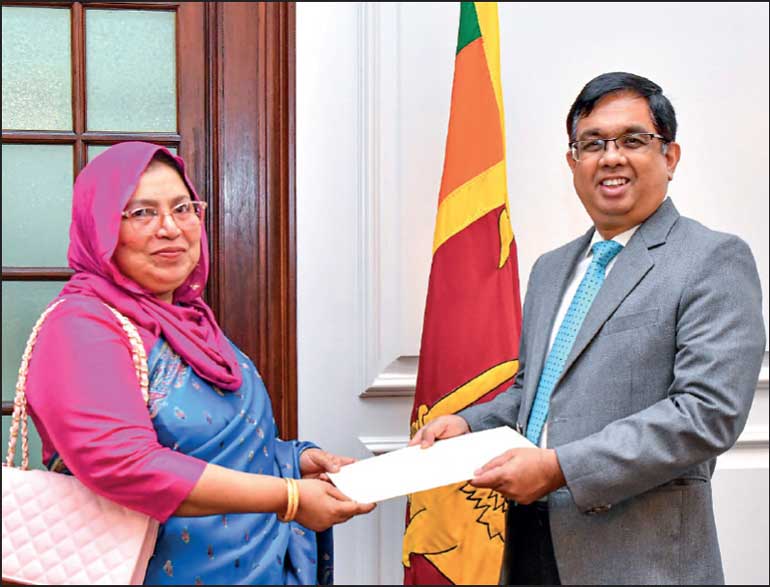
Finance Commission of Sri Lanka new Chairperson Noor Rizna Anees receives her letter of appointment from Secretary to the President
Dr. Nandika Sanath Kumanayake
The President’s Office has announced the appointment of new members to the Finance Commission of Sri Lanka. Its balanced composition is noteworthy.
That the chairpersonship of the Commission has been conferred upon Noor Rizna Anees, a retired senior officer of the Sri Lanka Planning Service with vast experience in senior positions within the Ministry of Finance, is welcome news.
She had her schooling in the suburbs of Galle and entered the University of Peradeniya from where she passed out with honours in Bachelor of Commerce. From a modest background and humble beginnings, she rose to become the Additional Secretary at the Presidential Secretariat, a post she held until her retirement. Her service in the public sector spanned 32 years in a variety of roles.
To put it in her own words, “Academically, I hold multidisciplinary qualifications, including: Bachelor of Commerce (Honours) – University of Peradeniya; Master of Agricultural Science – Nagoya University, Japan; Master of Project Management – University of Bedfordshire, UK; Postgraduate Diploma in Labour Studies – University of Colombo; and Bachelor of Laws (LL.B.) (Honours) – New Buckinghamshire University, UK.”
Her husband is also academically accomplished with a doctorate in political science, and serves as a senior lecturer in a Sri Lankan university. He hails from Vavuniya, so essentially it is a North-South match.
Nearly a decade ago, he was appointed Sri Lanka’s Ambassador to a West Asian country -- now a likely game-changer in the regional order transformation. It was during the Maithripala Sirisena–Ranil Wickremesinghe administration. His writings and remarks of late appear to reveal a sympathetic streak towards JVP/AKD Government.
As her profile bears out, N.R. Anees’ ascendance in the public service is well deserved. She has agency and a proven track record to boot. Her career advancement, as a Muslim woman from the periphery of Sri Lanka’s social, economic, and educational systems, is quite impressive. Her 32 years of dedicated public service have led to her selection to this new position.
The NPP Government could well have appointed her as Secretary to a Ministry, given her capability and diverse expertise across multifaceted roles. But when it comes to appointing Ministers or Secretaries from within the community, the NPP has consistently displayed extraordinary reticence, bordering on exclusion.
The Finance Commission which she now heads is a constitutional mechanism that came into existence through the 13th Amendment. Recommending a fair and equitable allocation of financial resources among the provinces remains its primary function. But beneath its attractive constitutional gloss, the fact remains, however, that its recommendations are not strictly acted upon, or are lightly dismissed.
No Government seems to have treated the Finance Commission with the seriousness it deserves -- beyond appointing chairpersons and members, some of whom were exceptionally good professionals.
Government’ conduct is generally influenced by the fact that it is Parliament -- and hence the party in power -- that has control over public finance.
The Commission’s remit to make recommendations on the allocation of financial resources to the provinces in a manner that addresses social and economic disparities among them remains significant. But in practice, ministers/ministries spearhead their programmes, often contributing to the deepening of disparities rather than helping to narrow them, even as a number of development coordination mechanisms are in place at divisional and District levels. That, of course, is a fundamental structural issue, partly rooted in Sri Lanka’s political culture. Whether the NPP Government will seek to transform this culture is anybody’s guess.
Further, given that there are currently no elected provincial councils and, hence, no legitimate demands for fair and equitable allocations (arising from elected representatives of provincial councils), the function of allocating funds to the provinces lies primarily at the discretion of the Government, with provincial governors -- the representatives of the President -- piloting, or exercising oversight over, development programmes falling within the subject areas of such councils.
In recommending a fair balance in the allocation of financial resources among the provincial councils, the Finance Commission is bound to act on criteria that emphasize equity and transparency. The criteria should also provide for accountability. However, there is a twin challenge here.
First, the Constitution makes the establishment of the Finance Commission mandatory. But implementing its recommendations is not legally binding. Second, the whole purpose of the 13th Amendment has become distorted. There are no elected councils, but unelected governors who perform their functions on behalf of the Executive President and the Government.
Nevertheless, the composition of the Finance Commission, with a capable woman at its helm, deserves appreciation. Its independence, effectiveness and credibility, however, remain to be seen, and the months and years ahead will undoubtedly demonstrate whether it rises to the occasion. Or, merely exists to satisfy the constitutional requirement of having such a Commission.
The other two new members of the Finance Commission are J.M.C.J. Wijetunga and
K. Karunaharan.




