Tuesday Oct 27, 2026
Tuesday Oct 27, 2026
Monday, 23 March 2026 02:49 - - {{hitsCtrl.values.hits}}
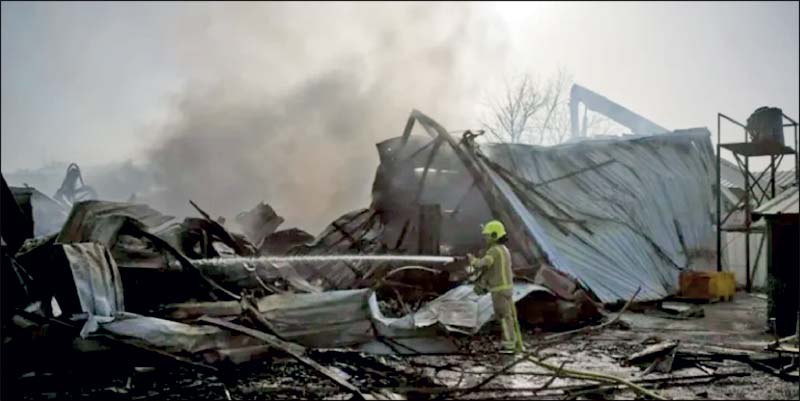
One of the world’s largest LNG facilities at Qatar’s Ras Laffan Industrial City has suffered extensive damage due to the Mideast war, and is expected to take three to five years to repair, with annual revenue losses estimated at around $ 20 billion
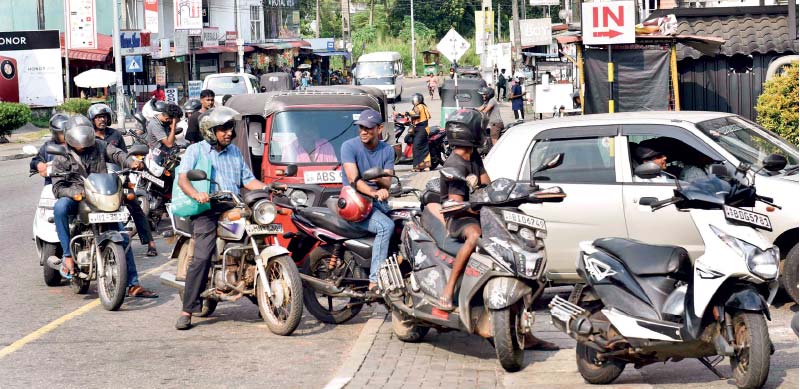
For Sri Lanka, a just-in-time consumer of global oil, the strain is only beginning. While the Government has raised domestic fuel prices and reintroduced quotas, its response may still fall short of the measures adopted by several peer economies
 Sri Lanka’s traditional lifeline, India, also facing severe shortages, will be prevented from coming to Sri Lanka’s aid as it has done in the past. Hence, the country will have to experience a shortage of essential items like, oil, cooking gas, chemical fertilisers and other items that pass through the Strait of Hormuz or the Red Sea. Though it can buy oil from other sources, the scarcity of tankers which are stuck in the Strait of Hormuz makes it more vulnerable to the issue
 Situation update of the Mideast war
Since the publication of the previous article in this series titled ‘Mideast war, emerging external shocks and Sri Lanka’s choices’ 1, the geopolitical picture looming over Sri Lanka and other nations has become scarier.
Here is a quick shot of the situation. The United States, the country regarded as having the most modern and equipped military, is unbelievably stuck in the war with Iran, a relatively less-sophisticated nation in military terms. At the outset, President Trump, the main war commander in this case, expected to finish the war within two or three days which was later extended to 4 to 5 weeks. Now, he is unable to give an end-date for the war and says that it will end when he feels it in his bones 2. The message conveyed by him is that the war will be further prolonged without a quick ending. In the meantime, as a leverage to force the USA and Israel to end the war, Iran’s new leadership took action to close the Strait of Hormuz, the narrow sea pass between Iran and UAE for commercial ships, thereby effectively halting the passage of crude oil and Liquefied Natural Gas (LNG) tankers through the strait. It has stopped nearly 20% of the global supply of both oil and LNG, thereby skyrocketing the prices of these two essential commodities.
When crude oil prices went up to $ 120 per barrel, to relieve the oil starved markets, a part of the strategic reserves held by the US and International Energy Agency (IEA) amounting to about 400 million barrels of crude oil and refined products were released, but it could not completely erase the negative sentiments in the markets. Hence, crude oil prices remain just above $ 100 a barrel, up by about $ 30 prior to the war.
The global community is also bombarded with news that Israel and US allies in the Mideast are experiencing a fast depletion of intercepting missiles 3 and Iran, on its side, renewed its attacks on Israel and US bases in the Mideast with more powerful hypersonic missiles 4. Meanwhile, attempts by President Trump to secure naval support from other nations to open the Strait of Hormuz for safe passage of ships were also not met with enthusiasm from them 5. So, it seems that the USA will have to do the job alone and, in that regard, it is reported that it has dispatched a naval force of about 2,200 to the Gulf area probably to take over the Strait of Hormuz by force 6. Thus, the Mideast war, now entering the third week, seems to be frightening the world nations for a prolonged period.
Vulnerability of just-in-time consumers
The situation in the Mideast will certainly derail Sri Lanka’s recovery attempts because it is a ‘just-in-time consumer’; living on energy and other essential supplies on a day-to-day basis without adequate storage facilities or adequate funds to finance the same. This will be further complicated by two other developments. One is the possibility of the effective blocking of Suez Canal by one of the proxy groups of Iran like the Yemen-based Houthis by attacking ships passing through the Red Sea 7. The other is Sri Lanka’s traditional lifeline, India, also facing severe shortages of these essential items, will be prevented from coming to Sri Lanka’s help as it has done in the past 8. Hence, the country will have to experience a shortage of essential items like, oil, cooking gas, chemical fertilisers and other items that pass through the Strait of Hormuz or the Red Sea. Though it can buy oil from other sources, the scarcity of tankers which are stuck in the Strait of Hormuz makes it more vulnerable to the issue. What this means is that Sri Lanka will have to adopt its own solutions without wating for outside support. So, it will be a home-grown solution as Sri Lanka’s leaders have preached its people in the past.
If the Mideast war leads to a negative economic growth in 2026 – it should be the case because of the surge of energy prices, fertilisers, and other essential inputs for production – the country will be driven back to a still lower real GDP, trapping it in an inescapable cycle of low growth coupled with inflation
Warning over relying on release of buffer stocks
Former Central Banker and presently the Team Lead at the Centre for Poverty Analysis, Roshan Perera, had analysed Sri Lanka’s vulnerabilities to the Mideast war from a different point in an article recently 9. She has warned that taking refuge in the current palliatives introduced by the warring nations like the release of buffer stocks of oil to the market is not the wise solution. Since the release of buffer stocks have not reduced the energy prices to pre-war levels, Sri Lanka should be prepared to bear a higher oil bill with each elevation of prices in the future.
She had opined that Sri Lanka should continue with its reform program uninterrupted, while taking action to speed up economic growth. Vindicating Roshan Perera, the oil prices surged within hours of Israel attacking oil facilities in Iran and the latter retaliating by attacking the same facilities in Qatar on 18 March 2026 10. But this is the beginning and oil prices are to rise further when the war escalates to the entire Gulf region destroying the oil processing infrastructure built at enormous costs. Given the severity of the issue, no amount of buffer stock releases will appease an energy-starved global economy.
Danger of stagflation setting in
The real Gross Domestic Product or GDP underlying the reported economic growth for 2025 at 5% is still below by 1 percentage point from the highest real GDP which the country had achieved in 2018.
If the Mideast war leads to a negative economic growth in 2026 – it should be the case because of the surge of energy prices, fertilisers, and other essential inputs for production – the country will be driven back to a still lower real GDP, trapping it in an inescapable cycle of low growth coupled with inflation. An unexpected consequence of this development which will be a blessing in disguise will be that the Central Bank will be able to satisfy the Parliament that it has attained the inflation target agreed with the Minister of Finance in September 2023, if the inflation rate could be kept below 7%, without doing anything to reflate the economy. Since economic growth is not within the Central Bank’s domain, the Government which is responsible for it, will be blamed for the shrinking of real GDP causing ‘stagflation’ to set in the economy.
In a situation of stagflation, poverty levels will go up, and job losses will be widespread delivering a double whammy to a population that has already been hit by elevated costs of living. Right now, it is only the fixed income groups like the pensioners, students, and housewives who are suffering from the high cost of living. To this will be added an unemployed army causing enormous social distress.
Sri Lanka’s Government is not responsible for this catastrophe because it had been forced to face it by an external shock over which it has no control. But the Government cannot ignore it because of the underlying social and political calamities it would bring in causing instability to the country’s system. What this means is that Sri Lanka must go a long way if it is to deliver the promised prosperity which people will feel in their bones. Otherwise, the current high growth is just a number without meaning.
Sri Lanka’s Government is not responsible for this catastrophe because it had been forced to face it by an external shock over which it has no control. But the Government cannot ignore it because of the underlying social and political calamities it would bring in causing instability to the country’s system. What this means is that Sri Lanka must go a long way if it is to deliver the promised prosperity which people will feel in their bones. Otherwise, the current high growth is just a number without meaning
Sri Lanka’s mitigating measures
Even before the full heat of the Mideast war has begun to scorch Sri Lanka, its Government has taken some early action to mitigate the harsh effects that would fall on its people. To distribute the limited availability of petroleum products among users, the Government has reintroduced the Quick Response or QR code system that it had used earlier when the country was going through the severest of the economic crises in 2023. Before the introduction of the QR system, prices of all petroleum products had been increased to reflect the increased costs. Through these two measures, the Government has rationed the use of petroleum products by quantity as well as by price. Both these measures will force users to economise.
In addition, to limit the use of use of petroleum products at the national level, every Wednesday has been declared a public holiday, closing both schools and universities as well. The Government has also demanded that all public events in which people are to participate in large numbers should be restricted voluntarily. In addition, public servants have been encouraged to work from homes until the situation eases. All these measures have been introduced to economise on the use of petroleum resources. However, Sri Lanka’s early action has been less stringent than the measures introduced by peer countries like Pakistan, Bangladesh, Indonesia, and the Philippines 11. But this is the beginning and as the conditions would change for the worse, much harsher measures will have to be introduced by Sri Lanka to prevent the situation from getting out of control.
Analogy of a credit cardholder
Counties like Sri Lanka are specifically vulnerable to this situation because it is like a credit cardholder who buys its needs on a credit basis. This credit card is valid for both domestic purchases and international purchases. By running a budget deficit, Sri Lanka’s Government buys goods and services – consumption as well as investment goods – by using this credit card. Interest on domestic purchases is paid out of the current Government revenue, while the capital payment is postponed forever by reusing the card, known in economics vocabulary as refinancing of maturing debt. If the Government loses this refinancing facility either due to changes in the domestic market structure or an increase in the purchases through higher increased Government expenditure, its credit card becomes unusable.
Similarly, in international purchases, Sri Lanka uses this credit card to buy goods and services on credit from the rest of the world. There again, with no improved domestic foreign exchange earnings, the credit balance as well as interest payments are made by borrowing. This increases the country’s indebtedness to foreigners. If Sri Lanka fails to borrow to make payments or in other words, if Sri Lanka cannot refinance its maturing debt, it hits the wall as it happened in April 2022. As the present developments reveal, the Mideast war seems to be closing the usability of this credit card on both counts.
Sri Lanka’s early actions to mitigate the impacts of the global supply chain shocks have been less stringent than the measures introduced by peer countries like Pakistan, Bangladesh, Indonesia, and the Philippines. But this is the beginning and as the conditions would change for the worse, much harsher measures will have to be introduced by Sri Lanka to prevent the situation from getting out of control
When credit card becomes unusable
On the domestic front, if inflation raises its ugly head again over and above the Central Bank’s inflation target, the Bank will be forced to take restrictive monetary policies in the form of higher interest rates and credit restrictions. This will cause the current low interest rates on Government borrowings from the domestic market making the honeymoon period it has been enjoying shorter. It will increase the cost of the domestic use of the credit card by the Government. Further, if the money supply is restricted as a part of the restrictive monetary policy, the available liquid funds to meet the Government’s increased borrowing requirements will also be curtailed. This is equivalent to cutting the credit limit available in the credit card. On the international front, the usable balance in the credit card will be reduced by a curtailment of inflows for making timely payment by Sri Lanka. In 2025, Sri Lanka had a bonus in the international credit card due to a one-time surplus in its current account. That had been brought in by high inflows to the country through remittances and income from tourists. The Mideast war will put a barrier to both these sources.
Further, since the war has hit the entire globe, the conditions in the international money and capital markets will not be favourable for Sri Lanka to refinance its maturing debt. This will be aggravated by the higher import bill it has to pay for petroleum products, cooking gas, fertilisers, and other essential items. Thus, on one side, the usability of the credit card is restricted. On the other, the burden falling on the credit card will also be higher due to the increased import costs. Therefore, on both the domestic and the international fronts, Sri Lanka will be hit by a double whammy.
There are signs that the war will escalate further, driving the global economy into stagflation. Hence, the difficulties experienced by Sri Lanka today are not the final outcomes it will have to bear. It is, therefore, advisable that all warring parties within Sri Lanka get together and seek a common solution to its problems. If Sri Lanka can face this war as a united force, it can win. If it fails, the chances are that it will perish
Need for united action
There are signs that the war will escalate further, driving the global economy into stagflation. Hence, the difficulties experienced by Sri Lanka today are not the final outcomes it will have to bear. It is, therefore, advisable that all warring parties within Sri Lanka get together and seek a common solution to its problems.
If Sri Lanka can face this war as a united force, it can win. If it fails, the chances are that it will perish.
(The writer, a former Deputy Governor of the Central Bank of Sri Lanka, can be reached at [email protected] )
(Endnotes)
1https://www.ft.lk/columns/Mideast-war-emerging-external-shocks-and-Sri-Lanka-s-choices/4-789264
2https://youtube.com/shorts/4eRtkQp5g_w?si=AJmD0KjIjV5zLx9_
3https://www.middleeastmonitor.com/20260314-israel-warns-us-it-is-running-low-on-missile-interceptors-report/
4https://www.youtube.com/live/ACPBY5kRZ3g?si=f6eCooqEexKO1jsc
5https://youtu.be/Lwzuki13JWM?si=3YoWYbFarggq3aCh
6https://www.iranintl.com/en/202603131206
7https://youtu.be/JxxjTTG_ZDM?si=ebSSx7t0bwuhE3B7
8https://www.bloomberg.com/news/articles/2026-03-17/india-growth-seen-at-risk-as-iran-war-shows-no-sign-of-easing?embedded-checkout=true
9https://www.ft.lk/columns/Shock-from-the-Gulf-Buffers-hold-for-now-but-reform-delays-leave-SL-vulnerable/4-789647
10 https://www.reuters.com/business/energy/oil-rises-3-after-iran-strikes-middle-east-energy-facilities-2026-03-19/
11 For details, see: https://global.chinadaily.com.cn/a/202603/18/WS69ba0c4ba310d6866eb3e72f.html




