Tuesday Oct 13, 2026
Tuesday Oct 13, 2026
Friday, 3 April 2026 00:45 - - {{hitsCtrl.values.hits}}
 There are days when the world news reads like a policy brief on antidepressants. And then there are those few weeks in which it feels like a fever-dream ghost-written by the apocalyptic visionary. One who penned the more epileptic passages of the Book of Revelation. And that is scary in more ways than one.
If you will listen closely – beyond the buzz of the markets and the hum of the summits and the polite applause at the multilateral talk fests – you can almost hear the hoofbeats. Not literally, of course. This apocalyptic scenario, in our troubled day and age, travels business class, speaks in fancy acronyms (IMF, NATO, POTUS) and prefers Davos to doomsday scenarios.
But make no mistake: the Four Horsemen of old are alive and well, and filing more than the news – in fact, they’re filing expense reports – from the far-flung, war-torn, disaster-ridden corners of the modern world.
And you might enjoy – I do use the term ironically – a close-up view...
Geopolitics
The First Horseman, once known as Conquest, has been rebranded. Today, it answers to the name ‘Geopolitical Competition’ – which sounds benign enough, until you realise that it’s still conquest dressed up in corporate attire.
There is no need for heavy cruisers when you have chips, code, and capital. The trade-led contest between the United and States and China, for instance, is less about who plants a flag where, and more about who writes the operating system of the future. Standards are the new territory, and supply chains the new frontier.
It’s conquest without the inconvenience of occupation. Why invade, when you can integrate – and then dominate?
Conflicts and conflagrations
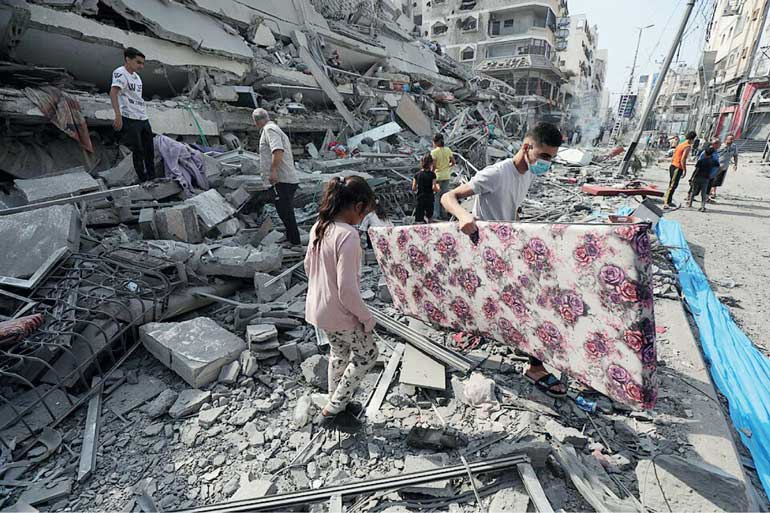
The Second Horseman – War – has also had a makeover. It no longer gallops in with a martial declaration and a military drumroll. It creeps in, it seeps in, it lingers, it multitasks. Yes, there are still old-fashioned wars... the grinding brutality of the Russia-Ukraine conflict constantly reminds us of that.
 Let’s not even mention the Levant or the Middle East. But elsewhere, war has become ambient, barely recognisable, camouflaged as superpowers ‘peacekeeping’ or ‘policing’ the planet.
You may not notice it at first. A cyber-attack here, a disinformation campaign there. A tanker seized or a frigate torpedoed, a drone downed, a currency squeezed. The line blurs. Peace becomes less a state of being than a security concern for those with vested interests. Ahem. Oil in Sri Lanka? Godhelpus!
And perhaps, like all other background noise, wars and rumours of wars become most insidious – and dangerous – when you stop hearing it because it’s always there, or choose to tune out or turn down the volume.
Starve a world to win a war
The Third Horseman – Famine – rides in not as a skeleton brandishing a scythe but as a highly qualified, widely read economist explaining a spreadsheet and sometimes a strategist choking a targeted population.
There is arguably an abundance of food in the world, plentiful energy sources and a planet-ful of water. And yet somehow, strangely, there isn’t a sufficient quantum of these precious resources for particular people in specific parts of the globe at peculiar times. Or the right types of the same in the correct quantities when it matters and where it matters, and at the right price in the proper season.
It’s not a case of a bare kitchen cupboard, but the mystery of the missing key. Into which traumatised domain comes another intruder like a thief in the night.
Enter climate change: the ultimate global party-crasher.
Droughts scorch one region of a beleaguered planet, while floods drown another hapless region. Harvests wobble in-between adverse climate events and embattled populations. Supply chains – once the pride of globalisation – now act out like temperamental prima donnas, collapsing like tired out divas at the first sign of stress.
The result is not famine in the biblical sense, but arguably something more pernicious: a slow, debilitating anxiety that keeps entire nation states on the edge of panic.
Rides a pale horse
And then, with a flourish of finality and a grinding sense of inevitability, comes the Fourth Horseman – Death. Not on a pale horse, but in dark disguises, and once again to a revised standard script deviant from the authiorised version. That death no longer needs to make a dramatic entrance is evident in the novel ways we have to kill each other, for we have inhumanely learned the art of the long game, of survival of the fittest and fiercest.
The spectre of COVID-19 not too long ago – and now and then hints of variant and resurgent strains more malign and resistant to vaccines than ever – shocked us with how quickly mortality can spike.
 But the deeper malaise is subtler and more diabolical. Institutions are hamstrung, trust evaporates, and society polarises into echo chambers where debate and investigation with an open mind go to wither and die.
Even the most well-meaning of Governments, together with the mediocre and the moderately authoritarian (another oxymoron, like ‘military intelligence’), discover – often too late – that the legitimacy of their mandate is not a given, but a daily referendum. Anyone remember our own political messiahs promising heaven on earth, later crucified on a cross of their own crafting?
This is death by a thousand cuts... not of people alone, but of norms, of systems, and of the quiet citizen confidence that tomorrow will look reassuringly like today, while the over-morrow remains vague and incalculably unconsidered.
Highly strung quartet
Individually, each of these horsemen is relatively manageable. Humanity, after all, has collectively survived wars, conquests, famine, and worse. And who knows, given the way technology in hidden corners of over-reaching enterprises has proceeded apace in cryogenic labs, we might even outlive death itself. Taken together, however, they comprise an ominous quartet that is rising like a threatening spectre over the whole planet in general and human existence in particular.
Because they don’t take turns, as do Trump and Netanyahu. They collaborate, as do – well, the Donald and Bibi. War disrupts food and energy. Scarcity fuels unrest. Unrest weakens states. Weak states invite intervention – subtly or straightforwardly so – which circles us neatly back to conquest. Meanwhile, institutional decay ensures that even the best-laid plans of the most prepared nation-states and their Governments unravel at the first whiff of major or severe crises.
For countries such as Sri Lanka this is not an abstract meditation fit for think tanks and late-night panels sanguinely facing the nation. It is our lived reality.
When great powers jostle, smaller nations don’t get to sit it out quietly on the sidelines. Trade routes shift. Energy prices spike. Diplomatic balancing acts become high-wire performances without a safety net.
Neutrality, once a comfortable middle path, now resembles a busy highway of jostling great-power rivalry, where to remain in the middle of the road almost guarantees being run over.
And yet, before we start stockpiling and quoting scripture, there is a twist in the tale. The horsemen, for all their devilish drama, are not divine inevitabilities. They are human constructs – powered by choices, incentives, and occasionally spectacular misjudgements. The same ingenuity that built the systems now under strain, can – in principle and precept if not in practice – repair and restore them.
The catch of course is that such repair and restoration require something in evident short supply. Cooperation in an age of competition, restraint in an era of arrogant assertion, and long-term thinking in a world committed to the next quarter’s results.
Chaos: not a theory
Which brings us by a back path to the putative Fifth Horseman of the Apocalypse – chaotic Uncertainty, an apocryphal addition to the biblical canon.
Not the common or garden variety that keeps economists employed, but a deeper more existential fog. The old rules no longer quite apply. The new ones have yet to be written. Signals are mixed. Outcomes are opaque. The margin for error shrinks even as the complexity of decisions expands.
It is, in short, the perfect environment for getting things wrong – in order to, ultimately, get everything right.
And yet, if there is one lesson that history insists on teaching – usually to those least inclined to learn from them – it is that moments of maximum peril often coincide with moments of maximum possibility and potential for change. Systems under stress can fracture. They can also falter, fail and be born again, building back better what was broken.
The difference lies in whether we recognise the hoofbeats for what they are – not a call to panic, but a call to prayerful attention.
So yes, the Four Horsemen are riding again. But they are not cantering unchecked across some predestined apocalyptic landscape. They are navigating a presently pockmarked-by-war terrain that humanity as a whole has shaped. Which means we (ahem, the US for now; yes, even empires in decline have their last hurrahs) can have a say where they go next.
The question is whether we (the bold or brave in the Global South? the remnant of the West’s stricken rules-based order – with a conscience, and a spine!) will take the reins. Or applaud politely as they all pass by and the state of the world passes into oblivion.
(The author is the Editor-at-large of LMD, and has a Post-graduate Diploma in Politics and Governance)




