Thursday Oct 15, 2026
Thursday Oct 15, 2026
Thursday, 19 March 2026 04:00 - - {{hitsCtrl.values.hits}}
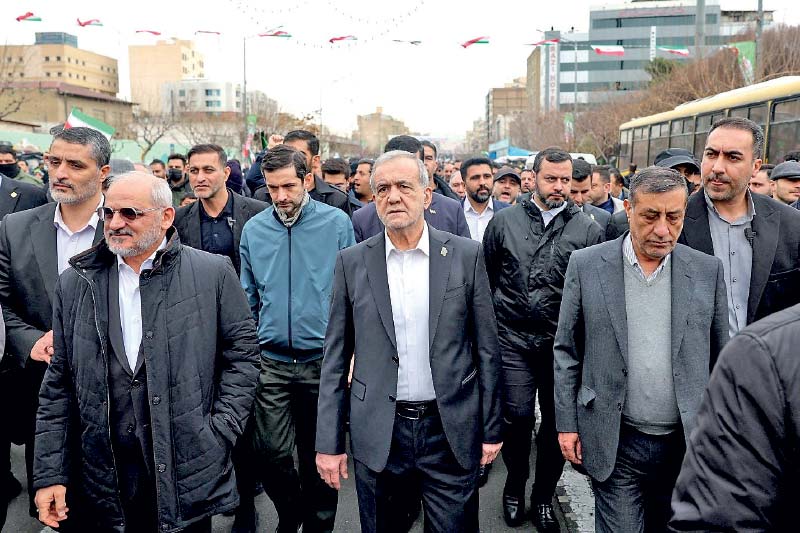
Iran’s President Mahmoud Pezeshkian, heart surgeon, marching on Al Quds Day, Tehran
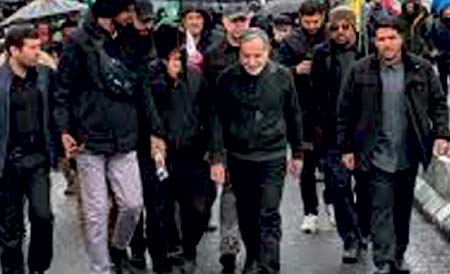
Iran’s Foreign Minister Abbas Araghchi, political scientist, author, diplomat, marching in Tehran
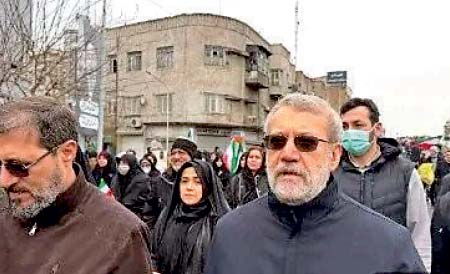
Ali Larijani, Secretary/National Security Council, philosopher, author of a book on Kant, marches on Al Quds day
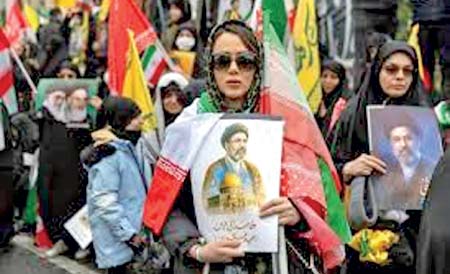
Women in the Al Quds Day March, Tehran
| This column was submitted for publication before the Israeli leadership announced the assassination of Ali Larijani, which the Iranians later officially confirmed on 17 March 2026. |
 The energy shock is impacting on an economy already constricted not only by the debt crisis and the IMF strictures but also by AKD’s refusal to even try to renegotiate and revise the terms of the IMF and private debt repayment agreements
 While the external shock of the US-Israel war on Iran (and Iran’s asymmetric regional retaliation), surely cannot be blamed on the AKD administration, the latter must definitely be blamed for the manner in which it chose to position Sri Lanka’s economy when there were other, better, more prudent and progressive alternatives.
The external shock will be enhanced due to our avoidable extra vulnerability sourced in AKD’s myopic stubbornness. The energy shock is impacting on an economy already constricted not only by the debt crisis and the IMF strictures but also by AKD’s refusal to even try to renegotiate and revise the terms of the IMF and private debt repayment agreements.
Given my accumulated practical experience as a former Vice-President of the UN Human Rights Council, Chairman ILO, Chairperson-Rapporteur of the Inter-Governmental Working Group on Implementation of the Durban Declaration, and Coordinator of the Agenda item on General and Complete Nuclear Disarmament as well as of the G21 (NAM group) at the Conference on Disarmament in Geneva, I am certain that the AKD administration could have secured meliorative improvements and more wiggle room from both the IMF and the private creditors, if he tried.
Elected to office on the back of the first mass uprising in South Asia in the 21st century, the Aragalaya, AKD had the explicit support of the Debt Justice coalition which included Nobel Prize winner Joe Stiglitz. To give just one example, the NPP negotiators could have screened Beena Sarwar’s award-winning ‘Democracy in Debt’ before the IMF and the private creditors. (Double win for ‘Democracy in Debt’ at Jalgaon International Film Festival – Sapan News) Despite having pledged to present an alternative Debt Sustainability Analysis (DSA), AKD chose not to do so.
As for negotiation with the private creditors, which the IMF was not involved in, Anura inexplicably accepted one of the smallest ‘haircuts’ ever, namely well under 10%, roughly around 7.5%.
A second chance—that rarest of opportunities—came with cyclone Ditwah. Despite the support publicly extended once again by Joe Stiglitz and other top economists who called for a debt moratorium or drastic downward revision for Sri Lanka due to the Ditwah devastation, and the pledge by Sajith Premadasa of Opposition support in making such a case (jointly if needs be), Anura was arrogantly dismissive.
Now we have the energy shock coming on top of a constricted, debt-ridden economy, with President AKD boasting that his Government has borrowed $ 700 million in the markets.
The JVP-NPP will end up in 2029 where the Nepali left just has. The abiding sin of the Nepali left was that unlike the Kerala left, it never formed a united front Government of all left parties. Throughout its history, the JVP never formed a left bloc except fleetingly in 1979.
Socio-existential threat
AKD-JVP-NPP’s policies are misplaced, the learning curve too steep and the systemic dysfunctions too many. This is not a simple consequence of excusable inexperience, but results from the JVP’s choices.
Globally, the left has two broad strategic trajectories:
 Guerrilla warfare.
Electoral politics.
Both paths lead to an experience of administration, including managing a productive economy, however rudimentary. Guerilla warfare from China to Cuba creates liberated zones. Deng Xiaoping’s liberated zone yielded the economic doctrine he later used to reform and modernise China. Che Guevara’s liberated zone famously had a shoe factory. Even when guerrilla war has been superseded by a hybrid model of negotiations and elections as the path (or home-stretch) to power, the vanguard party/movement has accumulated the experience of managing a liberated zone along the way, e.g. El Salvador.
However, the JVP’s unique military model—which uniquely led to two crushing military defeats—afforded it no opportunity to run a productive economy in a liberated area.
The other model is the parliamentary path of “the Long March through the institutions”. Lula was mayor of Sao Paulo, Gabriel Boric was mayor of Santiago before election to the presidency. The JVP’s electoral experience gave them only a single brief episode of administrative experience and that too at Cabinet level, neither provincial nor municipal—before they peremptorily quit the Government.
Left politics provides a way of compensating for lack of administrative experience: the Popular Front, with a left-led partnership of left and progressive parties and dissenting factions, some which have served in Government, as allies.
The JVP-NPP spurned that option throughout its history and most pertinently in mid-2024. Having eschewed all three options, the JVP-NPP is dependent on big business, exemplified by the Ceylon Chamber Commerce Chairman (at the time) Duminda Hulangamuwa, to do its economic thinking and international negotiating. Owning, managing, or accounting/auditing businesses is a very far cry indeed from running a nation’s economy. The contrast between Anura’s economic A-team, a bizarre amalgam of the NPP and the Chamber of Commerce, and Finance Minister Ronnie de Mel, is glaring.
Lenin sardonically entitled a book ‘One Step Forward, Two Steps Back’. A comparison of the JVP-NPP Government with administrations since 1948 (barring Gotabaya’s insane overnight, island-wide fertiliser ban) would be best described as ‘One Step Backwards, Two Steps Down’. The empirical evidence is in.
‘…Food insecurity increased more than fivefold from 2019 to 2025, while rates of monetary poverty tripled over the same period, according to a study from the International Food Policy Research Institute (IFPRI).
The survey which was conducted recently in 2025 by IFPRI and International Water Management Institute (IWMI) said that “…monetary poverty only captures part of the picture, as 25% of households were multidimensionally poor, meaning they experienced several simultaneous deprivations such as low living standards, limited education or health constraints. Experience-based food insecurity was even more prevalent, with roughly 33% of households reporting moderate or severe insecurity.”
The report mentions that these findings are particularly concerning given that Cyclone Ditwah has hit many of Sri Lanka’s most vulnerable households particularly hard. Moreover, the ability of poorer households to cope with the Cyclone’s impacts is limited. Over 40% of households reported being in debt, with many households indicating that repayment would be difficult…’
The Anura administration neither has the intelligence and foresight to anticipate and plan for crises nor the open-mindedness to consider the numerous alerts by Leader of the Opposition Sajith Premadasa and the precautionary measures suggested by him. The NPP Government has a dog-in-the-manger mindset.
Sri Lanka and its people simply cannot afford another term of this Government, which, with its ignorance, incompetence, inefficiency, boastful hollow rhetoric, and middle-brow mediocrity, is propelling us towards the abyss.
Inheriting a country “ablaze at both ends” with twin civil wars, President Premadasa rapidly achieved absolute and relative poverty reduction (through ‘Janasaviya’) while simultaneously turbo-boosting the economy.
Having won a Thirty Years’ War in three, Mahinda Rajapaksa effected the island’s biggest, most rapid infrastructure development program.
Even adjusting for generational differences with their fathers, Sajith Premadasa or Namal Rajapaksa (currently in that order) would be a qualitative upgrade on AKD and his Government.
The US project is global overlordship; Israel’s is regional overlordship. Under Trump-Netanyahu, the two have dovetailed. ‘Captain America’ Pete Hegseth talks about the US-Israel partnership as the strongest in the world and waxes lyrical about the warplanes attacking Iran, some with the Stars and Stripes, others with the Star of David
Targets on our back
A French soldier is killed while training Kurds in Iraqi Kurdistan. US bases and radar stud the Gulf States, making them targets for Iranian counter-strikes. We must salute all post-Independence Lankan leaders who got rid of foreign military presences; fought with varying degrees of success to prevent secession and keep this island a single State; never allowed the semi-autonomous Provincial Councils—a valuable, necessary institution—to become centrifugal federal units neighbouring an ‘ethnic kinstate’ Tamil Nadu.
We must be especially grateful to presidents Ranasinghe Premadasa and Mahinda Rajapaksa, both of whom I had the privilege of working with during the most challenging times. Premadasa defeated the Pol Potist JVP and saved democracy, removed the Indian Peace Keeping Force, including from Trincomalee, when its presence had become counterproductive to the Sri Lankan State, and shut the Israeli Interests Section.
Succeeding where five predecessors (Sirimavo, JR, Premadasa, Wijetunga, Chandrika) who failed, before Mahinda Rajapaksa crushed Prabhakaran and his separatist Tigers.
President Dissanayake’s is the only administration since Independence that has signed defense agreements and defence-related agreements with a foreign power and refused to disclose their contents to Parliament and the citizens from whom sovereignty flows in a republic.
Sri Lanka is the small ‘island-pendant’ at the bottom of a subcontinent which has two nuclear powers, India and Pakistan. Those two powers went head-to-head in a conventional conflict, which was stopped short of going nuclear by President Trump, at least according to the latter. What if Washington doesn’t or can’t intervene next time? We shall find out what commitments the AKD-JVP-NPP administration has entered into with India only when the other side targets those locations because of their actual or potential roles/uses/capacities.
What if there’s confrontation between India and China, as happened several years back? Or between the USA and China? Long after the Anura-JVP-NPP Government has been evicted and exiled by voters, Sri Lanka will still have targets tattooed on its back: the undisclosed agreements AKD arrived at with India and probably the USA.
Generations in the Middle East and among the world’s Muslims—the people, not Governments—will act on the transmitted collective memory, just as the Iranian people did in 1979 on the transmitted memory of the US-UK coup against Mossadegh in 1953
Lebanon
Lebanon’s Hezbollah aren’t foreigners—neither Iranians nor a mix of nationalities like the Al Qaeda or ISIL. Hezbollah fought against ISIS in Syria. It consists exclusively of native Lebanese. When it fights in Lebanon, it isn’t invading any country, it is defending its native soil, like the French resistance in WWII with Lebanon’s leaders playing the role of Petain and the collaborationist Vichy regime.
In 1982, I watched on TV in LA as the IDF led by General Ariel ‘Arik’ Sharon made eleven assaults on Beirut, bombing it based on a lie—that the PLO was responsible for a terrorist act actually perpetrated by an anti-PLO splinter group. The Hezbollah emerged as a resistance movement only in 1982 to fight the Israeli occupation forces in South Lebanon with logistical help and training from Syria and Iran.
Israel is once again waging war on Lebanon; destroying it like Gaza rather than conducting special ops counterguerrilla war against Hezbollah. The IDF has miserably failed to eliminate or disarm Hamas in Gaza. The more of Lebanon Israel devastates, invades and occupies, the more it motivates Hezbollah, provides it with young Shia recruits and a target-rich environment for protracted guerrilla war. Lebanon’s Government may fissure between patriots and puppets.
Under unprecedentedly intense bombing, Iran’s morale, militancy and motivation remain high. There is something noble and heroic about the Iranian spirit of courage, steadfastness and resistance to the Empire and its genocidal Zionist partner. It is an existential example
Middle East myths and truths
The USA and Israel aren’t waging war to prevent Iran from producing nukes. In 2016 Trump tore up the JCPOA that President Obama signed with Iran in 2015, which achieved just that. If the JCPOA had deficiencies, they could have been rectified by further negotiations. Instead, Trump shredded it unilaterally, and in 2020, assassinated Iran’s General Qassem Suleimani who was on a diplomatic mission.
The Middle East war is about two intertwined strategic projects, those of the USA and of Israel.
Post-Cold War US strategy is two-pronged.
NATO obliteration of Yugoslavia (1999), invasion of Iraq (2003), regime change bombing in Libya, subversive war in Syria to topple Assad, eastward expansion of NATO towards Russia triggering the Ukraine war, and now, all-out war against Iran. The logic is the destruction of sovereign States so that the USA establishes a monopoly of force, reinforcing the tendency towards unipolarity and retarding if not reversing the tendency towards multipolarity.
Unilaterally shredding strategic arms control agreements with Russia, dismantling the entire architecture from the 1960s which imposed limits on the nuclear arms race. This permits the US to unrestrainedly maximise its military edge vis-a-vis Russia and China.
The Israeli project is to turn the entire Middle East into a Gaza or West Bank. It is experimenting with extending Gaza-type genocide to Lebanon and Iran.
The US project is global overlordship; Israel’s is regional overlordship. Under Trump-Netanyahu, the two have dovetailed. ‘Captain America’ Pete Hegseth talks about the US-Israel partnership as the strongest in the world and waxes lyrical about the warplanes attacking Iran, some with the Stars and Stripes, others with the Star of David. There’s an audio of US and Israeli pilots exchanging salutations (“gentlemen…strike hard”) in mid-air. Generations in the Middle East and among the world’s Muslims—the people, not Governments—will act on the transmitted collective memory, just as the Iranian people did in 1979 on the transmitted memory of the US-UK coup against Mossadegh in 1953.
The US-Israel axis hopes to be the determinant in shaping the world’s future by imposing its rule over the Middle East, thereby shifting the global geostrategic balance of forces.
The US has outrageously posted rewards of $ 10 million each for information on the whereabouts of the legitimate leaders of Iran. A precursor was the ‘deck of cards’ featuring Saddam Hussein and Iraqi Baathist leaders during the 2003 invasion. In the future, such mercenary rewards could conceivably be offered for leaders of Mexico, Turkey, South Africa, Brazil, Indonesia, Malaysia. Is that US-led ‘Westworld’ what we want to live in, and under?
The Middle East is the epicentre of global contradictions; the crucible in which the world order—unipolar or multipolar—will be shaped
Existential example of Iran
On Friday, 13 March 2026, hundreds of thousands of Iranians marched in Tehran and other cities observing Al Quds (Jerusalem) Day in solidarity with Palestine, declared in 1979 in the wake of the Revolution’s historic victory by its iconic leader Ayatollah Khomeini. It is an annual event, but this year men and women of all ages, including young couples and younger women without headgear, marched despite an evacuation order by the Israelis and scattered explosions causing fatalities close to the march.
Seen marching with casual defiance with US and Israeli warplanes prowling overhead, and being greeted with great personal affection by the crowd, were:
Masoud Pezeshkian, Iran’s President, a heart surgeon.
Ali Larijani, Secretary National Security Council, philosopher, author of a book on Kant, and former IRGC officer.
n Abbas Araghchi, Foreign Minister, PhD in Politics, University of Kent (his supervisor, Marx scholar David McLellan), author of a book on ‘Negotiations: The Power of Diplomacy’; former IRGC volunteer.
Replying in English to a foreign TV station while marching, Ali Larijani said that “President Trump lacks the intellect to grasp that the greater the pressure from the US and Israel, the greater grows the resolve of the Iranian nation”.
Al Jazeera showed Iran’s Chief Justice being interviewed by State TV during the march. Suddenly, there was an explosion and the interviewer shouting “air strike!” attempted to evacuate the Chief Justice. The snowy-bearded senior cleric unflinchingly stood his ground and completed his declaration of defiance.
Under unprecedentedly intense bombing, Iran’s morale, militancy and motivation remain high. There is something noble and heroic about the Iranian spirit of courage, steadfastness and resistance to the Empire and its genocidal Zionist partner. It is an existential example.
The Middle East is the epicentre of global contradictions; the crucible in which the world order—unipolar or multipolar—will be shaped.
Whether consciously or not, the region’s resistance forces—the patriotic Iranian State and nation with their military and IRGC, Lebanon’s Hezbollah, Iraq’s Hezbollah, Gaza’s ineradicable Hamas (currently hibernating), the (dormant) Houthis—haven’t been and aren’t fighting only for the Shia Muslims or even Muslims in general. Objectively, they are fighting back, defying and resisting the Empire and the genocidal Zionist machine, for all of us and a balanced, multipolar world too.




