Thursday Oct 15, 2026
Thursday Oct 15, 2026
Monday, 6 April 2026 03:42 - - {{hitsCtrl.values.hits}}
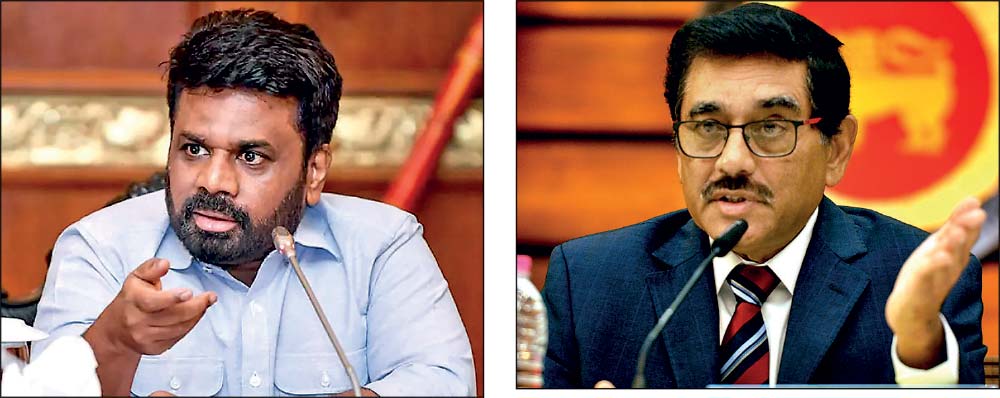
President and Finance Minister Anura Kumara Dissanayake (left) and Central Bank Governor Dr. Nandalal Weerasinghe have limited options at their disposal amid the escalating Middle East war
 The fiscal space should have a sufficient resource base to spend instantly without calling the people to bear the burden of economic reconstruction. However, Sri Lanka does not have such fiscal space today. Hence, without imposing new taxes, it is unlikely that the Government will have sufficient fiscal space to rescue the economy
 The Aragalaya song: indictment of the elders
This writer was invited to deliver the keynote address at a recent event. At the outset, the promoters noted that the Ceylon Foundation for Economic Policy Analysis (CFEP) had its origins in the severe economic crisis Sri Lanka faced in 2022. They also observed that the young people engaged in this policy analysis, commonly referred to as Generation Z or Gen-Z, differ markedly from the older generations that had governed the country. It was this difference that led them to engage in a public agitation campaign—Aragalaya—to make their voices heard, culminating in a change of Government, though not of the system, in 2022–23.
I therefore consider it appropriate to draw the attention of these Gen-Z participants to the voice they themselves expressed through a Sinhala pop song dedicated to those who took part in Aragalaya. The song, penned, composed, and performed by the young engineer-turned-musician Arjuman de Saram, is titled in English When We Were Little Kids[1]. In it, the children—voicing their dismay at the elders—recall the lofty exhortations made to them in childhood, even as they played carefree in the rain. They juxtapose this with a darker sentiment: a wish for escape, even unto death, and a longing for peace beneath the earth alongside their forebears.
The most striking line follows. They ask, pointedly, why an educated elite now stands in queues under the scorching sun, metaphorically holding out a begging bowl. As I have explained in an earlier article in this series[2], the “begging bowl” symbolises the long-standing practice of policymakers seeking financial assistance from donors, international institutions, and friendly nations. In another stanza, the song gives voice to anger directed at those who were brought to power through a sacred vote. That mandate, granted in good faith, was ultimately betrayed when those elected turned once again to institutions such as the International Monetary Fund for loans.
This reflects a clear division of opinion between Gen-Z and those who govern them. It is a message that policy analysts would do well not to ignore.
Two external shocks
In the recent past, Sri Lanka was hit by two severe external economic shocks. One was God-made, the Ditwah cyclone that landed on the country unexpectedly. The Ditwah cyclone destroyed Sri Lanka’s economic infrastructure, displaced thousands of people from their normal occupations, and drove many Sri Lankans into poverty.
The other was man-made, the ongoing Mideast war, first involving the USA and Israel on one side and Iran on the other. It soon escalated to the Gulf region, dismantling their traditional economic activities. By blocking the supply chains emanating from the Gulf region, it has caused a worldwide shortage of fossil fuel, cooking gas, fertilisers, and other essentials, hiking their prices. It has also disrupted the otherwise normally functioning civil aviation and commercial shipping systems, dwindled tourism and remittance flows, and made an irreparable dent in the global economic fabric.
The impact of these negative outcomes is now being felt across the globe. By far, this is the severest external shock that has been delivered to the global economy since the onset of the COVID-19 pandemic in early 2021. Thus, no country has been free from its harsh remnants.
Danger of overstressing the economy
When this type of an external shock hits a country, its economy is stressed just as a human body gets stressed when one starts to perform a new task. Stress is a necessary element for the proper functioning of a human body. Likewise, it is a necessary element for an economy to function.
Therefore, economic policymakers should necessarily stress an economy if they wish to increase output, reduce poverty, and bring down inflation, and so on. Hence, stressing an economy is a necessary condition for an economy to move forward. However, an overstressed economy, just like an overstressed human body, carries negative repercussions that can lead to long-term disasters.
The normal development policy does not work in an overstressed economy, making economic policymaking a challenging task. There are several reasons for this policy failure.
First, the overstressed economy does not respond to the commonly used economic policies based on the price mechanism to stimulate or incentivise economic activities. Second, there is a sudden deviation of the economy from the normal growth path, needing quick fixes.
Third, if there is no sufficient monetary or fiscal space available to make these quick fixes, the cost of economic recovery should be passed on to the people. Fourth, the consequential public discontent needs to be managed properly if the economic policy is to be continued till it reaches its final goal. This is the biggest challenge which a policymaker or a politician faces in an overstressed economy.
Manifestation of stress
There are several manifestations which permit policymakers to identify an overstressed economy.
First, in an overstressed economy, the financial system also gets overstressed, leading to financial crises. This dysfunction in the financial markets, often caused by excessive lending to state enterprises or the bursting of lease-finance bubbles, makes the financial institutions unstable, forcing the Government to rescue them or activate deposit insurance windows to protect the small savers, the lifeline in a normal economic system.
Second, there is a high level of debt accumulated by households, businesses, or the Government, taking the financial institutions away from the normal debt recovery paths. The affected borrowers whose businesses have been disrupted due to the external economic shock will fail to service their debt as agreed.
Third, the external shock reduces the availability of goods and services in the market, causing their prices to go up and thereby elevating the cost of living of people. The consequential erosion of the purchasing power of the people generates economic, social, and political anxiety among the people.
Fourth, this will be further aggravated by the gloomy economic conditions, creating job insecurity and loss of income opportunities. There will be unemployment, manifesting widespread job losses, underemployment showing a rise in part-time work when full-time is desired, and stagnating or falling wages in real terms.
Fifth, the dent in the economy will cause total output, known as the Gross Domestic Product, to contract or slow growth due to a shrinkage of exports of goods and services on the external front and disruption to domestic economic activities due to a failure in the functioning of supply chains. Sixth is the worst manifestation that comes in the form of social and political disorder, which will further disrupt normal economic activities. These are fine points which economic policymakers should keep in mind when dealing with an overstressed economy due to a severe external shock.
The Central Bank cannot directly expand the credit base since it cannot lend to the Government. Hence, the expansion of the credit base should be done by the bank indirectly by increasing the reserve money base, mainly by buying foreign exchange from the market or lending to commercial banks. Both are impossible tasks in the current period. Therefore, though there is monetary space available to the Central Bank, it cannot use it effectively
Sri Lanka: Low-growth and high inflation
Sri Lanka has been a low-growth country since independence and a high-inflation economy since 1978. Sri Lanka’s inherent economic growth since independence has been 4%, akin to India’s Hindu Rate of Growth of 3.5–4%. In my view, any growth rate close to 4% is low growth and anything below is negative growth. Hence, the reported growth rate of 5% in 2025 is a low growth rate about which Sri Lanka cannot be proud.
Sri Lanka’s average inflation, measured in terms of the Colombo Consumers’ Price Index, during 1979 to 2024 has been at 11%, a high inflation rate by any standard. It is in this background that Sri Lanka was subject to a man-made economic crisis of the worst magnitude in the early 2020s. All economic numbers – output, its growth, price stability, and standard of living, freedom from poverty, foreign reserves, debt repayment capacity, and budget numbers – made a deep dive during this crisis.
After Sri Lanka started a recovery program led by the IMF, the economy was gradually recovering, heightening the country’s hopes of attaining full recovery by the end of this decade. When the country was hit by the two external shocks in late 2025 and early 2026, respectively, these hopes have now been shattered.
The challenge faced by economic policymakers today is how to put the derailed economy back on the normal growth path without allowing it to deteriorate further. That is difficult but not impossible. It is difficult because it cannot rely on Sri Lanka’s traditional supporters since they too have been equally hit by the repercussions of the Mideast war. But it is not impossible since Sri Lanka could address the issue with suitable domestic policies.
Transmission channels
There are four noted economic transmission channels resulting from the current external shock.
First, the shock is transmitted to the economy via an increase in energy prices and the choking of the growth-supporting supply chains. Since there is no end date for the war, it is likely that oil prices will surge towards $ 100 plus per barrel. Sri Lanka’s refinery industry is subject to a technical vulnerability because its only refinery at Sapugaskanda has been built for using Iranian and regional crudes, which are not freely available to the country. Therefore, supply diversification in the short run is a non-event for Sri Lanka.
The second transmission channel relates to the blocking of remittance flows, which remain the forex lifeline of the country. Since Sri Lanka gets about 50% of its remittances from the Gulf region, the war leading to job losses for migrant workers will disrupt the remittance flow of the country considerably.
Third, Sri Lanka’s other lifeline involving tourism and aviation services that generate local employment and earn foreign exchange has been curtailed.
Fourth, spikes in freight costs and disruptions in fertiliser imports will threaten domestic agricultural production and agricultural yield rates. All these channels have been blocked by the ongoing Mideast war.
In this situation, the option available to policymakers is to call all Sri Lankans to work harder, freeze salary levels, improve productivity, and adopt technology. Thus, there is no easy path to recovery. It should be done gradually, facilitating people to make that sacrifice as was done by the Japanese after the Second World War. This is the bitter lesson which economic policy analysts should learn today
Ending subsidy culture
IMF support has been a blessing to Sri Lanka when it was hit by the earlier man-made crisis. While providing funds to the Government as budget support under its Extended Fund Facility, the IMF got the Government of Sri Lanka to adopt a policy package to build international confidence on one side and reform the economy so that it would be able to withstand similar crises in the future.
The policy anchor used was the adoption of a cost-reflective pricing structure in key Government services, thereby putting a halt to the long-standing subsidy culture, curbing inflation through high interest rates and the introduction of aggressive tax hikes to build a surplus in the primary account of the budget.
When Sri Lanka was hit by the latest external shock, the adoption of a policy package to take the country out of the economic downturn has been constrained by the need to adopt restrictive measures under the IMF package. Therefore, what was once considered a blessing has now turned into a trap from which Sri Lanka cannot escape easily.
A hole cut in economic fabric
When a country is hit by two disastrous external shocks, one coming after the other, the hole cut in the economic fabric should be mended as soon as possible. For that, both fiscal policy and monetary policy should have sufficient space to act without harming the people. The present situation in Sri Lanka is that it does not have fiscal space but its inflation-targeting monetary policy platform with its underperformance has some space to act on.
Inadequate fiscal space
The fiscal space should have a sufficient resource base to spend instantly without calling the people to bear the burden of economic reconstruction. However, Sri Lanka does not have such fiscal space today.
The Treasury’s much-acclaimed accumulated surplus cash balance amounting to about Rs 1.3 trillion in mid-2025 has been due to the non-repayment of the maturing debt on one side and the under-expenditure of capital expenditure on the other.
Rs 500 billion out of this cash surplus has already been expended in December 2025 to provide support to people affected by the Ditwah cyclone. The rest will be expended when the country starts repaying the postponed external debt through a debt restructuring program initiated by the IMF. Hence, without imposing new taxes, it is unlikely that the Government will have sufficient fiscal space to rescue the economy.
Unworkable monetary space
The monetary space available to the Central Bank is different from fiscal space. In terms of the inflation targets which the Central Bank had agreed with the Government in September 2023, the desirable inflation rate is 5% with a plus or minus of 2 percentage points. Under this, inflation should at least be 3% and at most be 7%. However, for eight consecutive quarters, the inflation rate has been less than 3%. Thus, the Central Bank could adopt an expansionary monetary policy package to push aggregate demand up to be equal to aggregate supply.
For this purpose, the Central Bank should reduce interest rates further and expand the credit base. In fear of high inflation emanating from the two external shocks, the Central Bank has been keeping its policy rate fixed. It cannot directly expand the credit base since it cannot lend to the Government. Hence, the expansion of the credit base should be done by the bank indirectly by increasing the reserve money base, mainly by buying foreign exchange from the market or lending to commercial banks.
Both are impossible tasks in the current period. Therefore, though there is monetary space available to the Central Bank, it cannot use it effectively.
Unforgettable policy learning
In this situation, the option available to policymakers is to call all Sri Lankans to work harder, freeze salary levels, improve productivity, and adopt technology. Thus, there is no easy path to recovery. It should be done gradually, facilitating people to make that sacrifice as was done by the Japanese after the Second World War.
In my view, this is the bitter lesson which economic policy analysts should learn today.
Endnotes:
[1][https://youtu.be/stQGO227U7Y?si=FuXvWB4rvwhZi8LY](https://youtu.be/stQGO227U7Y?si=FuXvWB4rvwhZi8LY)
[2] [https://www.ft.lk/columns/Sri-Lanka-s-FDI-woes-A-one-stop-shop-is-the-most-urgent-priority/4-789593](https://www.ft.lk/columns/Sri-Lanka-s-FDI-woes-A-one-stop-shop-is-the-most-urgent-priority/4-789593)
(The writer, a former Deputy Governor of the Central Bank of Sri Lanka, can be reached at [[email protected]](mailto:[email protected]))




