Tuesday Oct 06, 2026
Tuesday Oct 06, 2026
Tuesday, 6 October 2026 05:53 - - {{hitsCtrl.values.hits}}
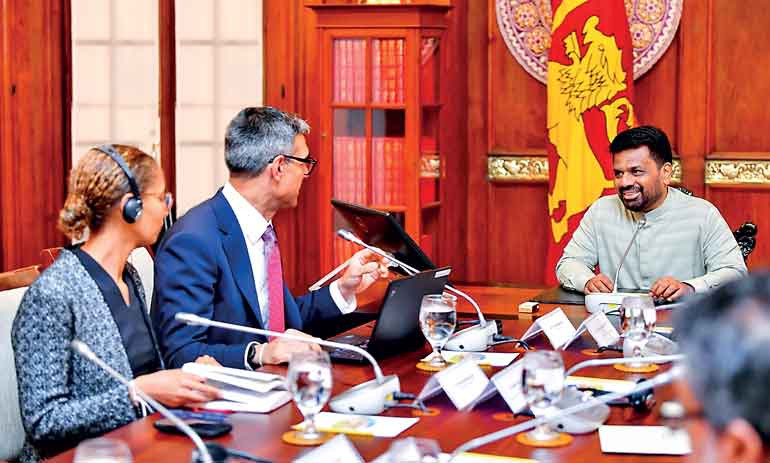
President and Finance Minister Anura Kumara Dissanayake meeting with the visiting IMF Review Mission in September 2026
 When I asked in these pages whether Sri Lanka was really going back to the International Monetary Fund (IMF) for an 18th time, I argued that the country should resist the pull towards a follow-on arrangement once the current Extended Fund Facility (EFF) expires in March 2027.
It is therefore with some satisfaction that I note the Government’s position, as set out by Minister Bimal Rathnayake in a recent television interview: the current program will be completed, it will not be followed by another program linked to debt restructuring, and Sri Lanka will continue its normal engagement with the IMF and the World Bank thereafter.
“We will definitely exit this agreement,” the Minister said. I welcome that clarity, and I say so without reservation. But a declaration of intent is not a plan. Whether this exit is remembered as the moment Sri Lanka took ownership of its own recovery, or as a leap taken without a net, depends entirely on what the Government does in the next 18 months. On that, the Minister’s remarks leave a number of important questions unanswered.
Finish the program properly
The first task is the most immediate. Two reviews of the current EFF remain, and the IMF mission that ended on 23 September left the island without a staff-level agreement on the seventh review. The Fund says discussions will continue “in the near term” on the policies and parameters needed to conclude it. That is not a crisis, and delays of this kind are not unusual. But it matters a great deal how the program ends.
There is a world of difference between a country that completes its program on schedule and then chooses not to renew, and a country whose program simply runs out after stalled reviews. Markets, rating agencies and creditors will read the first as confidence and the second as fatigue. If the Government wants its exit to carry the credibility it deserves, it must bring the seventh and final reviews to a close, and it should tell Parliament and the public plainly what the outstanding issues are. Reform owned domestically begins with being candid domestically.
What we lack is a published, medium-term financing plan covering the repayment years, showing how obligations will be met through revenue, domestic markets and non-debt-creating inflows rather than fresh borrowing. We also lack a medium-term revenue strategy that moves the burden away from value added tax (VAT), which falls hardest on lower-income households, and towards under-taxed property and wealth. And we still need a competition authority with the power and the appetite to open concentrated markets to new entrants
“Normal engagement” must mean something
The Minister is right that the IMF and the World Bank are international institutions with which any country in the global economic system must maintain relations. Every member country undergoes regular Article IV consultations; that is not dependence, it is membership.
The IMF’s mission chief, Evan Papageorgiou, has said that any request for a successor program is a decision for the Sri Lankan Government. Good. Then let the Government own that decision fully and explain it.
In practice, “normal engagement” could mean several things: routine surveillance alone, technical assistance, or a non-financing arrangement that offers a policy signal without new borrowing or binding conditionality. Each carries different implications for investors, for creditors and for the scope of domestic policy choice. Ambiguity on this point will be priced by the markets as uncertainty, and uncertainty is precisely what the business community has warned against. The Government should set out, well before March 2027, what shape its post-program relationship with the Fund will take and why.
The repayment wall does not move
The Minister acknowledged that Sri Lanka will remain bound by its existing debt repayment commitments for years to come. That is the heart of the matter. External debt service begins to rise from 2028, and it is in those years, not in March 2027, that the wisdom of this exit will be tested. In my earlier piece I accepted that stepping away from the Fund carries a real risk, which is that an early exit is read as a retreat from reform, raising borrowing costs at the worst possible moment. That risk does not disappear because the Government has made the right call. It has to be actively managed.
Managing it means replacing an external anchor with domestic ones that are at least as credible. We already have some of the architecture: a Central Bank with legislated independence, and fiscal rules written into public financial management law. What we lack is a published, medium-term financing plan covering the repayment years, showing how obligations will be met through revenue, domestic markets and non-debt-creating inflows rather than fresh borrowing.
We also lack a medium-term revenue strategy that moves the burden away from value added tax (VAT), which falls hardest on lower-income households, and towards under-taxed property and wealth. And we still need a competition authority with the power and the appetite to open concentrated markets to new entrants. None of these requires Washington’s approval. All of them require the Government to commit publicly, and to be held to account in Parliament.
On the debt terms: fair criticism, and responsibility
The Minister was sharply critical of aspects of the debt restructuring negotiated under the previous administration, in particular the mechanisms under which repayments to some creditors vary with Sri Lanka’s economic performance. “If we grow the economy, the amount of debt we have to repay increases,” he said, arguing that this reduces the resources available to pass the benefits of growth on to the public.
Leaving the program gives the Government, for the first time in four years, the freedom to make those choices on its own terms and at its own pace. It also removes the familiar excuse that unpopular measures are imposed from outside. From March 2027, every decision on VAT, utility tariffs, public wages and State enterprise reform will be Sri Lanka’s alone, and so will the accountability for it. That is how it should be
There is substance to that concern. It is uncomfortable that part of the dividend from growth, earned through years of sacrifice by ordinary Sri Lankans, should flow to bondholders. But honesty requires two further observations.
First, these instruments were designed to cut both ways: payments linked to economic performance can fall as well as rise, and the arrangement was part of the price of securing creditor agreement at a time when Sri Lanka had very little bargaining power.
Second, the present Government, having criticised these terms in opposition, chose to complete the restructuring after taking office. That may well have been the responsible choice, since reopening the deal would have prolonged the default. But having made it, the Government now owns those terms as fully as anyone else.
That is why the Minister’s statement that the Government is examining “available financial-market mechanisms” to minimise the adverse impact of existing terms deserves careful scrutiny. Liability management operations, such as buybacks, are legitimate tools used by many sovereigns, and if market conditions allow Sri Lanka to retire costly obligations on favourable terms, it should do so. But any such step must be transparent, conducted on market terms, and disclosed to Parliament in advance.
A country four years out of default cannot afford even the perception that it is seeking to unpick a settlement it has signed. The goodwill earned through restructuring could be lost far more quickly than it was won.
Growth that reaches the household
The Minister’s underlying point, that the benefits of growth must be passed on to the public, is the right one, and it is the test I would apply to everything that follows the program. But the obstacle is not only what we owe to creditors. It is also the choices we make at home: how we tax, how we price electricity and fuel, how we treat the small manufacturer and the family retailer, and whether public sector workers and minimum-wage earners see their real incomes recover after years of erosion.
Leaving the program gives the Government, for the first time in four years, the freedom to make those choices on its own terms and at its own pace. It also removes the familiar excuse that unpopular measures are imposed from outside. From March 2027, every decision on VAT, utility tariffs, public wages and State enterprise reform will be Sri Lanka’s alone, and so will the accountability for it. That is how it should be.
The Government has made the right decision. The question now is whether it will do the harder work that makes that decision stick, which is, completing the current program cleanly, defining its future relationship with the Fund clearly, publishing a credible plan for the repayment years, dealing with the debt terms transparently, and ensuring that stability is finally felt in the household and not only in the ratings.
Owning the exit
The Government has made the right decision. The question now is whether it will do the harder work that makes that decision stick, which is, completing the current program cleanly, defining its future relationship with the Fund clearly, publishing a credible plan for the repayment years, dealing with the debt terms transparently, and ensuring that stability is finally felt in the household and not only in the ratings.
Sixteen previous programs ended, and the country found its way back to the Fund’s door. What will make the 17th different is not the fact of leaving, but what we build once we have left. If the Government brings that plan to Parliament, it will have my support in holding the course. If it does not, the same cycle will be waiting for us, and the same people will once again pay the price.
(The writer is a President’s Counsel and a Member of Parliament)



