Monday Oct 12, 2026
Monday Oct 12, 2026
Wednesday, 26 August 2026 00:26 - - {{hitsCtrl.values.hits}}
 The world order is not only in flux but in transition in an uncertain direction to an unknown new pattern. The change is kaleidoscopic; the transition open-ended. It is not inexorably linear from unipolarity to multipolarity.
Current global dynamics must be understood as multidimensional, with porous membranes between the dimensions, making for inter-dimensional interface.
The world is no longer unipolar in many respects, yet still unipolar in some respects and to some extent—such as the unparalleled global reach and combat experience of the US military. However, the complete failure of the mighty US military in its Iran war to achieve the main objective of strategy against any enemy—to force the adversary to bend to its will and surrender—shows us the limited and relative scope of America’s military quasi-unipolarity.
The twin wars ongoing in the Middle East and Russia-Ukraine will affect, if not determine, the outcome of the transition in the world order.
Already the Israelis have attacked a military base near the Turkish border within post-Assad Syria, friend of the West, on the grounds that Turkey was about to station troops there. If there were to be war between US partner Israel and NATO member Turkey, what would befall NATO?
We may have to speak of a world order in transitions (plural) not a single transition. The transition/s are uneven and contradictory in character.
In economics, the world is at least bipolar—USA and China—but is probably closer to multipolarity. In strategic nuclear power, the world is bipolar or tripolar—USA-Russia, or USA-Russia-China. In an overall, composite sense, the world is increasingly bipolar: USA/China.
Globalisation’s contradictions
US strategy towards globalisation had several stages. Henry Kissinger regarded the world order in the late 1960s and 1970s, dominated by the Vietnam War, as similar to that of Europe after the French Revolution and during the Napoleonic wars: a period of systemic revolution. Like his hero Metternich during the period of European volatility, he sought to stabilise the international system. His strategy was to draw in both China and Russia as stabilising stakeholders, while playing one against the other.
Bill Clinton extended US globalisation strategy, drawing China through the WTO deeply into the world capitalist economic system. During the 2008 economic crisis, the US had reason to be pleased because China’s participation in the system and investment in the USA, stabilised world capitalism.
The US perspective on globalisation unravelled as the neoliberal model of globalisation began to de-industrialise the US itself, causing the collapse of whole industries and communities of workers. US voters have reacted through shifts to the populist right and left, while UK voters reacted to the same erosion through Brexit.
Meanwhile the unipolar moment of the 1990s encouraged US military adventurism in former Yugoslavia and the Arab world, causing Russia to reassert itself and push back under Putin.
A string of wasteful and unsuccessful wars depleted the US economy while China began to successfully compete with and overtake the USA in some respects in the globalised world economy. 
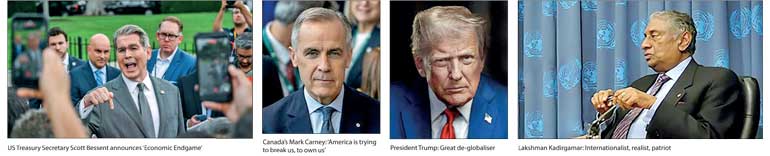
President Trump’s tariff wars on rivals and allies alike, and his war on Iran which has blocked oil and trade flows through the Strait of Hormus, have massively disrupted economic globalisation. US Treasury Secretary Scott Bessent’s total economic cutoff of Iran and threat of secondary sanctions on anyone who interacts economically with Iran, will further disrupt and damage the globalised world economy.
The US-Canada-Mexico Free Trade Agreement (formerly NAFTA) has been upended by the US tariff attack on Canada and Canada’s admirable resistance through reciprocal tariffs.
As Antonio Gramsci legendarily said, “the old is dying and the new cannot yet be born. In this interregnum the most morbid symptoms appear”. It is precisely in ‘this interregnum’ that Sri Lanka must regenerate the clarity and strategic sagacity to identify and protect its core long-term national interests.
Endgame: Total economic war
Targeting Iran, the United States has now declared “the most severe economic campaign of isolation in history”, terming it “D-Day” and the “Endgame”, threatening anyone who violates that total embargo be they US competitors or allies. Channelling the disastrous President George W. Bush, Scott Bessent has warned America’s allies that “if you aren’t with us, you’re against us”.
The stated goal so far was that Iran will never have a nuclear weapon. But if Iran had wanted a nuclear weapon it would not have signed up to the JCPOA with President Obama. It was President Trump who walked out of the JCPOA unilaterally (and assassinated General Qassem Suleimani).
After the USA shredded the JCPOA, Iran proceeded to exceed the percentage of enrichment permitted under the JCPOA which no longer existed, in the hope of driving the US back to the negotiating table. Instead, the West—the EU—hit Iran with ‘snapback’ sanctions designed for violations of the JCPOA, but did so hypocritically after the USA had torn up the JCPOA, i.e., after it no longer existed, while the unilateral violator, the USA paid no punitive price.
The stated aim of US policy has now shifted from ending Iran’s allegedly non-peaceful nuclear ambitions. Treasury Secretary Scott Bessent says that the aim is to end the post-1979 Iranian regime and that US allies too must confront the issue of whether or not they want the regime to continue.
The US which has tried to undermine the Iranian Revolution since 1979, has unveiled its ‘Endgame’: total economic warfare, encompassing and engaging the whole world, aimed at state collapse and counterrevolutionary regime change.
Which will outlast which: the Islamic revolutionary regime in Tehran or the counter-revolutionary, restorationist administration in Washington?
What will be the impact on the world economy already affected by the dual blockade by the US and (in retaliation) Iran of the Strait of Hormus? The US claims it controls the Strait but the number of ships passing through has been reduced to a trickle, giving the lie to that claim.
What will China do in the face of US economic threats over any economic relations with Iran? What will/ can the US do about what China does or doesn’t, and how will China react?
How will the rest of the world respond to the US economic threat? Will all countries comply, and what happens to those who don’t—with what cumulative effect on the world economy?
As with Russia-Ukraine, will the refusal to comply with unilateral US sanctions on Iran enlarge the zone of countries which comprise an autonomous third space, re-patterning globalisation and enhancing economic multipolarity?
Concrete existential realism
The fissured West has in common its unrealistic striving to regain and restore the unipolar moment—the 1990s—of Western hegemony in the immediate aftermath of the Cold War and Soviet collapse. Marco Rubio went further at the 2026 Munich Security conference and urged a return to the era of dominance of the world by Western civilisation.
Given that the USA has shown its capacity for extreme volatility and capriciousness in its external economic policies, even if Democrats win in 2028 and things improve, another Trump-type administration further down the road cannot be excluded. Meanwhile the EU, UK and most of NATO have overreacted in their sanctions policy towards Russia instead of searching for a diplomatic solution to the Ukraine war. Britain has decided to give Ukraine the technology of its long-range Storm Shadow missiles for strikes deep inside against Russia. A hard-line re-composition of the Russian power-bloc may result.
Therefore, Sri Lanka and other countries outside the West/North quadrant of the world economy, must logically make themselves less dependent on and less vulnerable to the volatile Western vortex.
Given the US tariffs on friendly neighbour Canada, and Mark Carney’s statement that the US “wants to break us, to own us” Sri Lanka must rethink ideas of free-trade area connectivity which can give the larger neighbour and partner a handle over the livelihoods and lives of our citizens.
One foreign policy ‘tendency’ in Sri Lanka advocates satellite-like status with the West to pre-empt and buffer against volatility. Such a West-centric throwback to centuries of colonialism is unviable for at least three basic reasons.
(a) It means lining up against China, the Asian economic superpower and peer competitor of the USA. It is actually bigger than/ahead of the US in certain economic respects, and has been a reliable economic partner of countries of the global South including Sri Lanka. To forfeit China as an engine of growth, or to impose limits on one’s own recourse (as a small country) to China, is economic lunacy. China is also Sri Lanka’s greatest counterweight against any Diaspora-prone Western policy and Tamil Nadu-pressurised Indian posture.
(b) It means lining up against Russia, the world’s largest country, the only peer-rival of the USA as a nuclear superpower, and a reliable strategic diplomatic backstop for Sri Lanka in the Security Council and other UN forums.
(c) It would make Sri Lanka utterly vulnerable to Western demands on wartime accountability and national State architecture (federalism, or carving up as in Cyprus and ex-Yugoslavia), driven by the increasingly high-profile Tamil diaspora influentials and voters. This would trigger extreme Southern sociopolitical upheaval.
What I term an ‘Existential Realist’ perspective or ‘Concrete Realism’ suggests the solution:
Sri Lanka should:
I. Reduce its exposure and vulnerability to such countries and zones (especially adjacent sub-regional ones).
II. Enhance its economic and strategic linkages and partnerships with those nations and zones which are not susceptible to Diaspora or domestic communities demanding interference/interventions which threaten to erode Sri Lanka’s sovereignty, independence, self-determination, unity and territorial integrity.
This translates into a concrete 10-point realist perspective:
1. The challenge is to seek out a safe grand-strategic space in the global arena in which to dwell, to inhabit, so to speak.
2. This by no means is a space in which Sri Lanka can gain acceptance for a maximalist-majoritarian view of itself. There is no safe, secure strategic space which will accept that Sri Lanka can ride roughshod over its minorities—Tamil, Muslim, Christian. Sinhala ultranationalist notions that the Global South and Eurasia do not care about wartime accountability or Tamil political rights, are absurd. Many Latin American states do care about human rights and are anti-militarist, while several Afro-Asian states such as South Africa, Malaysia and Singapore have important Tamil communities.
3. Sri Lanka has to engage in trade-offs on issues that do not damage its core national and state interests, in order to defend those core interests. There is no cost-free or compromise-free global coalition possible. Conceding on devolution within the country (e.g., 13A) can ward off external pressures which may cumulatively break us up as a single country.
4. Those countries of the Global South which lobby Sri Lanka for devolution or against human rights violations or discrimination, are far more our friends than Western states which could mount sanctions on wartime accountability legislatively or legally driven by an embittered Diaspora hoping punish Sri Lanka for defeating Prabhakaran and achieve secessionist aims by external means, not internal insurgency.
5. Sri Lanka has no viable option of warding off threats by robust integration with the US, the West, the US-India axis, or India. The domestic price to be paid will be too large to sustain, and will result (as in the case of Ranil Wickremesinghe’s UNP) in being blocked from popular election to the country’s leadership. Even if elected, that administration will be dislodged by the people.
6. It is only the West and/or the state of Tamil Nadu (pressuring Delhi) that can divide Sri Lanka through external instrumentalities. The West, possibly on an axis with Tamil Nadu, is the most likely to be driven by the Diaspora into adopting sanctions or other inimical measures. ‘Integration’ with South India in this context, will increase the risks.
7. Therefore, Sri Lanka has to reduce, not enhance, its dependence on the electorally-driven volatile West and a pushy Tamil Nadu (which for Sri Lanka, is the equivalent of the state of Florida for the neighbouring island of Cuba).
8. Sri Lanka should proliferate links with the Global South and Eurasia in general-- while viewing India as a ‘swing state’ which requires a policy of buffering and hedging by Sri Lanka.
9. Lobbying for West-centricity and establishing contiguity with India including Tamil Nadu, is made on economic grounds, but economic factors tend to last only for decades, while the material realities of geography and therefore of geopolitics tend to be axiomatic, over the very long duration.
10. The long narrative of history arises for the most part from the material realities of geography. It is therefore an irresponsible gamble to incur geopolitical, geostrategic and existential risk for short-to-medium duration economic gains.
Conceptualising dilemmas
Colombo had a rich tradition of intellectual activity in this vital domain, ranging from the Ceylon Institute of World Affairs in the 1960s and 1970s (chaired by Maj. Gen. Anton Muttukumaru, with Mervyn de Silva as Secretary-General), through the Bandaranaike Centre for International Studies in the late-1970s and 1980s, and the Foreign Affairs Study Group of the late 1980s-early 1990s (chaired by Dr. Gamani Corea with Mervyn as Secretary-General.), to the Lakshman Kadirgamar years as Foreign Minister.
Today’s institutions dealing with world affairs are heavily patronised by external interests, or personal platforms or partisan enclaves. The steep intellectual decline began in the second term of President Mahinda Rajapaksa, with the appointment of the loutish Sajin Vass Gunawardena as Presidential Adviser on International Affairs—a post held by Bradman Weerakoon under President Premadasa—and the domination of the Kadirgamar Institute (the founding document of which was drafted by Aruni Wijeyawardena and myself, at Kadirgamar’s request) by Gotabaya Rajapaksa’s MoD.
Kadirgamar took over the Chairmanship of the Bandaranaike Centre for International Studies (BCIS) and reshuffled the Board, inducting Prof. Rajiva Wijesinha, Jeevan Thiagarajah, Tissa Jayatilleka and me. He launched the journal, “International Relations in a Globalising World” with a few of us on the Editorial Board (I doubled as a contributor).
He brought in his friend Sir Adam Roberts from Oxford and hosted a discussion at the Institute of International Relations and Strategic Studies he had founded (initially SLIIR, later to become the LK Institute), on ‘Sri Lanka’s Foreign Policy Challenges in the 21st Century’ (with Nanda Godage, Manel Abeysekara and I among the panellists).
Lakshman Kadirgamar was a lucid, enlightened realist, internationalist and Sri Lankan patriot, aware of complexity and crosscurrents in the context of which he sought to conceptually problematise Sri Lanka’s foreign policy dilemmas, sifting through options and identifying the optimal.
https://dayanjayatilleka.webflow.io/




