Thursday Oct 15, 2026
Thursday Oct 15, 2026
Thursday, 4 June 2026 00:20 - - {{hitsCtrl.values.hits}}
 “The greatest danger in times of turbulence is not the turbulence; it is to act with yesterday’s logic.”
- Peter Drucker
Introduction
As Sri Lanka finalises its debt-restructuring agreements under the IMF framework, the official narrative celebrating a return to fiscal sustainability risks masking a profound structural mathematical gap. Post-restructuring external debt servicing is projected to demand between $3 billion and $4 billion annually—a baseline obligation that Sri Lanka’s highly import-intensive export architecture cannot organically fulfill. To avert a catastrophic secondary default, the state must move beyond passive compliance with short-term IMF targets and deploy a unified, aggressive defense strategy.
This article argues that long-term survival hinges on upgrading and heavily institutionalising a stabilised Macroeconomic Policy Coordination Committee (MPCC) between the Central Bank of Sri Lanka (CBSL) and the Ministry of Finance (MoF). Operating as a synchronised financial command center, an empowered MPCC is the vital tool required to manage exchange rate depreciation risks, smooth upcoming repayment cliffs, and aggressively steer the nation toward a structural overhaul of its export basket and a rapid domestic energy transition.
The illusion of stability and the post-restructuring horizon
The impending completion of Sri Lanka’s debt restructuring process under the IMF’s Extended Fund Facility is being widely heralded as the definitive conclusion of the economic crisis. The formal finalisation of agreements with bilateral creditors and international sovereign bondholders is expected to clear the nation’s default status, stabilise credit ratings, and permit re-entry into global financial markets. However, a dangerous conflation exists within contemporary policy discourse: confusing short-term liquidity stabilisation with long-term debt sustainability.
The IMF program was fundamentally designed as an emergency intervention to enforce fiscal discipline, optimise revenue mobilisation, and secure essential structural adjustments. It was never intended as a mechanism to alter Sri Lanka’s underlying economic architecture. This means that the IMF program is fundamentally a short-term financial intervention designed to restore liquidity, enforce fiscal discipline, and ensure balance-of-payments stability, rather than a blueprint for long-term industrial transformation. Its core benchmarks focus heavily on cash-flow management—such as revenue mobilisation, subsidy removal, and cost-reflective pricing—which normalise the national balance sheet without altering the underlying composition of the economy.
 The framework lacks the mechanisms to seed high-tech industries, foster advanced domestic value-addition, or dismantle the high import-dependency that characterises Sri Lanka’s traditional export engines. Ultimately, the program’s objective is to transform the country into a disciplined, creditworthy debtor capable of re-entering global capital markets, leaving the responsibility of radically overhauling the fragile economic architecture entirely in the hands of domestic policymakers. Passing the IMF threshold merely establishes a regulated runway; it does not change the weight or aerodynamics of the economic engine itself.
Deconstructing the numbers and the public debt anchor
The absolute volume of the nominal public external debt stock, which stands at over $40 billion when accounting for publicly guaranteed State-Owned Enterprise (SOE) liabilities and central government external debt, has not vanished. Within this total, the restructuring process has merely altered the timeline of the roughly $28 billion portfolio owed to bilateral official creditors and commercial bondholders through maturity extensions, modest grace periods, and minor coupon adjustments. The remaining portion consists of non-restructurable multilateral debt to institutions like the World Bank and Asian Development Bank, which must continue to be serviced in full without interruption.
By pushing the heavy repayment cliffs further down the road, the commercial and bilateral agreements offer immediate cash-flow relief, but they preserve the massive underlying principal amounts. Once full principal and interest repayments resume—most acutely felt by 2028—Sri Lanka will be hit with a formidable annual foreign debt-servicing requirement of $3 billion to $4 billion.
This creates a critical mathematical bottleneck. Because net organic export savings are structurally incapable of generating this volume of uncommitted foreign exchange, the state will face an immediate cash shortfall. To bridge this annual gap and avoid an immediate secondary default, Sri Lanka will be forced to secure a variable external market financing gap estimated at well over $1.5 billion each year purely as a roll-over through new external borrowing or capital market issuances.
This persistent liability ensures that the country’s baseline structural vulnerability will remain completely intact long after the current IMF program concludes. The debt has been systematically reorganised, not erased; it simply transforms the solvency crisis into a permanent roll-over trap that remains a heavy anchor on long-term growth.
The fallacy of debt servicing via net export income
Official projections indicate that post-restructuring external debt servicing will escalate rapidly, requiring billions of dollars annually once full principal and interest repayments resume. Optimistic policy circles assert that organic growth in foreign exchange earnings will comfortably absorb this annual requirement. This assumption represents a fundamental misunderstanding of national trade accounting.
External debt must be serviced using net uncommitted foreign exchange surpluses, not gross export revenues. Sri Lanka’s export sector is structurally constrained by an exceptionally high import content. For example, the apparel sector relies heavily on imported textiles, synthetic yarn, accessories, and machinery. For every dollar earned via gross exports, a substantial percentage flows directly back out of the economy to purchase intermediate inputs.
Consequently, even when gross export revenues expand, the simultaneous expansion of required intermediate imports prevents the trade balance from achieving a true structural surplus. When essential imports of fuel, food, and medicine are factored in, the organic net trade balance historically remains in a deficit, leaving no surplus capital to service external debt.
The structural gap in the Current Account
To evaluate whether Sri Lanka can organically generate the required billions annually for debt service without new borrowing, one must look at the structural components of the current account. While tourism receipts and workers’ remittances provide critical liquidity buffers, they are highly sensitive to external shocks and domestic stability. Furthermore, as the government gradually lifts import restrictions, the import bill expands rapidly, consuming precious foreign exchange.
While a temporary current account surplus was achieved post-crisis via artificial economic suppression and strict import compression, this balance risks evaporating as economic growth resumes and normalisation demands higher imports. When the current account operates at a baseline deficit or marginal surplus, the cash required to settle annual foreign debt cannot be drawn from domestic savings. The foreign exchange needed is simply not being retained within the domestic banking system. Relying on current export growth models to settle external debt is mathematically unfeasible.
The inevitable reliance on continuous Roll-Overs
Because net organic inflows cannot cover the impending debt-servicing cliffs, policymakers face an inescapable reality: Sri Lanka must continuously borrow or roll over its obligations. Rolling over debt means issuing new foreign liabilities to settle maturing principal and interest payments. While this prevents immediate default, it keeps the nominal public debt stock permanently elevated. To execute this strategy successfully, Sri Lanka is entirely dependent on returning to international capital markets and issuing new commercial debt instruments to cover its annual roll-over gap. This introduces a secondary danger: if global interest rates remain high when Sri Lanka re-enters commercial markets, the country will be forced to replace older, restructured debt with new, high-cost debt. This dynamic creates a permanent roll-over trap, leaving the national budget perpetually vulnerable to shifts in global liquidity and credit-rating downgrades.
This permanent roll-over trap is not an inescapable law of economics, but breaking it requires a level of structural discipline rarely seen in contemporary national planning. Global history shows that nations that successfully avoided the roll-over cycle did so not through clever financial accounting but by fundamentally transforming what they produced and consumed. South Korea in the late 1980s escaped its crushing external debt burden by aggressively shifting to high-value technology exports while rapidly expanding domestic energy infrastructure to permanently suppress its import bill. The resulting massive, organic current account surpluses allowed it to prepay and retire its external debt principal entirely.
Similarly, nations like Norway utilised highly disciplined, state-led asset management to convert raw natural wealth into structural current account surpluses rather than consuming windfalls through populist domestic spending. For Sri Lanka, the lesson is clear: without a state-driven industrial policy that mirrors these high-retention and energy-independent frameworks, or the strategic deployment of debt-for-equity conversions for non-strategic public commercial assets, the country cannot organically break free from this perpetual borrowing loop.
To put it simply, Sri Lanka is acting like a household that takes out a new credit card just to pay off the bill on an old one. Because the country spends so much foreign currency on imported raw materials and expensive fuel, it doesn’t generate enough net savings to pay down its massive debt principal. To break out of this permanent borrowing trap, the nation must do two things: first, aggressively switch to domestic renewable energy like solar and wind to stop bleeding cash on foreign oil, while shifting exports toward high-profit fields like technology; and second, use “debt-for-equity” swaps by giving lenders a share of ownership in non-strategic state assets instead of borrowing more cash to pay them. Without these structural changes, the country is merely postponing bankruptcy, using fresh loans to temporarily hide a deeper solvency crisis.
The critical policy blind spot in national planning
There is a concerning lack of long-term planning among contemporary policymakers regarding this looming financial cliff. The current focus remains almost exclusively on near-term metrics: meeting primary balance targets, achieving revenue-to-GDP ratios, and passing formal IMF reviews.
While these stabilisation efforts are necessary, treating them as a total economic solution ignores the real structural problems. Policymakers risk celebrating an early victory, operating under the assumption that clearing the initial restructuring hurdles solves the solvency crisis. By failing to prepare the economy for the post-grace-period repayment schedule, the state is effectively delaying a major financial crisis rather than preventing it.
Institutionalising solutions: Upgrading macroeconomic coordination
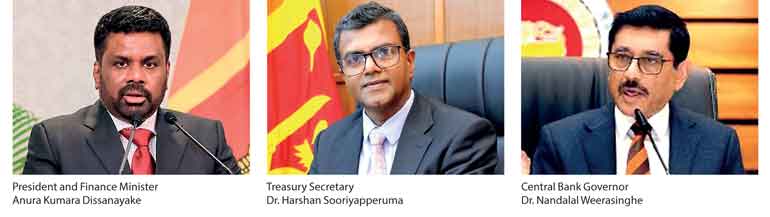
Managing this transition out of the roll-over trap requires a robust institutional framework to shield the economy from sudden macroeconomic shocks, such as severe exchange rate depreciation. Historically, uncoordinated policies have worsened external shocks; for instance, sharp currency depreciations instantly inflate the local-currency value of foreign debt servicing, wrecking fiscal budgets.
To prevent this, monetary policy and fiscal policy must operate in close structural harmony. The passing of the Central Bank of Sri Lanka Act in 2023 established a statutory Coordination Council to help synchronise policy. However, this legal baseline must be heavily elevated and institutionalised into a highly active Macroeconomic Policy Coordination Committee (MPCC). Crucially, this body must act as an information-synchronisation and strategic-planning hub rather than a mechanism that compromises central bank autonomy. Under flexible inflation targeting, the CBSL must retain its hard-won statutory independence to prevent the arbitrary printing of money to fund fiscal deficits.
Instead, an active, upgraded MPCC allows the state to strategically defend the currency against speculative shocks without distorting market fundamentals, smooth out domestic liquidity bottlenecks, and collectively engineer the complex annual roll-over exercises. Without this cohesive, highly functional institutional command center, the nation’s financial leadership will remain reactive, fragmented, and ill-equipped to handle the volatility of international capital markets.
Indeed, Sri Lanka’s future economic stability will depend not only on IMF support but also on the country’s ability to:
Given the above, the formal elevation and prioritisation of this coordination framework should not be delayed any further.
Redesigning the architecture for high-retention exports
Stabilisation is the responsibility of the state, but true structural transformation requires a complete overhaul of the national export basket. Sri Lanka must shift away from its traditional reliance on low-value-added, import-dependent manufacturing toward high-value, low-import-content sectors.
Information technology, software engineering, and specialised knowledge-process outsourcing require minimal physical raw material imports. Their primary input is domestic human capital, resulting in a foreign currency retention rate often exceeding eighty to ninety percent. Similarly, industrial policy must incentivise high-tech domestic processing, converting local resources into specialised components for global supply chains, rather than exporting raw agricultural or mineral resources.
Breaking the energy-dependency imperative
The second critical pillar of structural reform is reducing the nation’s massive fuel import bill. Petroleum and fossil fuel imports represent a persistent drain on Sri Lanka’s foreign currency reserves, often wiping out the liquidity gains generated by tourism and remittances. An aggressive, state-led transition toward domestic renewable energy—including large-scale wind, solar, and grid-modernisation projects—is a macroeconomic necessity. Every megawatt of energy generated via domestic renewable infrastructure directly reduces the volume of foreign exchange that must be exported to global oil and gas suppliers. Without breaking this fossil fuel dependency, true current account stability remains structurally impossible.
Conclusion: From debt restructuring to economic transformation
Sri Lanka’s debt restructuring marks an important milestone, but it should not be mistaken for the end of the country’s economic challenges. The restructuring has bought valuable time by easing immediate repayment pressures, yet it has not removed the underlying obligation to generate substantial foreign exchange for future debt service.
The central challenge remains unchanged. Once grace periods expire and full repayments resume, Sri Lanka will still require an estimated $3–4 billion annually for external debt servicing. Given the economy’s heavy dependence on imported inputs, fuel, and intermediate goods, current export structures are unlikely to generate sufficient net foreign exchange surpluses to meet these obligations on a sustainable basis.
The danger, therefore, is not an immediate crisis but the emergence of a long-term rollover dependency, in which new borrowing is repeatedly used to meet existing obligations. Such a strategy may preserve short-term stability but leaves the economy permanently exposed to fluctuations in global interest rates, investor sentiment, and external financial conditions.
To avoid this outcome, Sri Lanka must move beyond a stabilisation agenda and embrace a transformation agenda. The most urgent institutional step is the active elevation of the permanent Macroeconomic Policy Coordination Committee (MPCC), bringing together the technical execution of the Central Bank of Sri Lanka and the fiscal realities of the Ministry of Finance. Such a body would function as a strategic economic command center, ensuring that monetary policy, fiscal policy, reserve management, debt management, and growth strategies operate within a single coherent framework while fiercely guarding monetary independence.
At the same time, Sri Lanka must redesign the foundations of its foreign exchange earning capacity. Expanding high-retention exports such as information technology, knowledge services, advanced manufacturing, and value-added processing can significantly increase net foreign exchange earnings. Equally important is a rapid transition towards renewable energy to reduce the country’s chronic dependence on imported fossil fuels, one of the largest drains on external reserves. The challenge before policymakers is therefore much larger than successfully completing an IMF program. It is to build an economic structure capable of generating sustainable current-account surpluses and gradually reducing dependence on external borrowing.
Debt restructuring provides Sri Lanka with a second chance. Whether that opportunity becomes a pathway to lasting economic sovereignty or merely a pause before another debt crisis will depend on the decisions taken today. The establishment of a robust, active MPCC, combined with export transformation and energy independence, offers a practical framework for ensuring that Sri Lanka does not merely manage its debt but ultimately escapes the cycle of debt dependence altogether.
(The writer, among many, served as the Special Advisor to the Office of the President of Namibia from 2006 to 2012 and was a Senior Consultant with the UNDP for 20 years. He was a Senior Economist with the Central Bank of Sri Lanka (1972-1993). He can be reached via [email protected].)




